
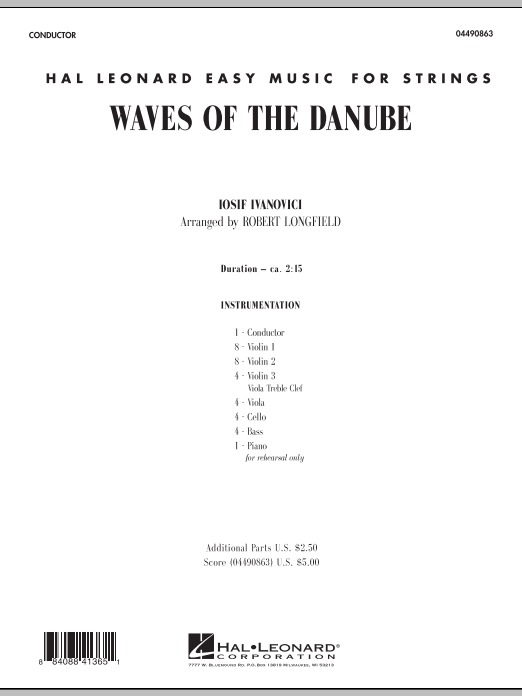

Waves of the Danube: String Orchestra Conductor Score & Parts
By Iosif Ivanovici / Arranged by Robert Longfield
Grade: 2
Item: 35-PK00132145
$40.00
Pickup currently not available
Buy Extra Parts (Digital PDF Download)
| Product | Price | Quantity |
|---|---|---|
| Waves of the Danube - Full Score | $6.00 | |
| Waves of the Danube - Violin 1 | $7.00 | |
| Waves of the Danube - Violin 2 | $7.00 | |
| Waves of the Danube - Violin 3 (Viola Treble Clef) | $7.00 | |
| Waves of the Danube - Viola | $7.00 | |
| Waves of the Danube - Cello | $7.00 | |
| Waves of the Danube - Bass | $7.00 | |
| Waves of the Danube - Piano | $7.00 |
Parts Added to Cart!
Description
This famous melody, often referred to as the "Anniversary Waltz," is arranged here in its original light classical style by Robert Longfield. Offering a nice variety of ensemble treatments throughout, melodic lines are scored for each section, giving this new version great appeal for student groups. Dur: 2:15


Waves of the Danube: String Orchestra Conductor Score & Parts isn't in MakeMusic Cloud just yet...but it could be. Let us know you'd like to see it, and you'll help shape what comes next. In the meantime, start a free trial and dive into thousands of interactive titles your students can play along with today.
Request This Title
Tell us you want it.
Start Your Free Trial
Explore everything that's ready to play right now.
Sample Audio
No sample audio found.
Sample Video
No sample videos found.
Additional Details
Publisher:
Hal Leonard
SKU:
35-PK00132145
More about this title
About the Composer: Iosif Ivanovici
Iosif Ivanovici was a Romanian composer and conductor of the late 19th century, best known for his spirited waltzes and light orchestral works. His music epitomizes the Viennese waltz tradition adapted for Eastern European audiences, combining elegant melodic lines with accessible harmonic language that appealed to both concert halls and popular entertainment venues.
Ivanovici's compositions remain staples of student and amateur orchestras worldwide because they balance technical clarity with genuine musical substance. His gift for memorable melody and transparent orchestration makes his works ideal vehicles for developing ensemble cohesion and musicality in growing ensembles.
Why we love this
This Longfield arrangement captures everything that makes Waves of the Danube enduring repertoire for string orchestras: a tune so inherently musical that students immediately connect with it, combined with scoring that treats each section as a contributor rather than filler. The variety of ensemble textures throughout keeps players engaged without requiring advanced technical facility, making it an excellent choice for building ensemble awareness at the Grade 2 level.
What to expect
Elegant and buoyant, this waltz carries the charm of 19th century ballrooms without pretension. The familiar melody unfolds like a gently moving river, sometimes flowing through the full ensemble and sometimes narrowing to intimate conversations between sections, creating a sense of gentle storytelling throughout.
Who it's for
String orchestras at the early intermediate level who are ready to explore light classical repertoire with genuine musical substance. This works equally well for beginning high school orchestras and advanced middle school groups seeking material that develops sectional independence and melodic awareness.
How to get the most out of it
- Shape the waltz rhythm with gentle emphasis on beat one rather than mechanical accent; let the melody breathe as it moves between sections.
- Balance the divided lines carefully so secondary melodic material supporting the main theme remains audible without overwhelming the primary voice.
- Keep the tempo steady and conversational; this piece thrives on lyrical phrasing rather than strict metronomic precision.
- Attend to dynamic transitions between sections; the shifts between full ensemble and solo sections read more effectively when the overall arch is planned across the entire work.
How to use it
Program this as a charming opener or closer on a concert featuring contrasting Classical and contemporary works. The 2:15 duration and accessible character make it ideal for spring pops concerts, family matinees, or as a transition piece between more substantial works on a formal recital.
Skills your students will build
- Stylistic phrasing in the Romantic waltz idiom
- Sectional independence within a larger ensemble texture
- Dynamic control across ensemble transitions
- Melodic awareness and line continuity