
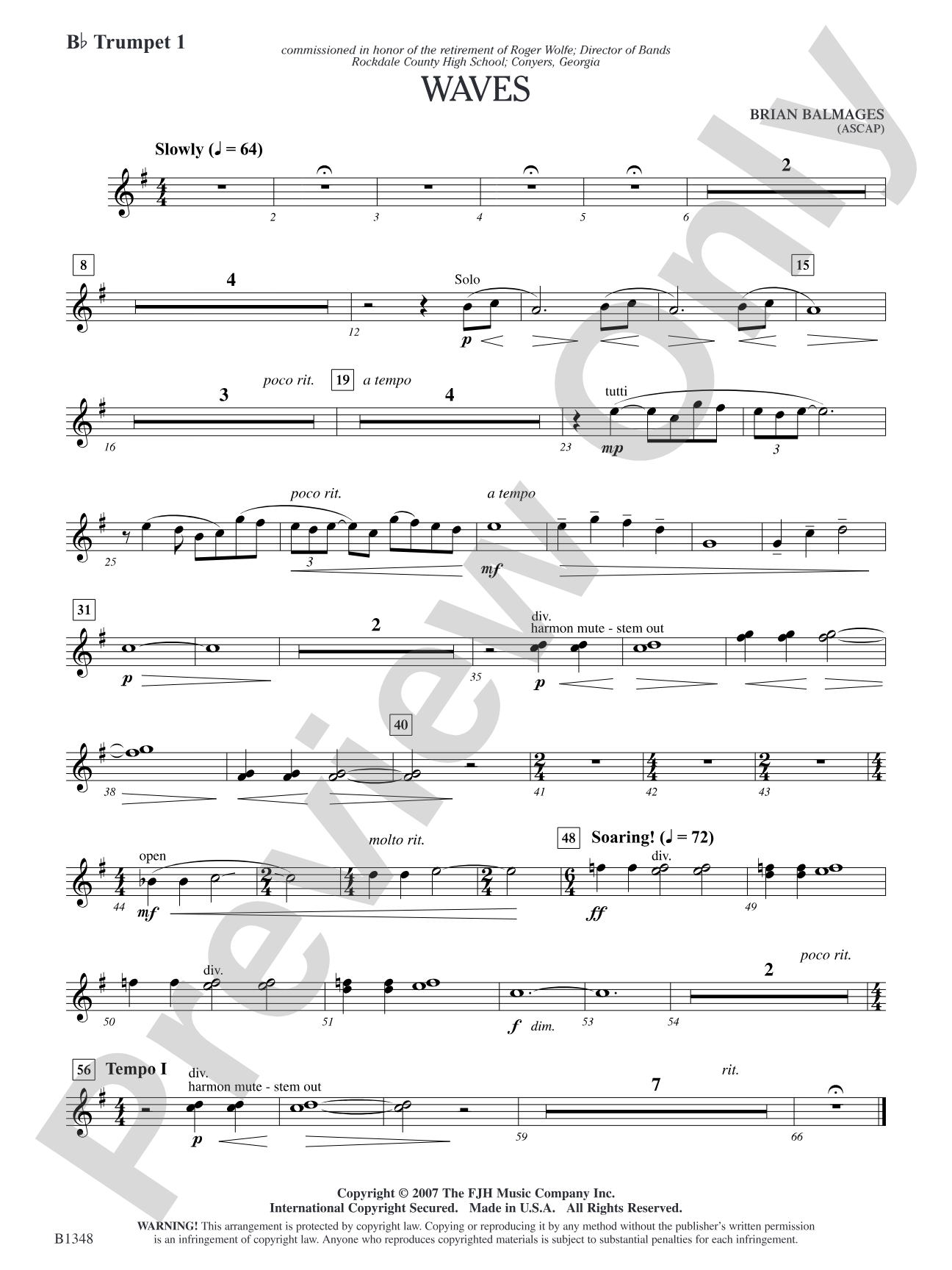

Waves: B-flat Trumpet 1
By Brian Balmages
Grade: 3
Item: 98-PC-DB1348_T1
$7.00
Pickup currently not available
Description
This lyrical work conjures images of the tranquility of the sea through its constant rising and falling phrases. Dense harmonies overlap as musical lines swell in and out of each other to create a seamless tapestry of changing timbres. As the waves continue to grow, they eventually come crashing to shore in a brilliant climax before rolling back out to sea. Emotionally powerful and uplifting!


Waves: B-flat Trumpet 1 isn't in MakeMusic Cloud just yet...but it could be. Let us know you'd like to see it, and you'll help shape what comes next. In the meantime, start a free trial and dive into thousands of interactive titles your students can play along with today.
Request This Title
Tell us you want it.
Start Your Free Trial
Explore everything that's ready to play right now.
Sample Audio
1
Audio File
--:--
0:00
0:00
Sample Video
No sample videos found.
Additional Details
Series:
FJH Concert Band
Publisher:
The FJH Music Company, Inc.
SKU:
98-PC-DB1348_T1
More about this title
About the Composer: Brian Balmages

Brian Balmages has established himself as a composer and conductor with equal facility across orchestral, band, and chamber idioms. His works have been performed by ensembles ranging from professional orchestras to school groups in prestigious venues including Carnegie Hall, the Kennedy Center, and the Sydney Opera House. He holds membership in the American Bandmasters Association and received the A. Austin Harding Award from the American School Band Directors Association, along with the 2020 NBA William D. Revelli Composition Contest prize for Love and Light.
Both James Madison University and the University of Miami have honored Balmages with distinguished alumni recognition, with Miami commissioning him to compose for the inauguration of the institution's sixth president. His music reached a national audience when performed at the 2013 Presidential Inaugural Prayer Service. As a conductor, he regularly leads all-state ensembles, university groups, and professional orchestras worldwide, with notable appearances at the Midwest Clinic, Western International Band Clinic, and numerous regional and national conferences. He currently serves as Director of MakeMusic Publications and Digital Education for Alfred and MakeMusic.
Why we love this
Waves achieves something difficult at Grade 3: genuine emotional depth without requiring virtuosic technical demands. The constant interplay of overlapping lines and shifting harmonies keeps students engaged in listening and balancing, while the natural arc from calm opening to dramatic climax provides meaningful context for dynamic shaping and phrasing that students can both feel and hear.
What to expect
Waves invites you into a state of calm observation that gradually builds tension as the sea grows restless. The music breathes like ocean swells, layering voices in and out until they collide in a moment of genuine drama, then subsides into stillness. There's something both soothing and powerful in that cycle.
Who it's for
Band directors looking for a Grade 3 work that challenges students musically without overwhelming them technically. Players at this level will develop real interpretive skills through this piece, and audiences respond to its emotional arc whether they're hearing it at a school concert or a festival.
How to get the most out of it
- Shape the opening lines as if they're literally rolling in and out; ask your students to listen for when their voice enters the wave rather than counting strictly from a cue. This creates the seamless texture the score describes.
- Map the climax section in rehearsal by having students mark where the waves 'crest' highest before subsiding. Clarity on this emotional journey prevents the ending from feeling abrupt.
- Balance the dense harmonies by sectional rehearsal, isolating which instruments carry the primary melodic motion in each phrase. Dense doesn't mean muddy.
- The return to calm after the climax requires discipline; the ensemble must resist the urge to rush. Hold back the tempo slightly to let the final waves settle naturally.
How to use it
Program this as the centerpiece of a concert exploring water or nature imagery, or place it strategically between more rhythmically active works to give your audience a chance to settle and listen deeply. The piece works equally well as a festival selection or as the emotional anchor of a spring concert finale.
Skills your students will build
- Balancing multiple simultaneous melodic lines without obscuring individual parts
- Shaping longer phrases with internal peak points and releases
- Dynamic control across sustained passages and gradual crescendos
- Listening across the ensemble to maintain coherent harmonic color
- Interpreting musical imagery (the ocean metaphor) through performance choices