
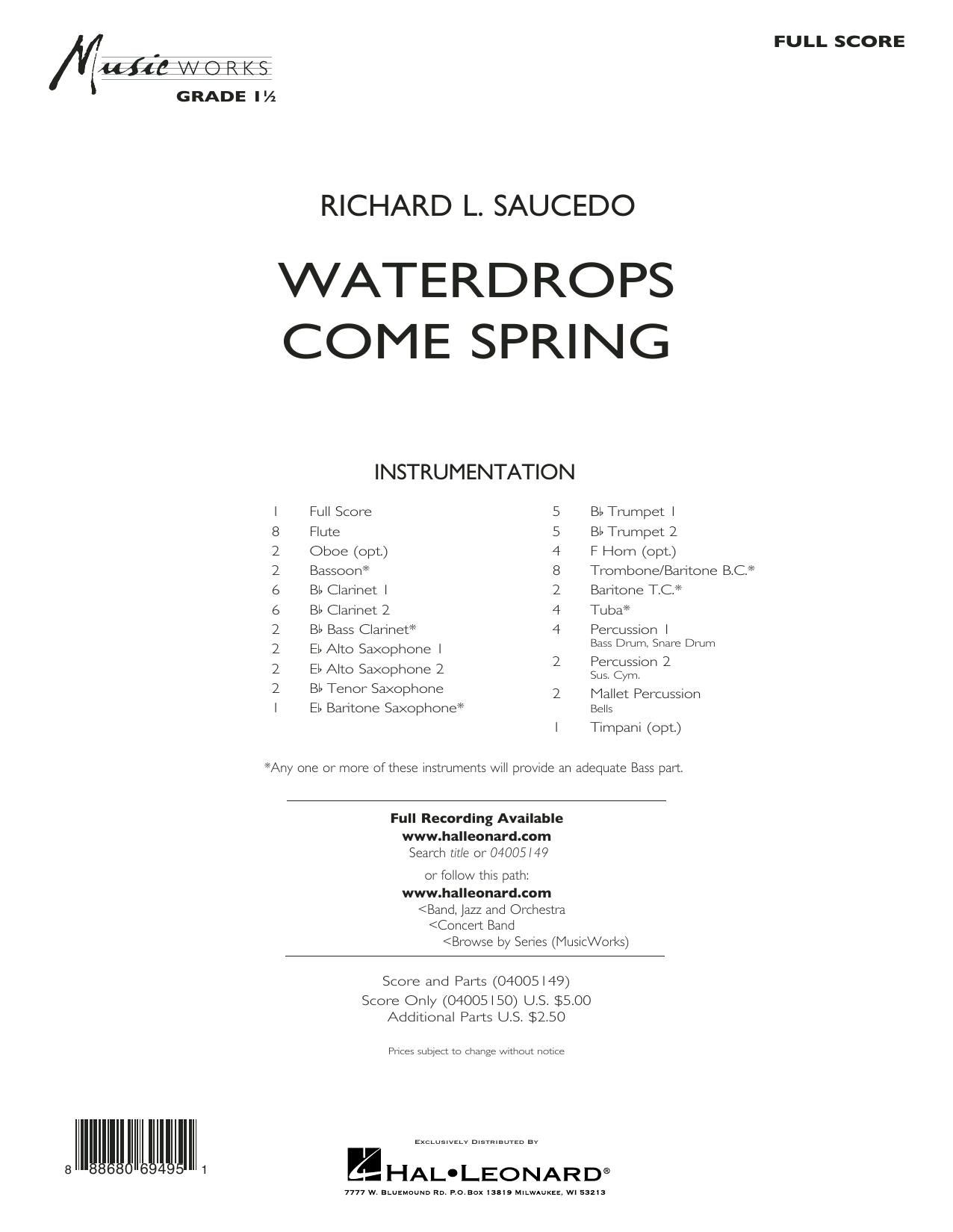

Waterdrops Come Spring: Concert Band Conductor Score & Parts
By Richard L. Saucedo
Grade: 1.5
Item: 35-PK00379494
$55.00
Pickup currently not available
Buy Extra Parts (Digital PDF Download)
Parts Added to Cart!
Description
Using very modest ranges and easy rhythms (no syncopation) Richard has created this tender lyric piece that evokes the beauty of Spring. Perfect for teaching good tone, breath support and phrasing. Dur: 2:50


Waterdrops Come Spring: Concert Band Conductor Score & Parts isn't in MakeMusic Cloud just yet...but it could be. Let us know you'd like to see it, and you'll help shape what comes next. In the meantime, start a free trial and dive into thousands of interactive titles your students can play along with today.
Request This Title
Tell us you want it.
Start Your Free Trial
Explore everything that's ready to play right now.
Sample Audio
No sample audio found.
Sample Video
No sample videos found.
Additional Details
Publisher:
Hal Leonard
SKU:
35-PK00379494
More about this title
About the Composer: Richard L. Saucedo

Richard L. Saucedo spent 31 years as Director of Bands and Performing Arts Chairman at Carmel High School in Indiana, where he built a program of remarkable sustained excellence. During his tenure, the Carmel Wind Symphony earned invitations to the Music for All National Concert Band Festival three times and claimed the Indiana State Championship, while the Carmel Marching Greyhounds competed at the Bands of America Grand National Championship's top tier for 17 consecutive years, capturing national titles in 2005 and 2012.
Since retiring in 2013, Saucedo has remained deeply embedded in the music education community as a Senior Educational Consultant for Music for All and Bands of America, a Chief Judge Team Leader for BOA competitions, and a prolific freelance composer and arranger. His recognition includes Indiana's "Bandmaster of the Year" (1998-99) and "Outstanding Music Educator" (2010) honors, induction into the Music for All Hall of Fame (2015) and Drum Corps International Hall of Fame (2022), and membership in the American Bandmasters Association. He also served as Brass Arranger and Composer for the Cavaliers Drum and Bugle Corps, contributing to five DCI world championships.
Why we love this
Saucedo understands what a young ensemble needs to succeed: music that sounds mature and beautiful without technical hurdles in the way. This piece trades complexity for melodic substance and gives every student in the band something singable to hold onto. The focus on tone production and phrasing means you're not just playing a concert piece; you're teaching the fundamentals that make everything else better.
What to expect
Water droplets catching light on their way down: gentle, deliberate, and full of quiet clarity. The piece inhabits a tender space where simplicity becomes an asset. There's no rush here, no showing off; instead, there's room to breathe, listen, and discover how much character emerges when a band commits fully to singing together.
Who it's for
New concert bands working at the 1.5 grade level will find this piece immediately playable while its musical substance keeps both students and audiences engaged. Teachers seeking repertoire that prioritizes tone development and intelligent phrasing over technical display will appreciate how Saucedo's composition serves pedagogy without sacrificing artistry.
How to get the most out of it
- Balance the ensemble around the lyrical melody so that whoever carries the tune never gets buried by accompaniment voices.
- Establish a steady, unhurried tempo that allows for genuine breath support rather than rushing through phrases.
- Shape each phrase from its point of entry to its peak, treating rests as active architectural moments rather than empty space.
- Use the 2:50 duration as an opportunity to demonstrate that emotional impact doesn't require rapid note values or dramatic key changes.
How to use it
Program this early in the concert season when teaching young ensembles how to approach lyrical writing and ensemble balance. It pairs well alongside other Grade 1 and 2 pieces that emphasize foundational skills, giving concerts thematic variety while reinforcing that good musicianship transcends difficulty level. Spring concerts, pops programs, or school assemblies where genuine listening matters will all benefit from this work's understated elegance.
Skills your students will build
- Breath support and phrasing across longer melodic lines
- Ensemble tone matching and balance in a homogeneous texture
- Responding to conductor shape and direction with simple rhythms
- Interpretation of lyrical content without complex technical demands
- Attention to dynamic shaping and articulation subtlety