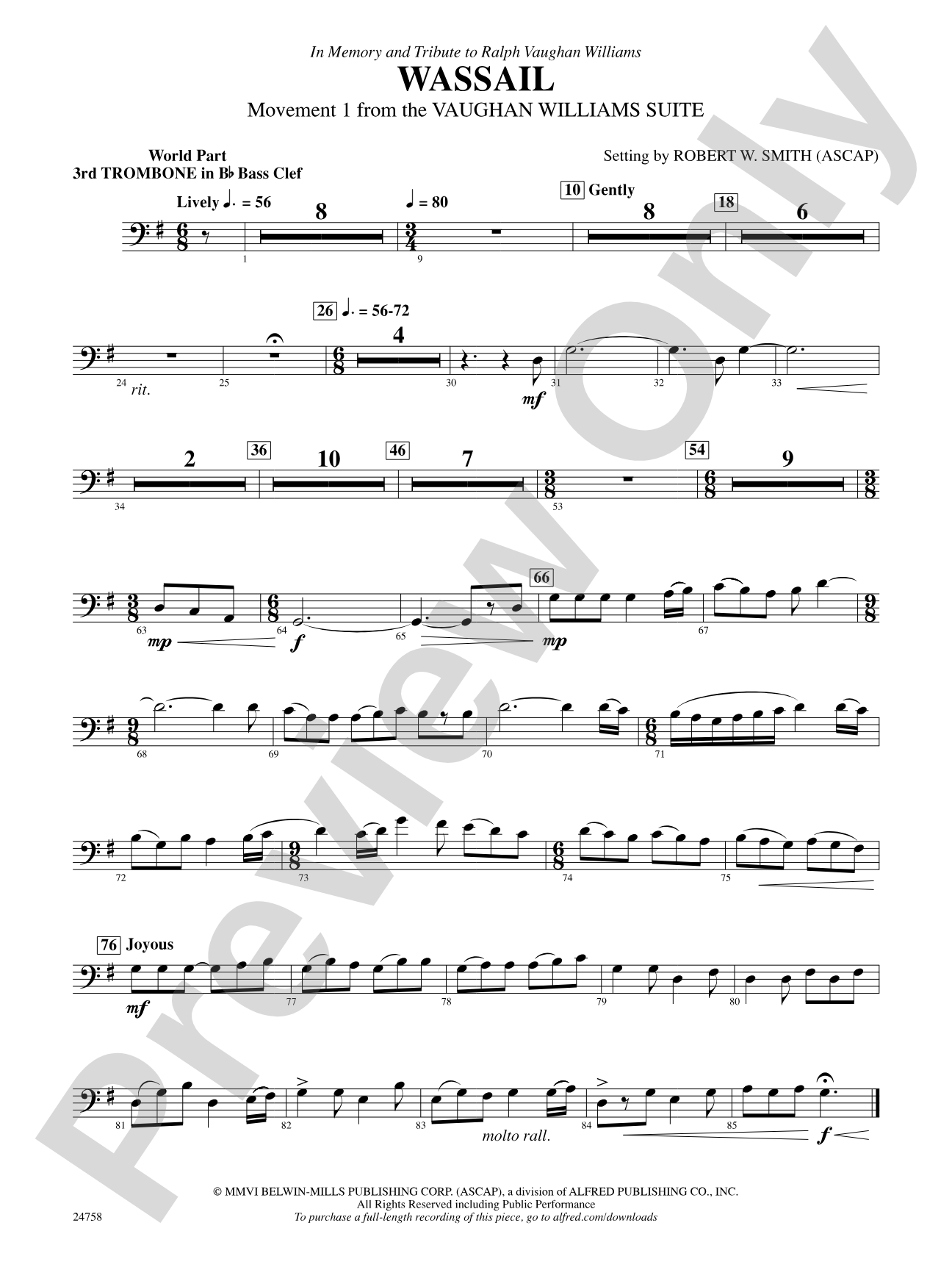
Wassail: (wp) 3rd B-flat Trombone B.C. Sheet Music Preview

Wassail: (wp) 3rd B-flat Trombone B.C.

By Robert W. Smith

Grade: 3 (Medium Easy)

Item: 00-PC-0000902_wpTN3BC

Digital Download
$3.00
Description
Robert W. Smith, in tribute to the great composer, has crafted a setting for the concert band of Wassail Song in the style of Vaughan Williams. Beginning with a lively solo statement of the melody, the clarinet choir introduces the song in its original form. Using Vaughan Williams as the inspiration, the melody is explored and restated in multiple variations using the various timbral colors of the concert band. This publication marks the first movement of Smith's "Vaughan Williams Suite."

Don't just read it, hear it, play along with it, and watch your students grow with it. In MakeMusic Cloud, Wassail: (wp) 3rd B-flat Trombone B.C. comes alive with professional accompaniment, adjustable tempo, and built-in practice tools that turn solo practice into real progress.

Sample Audio
0:00
0:00
Sample Video
Additional Details
Series: Belwin Concert Band
Publisher: Alfred Music
Page Count: 130
SKU: 00-PC-0000902_wpTN3BC

More about this title

About the Composer: Robert W. Smith

Robert W. Smith

Robert W. Smith stands among America's most recorded composers for concert band and orchestra, with over 400 published works performed by ensembles worldwide. His formal training at Troy State University and the University of Miami shaped a compositional voice that balances accessibility with musical substance, evident in works like The Tempest and his symphonic cycle (The Divine Comedy and The Odyssey), which have traveled from North America to Europe, Australia, and Asia.

Beyond the concert hall, Smith's music has underscored major television broadcasts, Olympic ceremonies, and cultural events ranging from presidential welcome ceremonies in Japan to the opening of the Macy's Thanksgiving Day Parade. As both conductor and clinician, he continues to shape music education internationally, bringing decades of performance experience to his compositions and arrangements.

Why we love this

Smith's gift for orchestration shines throughout this setting, where the Wassail melody unfolds through the band's various choirs rather than sitting atop them. The Grade 3 accessibility means your ensemble can explore sophisticated timbral writing without wrestling with technical hurdles, and the Vaughan Williams homage gives this seasonal standard both substance and personality.

What to expect

Warm and unhurried, like stepping into a familiar room that has been thoughtfully redesigned. The piece honors the Wassail melody's folk roots while letting Smith's orchestral imagination explore its contours through shifting colors and instrumental combinations, building a sense of gentle discovery rather than bombast.

Who it's for

Band directors programming winter concerts who want a piece that respects both tradition and craft. This suits developing ensembles (Grade 3) strong enough to handle multiple key areas and textural shifts without requiring advanced technique.

How to get the most out of it

  • Balance the opening clarinet solo carefully; it should sing forward without overshadowing the harmonic foundation. Encourage the soloist to shape the phrase naturally, as if introducing something cherished.
  • Allow each variation to breathe with its own character. The shifts between instrumental choirs are compositional statements, not mere orchestration, so highlight the timbral contrasts rather than blending them away.
  • Attend to the inner voicing, particularly in the middle voices of the band. Smith's writing often rewards careful balance among the saxophones, French horns, and middle woodwinds.

How to use it

Place this early in a winter concert to establish an accessible yet musically substantive tone, especially if you're pairing it with other holiday fare. Its lyrical focus makes it an ideal centerpiece for programming around carols and seasonal works, or lead with it to demonstrate your ensemble's musicality before shifting to heavier repertoire.

Skills your students will build

  • Balanced voicing across multiple instrumental choirs
  • Sensitivity to timbral color and orchestration
  • Phrasing and shaping of lyrical melodies
  • Reading multiple key signatures and harmonic areas
  • Listening for inner voices and supporting textures

You May Also Like