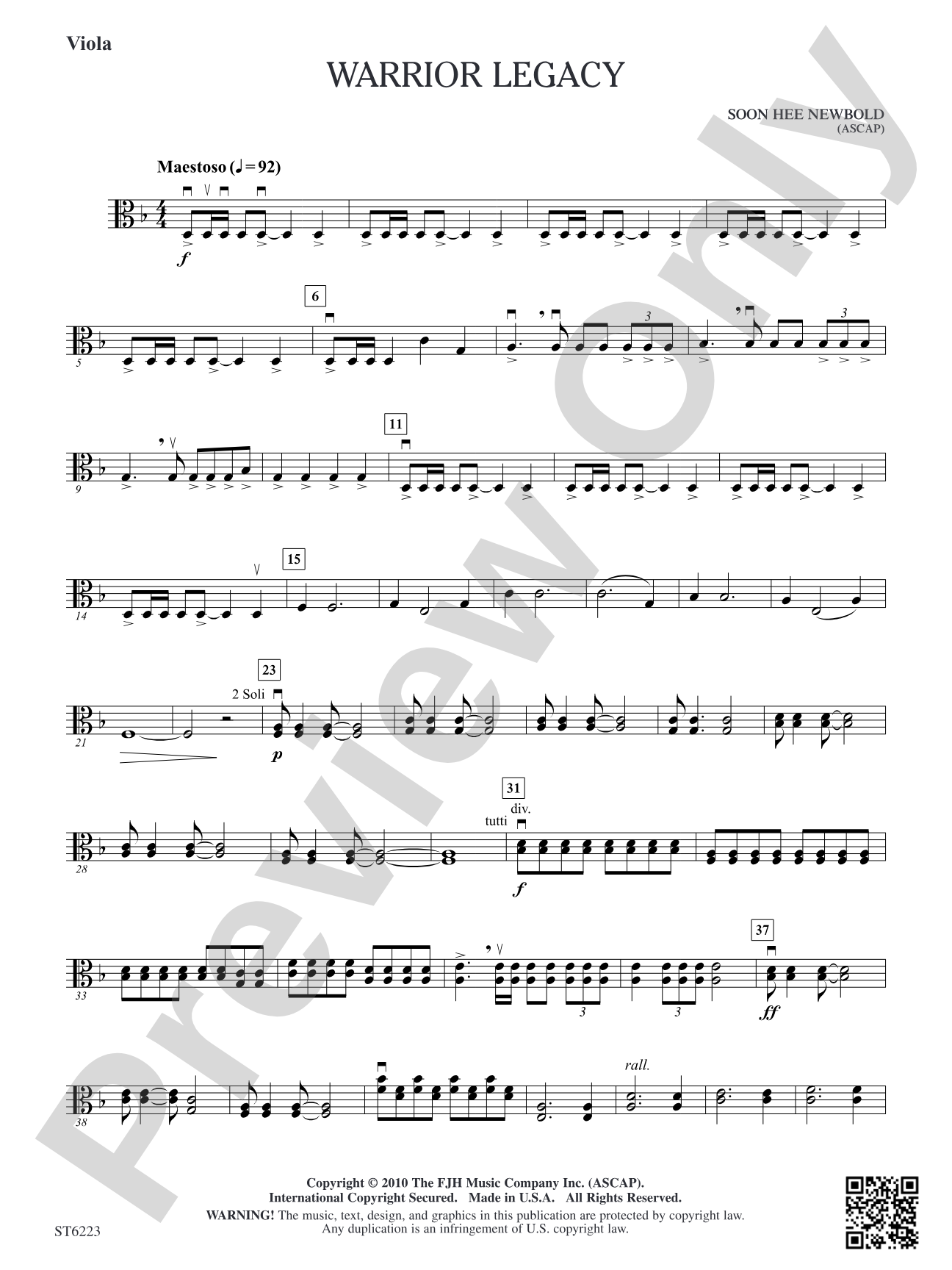
Warrior Legacy: Viola Sheet Music Preview

Warrior Legacy: Viola

By Soon Hee Newbold

Grade: 3

Item: 98-PC-DST6223_VA1

Digital Download
$7.00
Description
Explore the heroes and warriors of myth and legend! The adventure starts with war drums in the lower strings and contrasting melodic themes in the violins. This cinematic-type score includes various solos throughout and a thrilling 12/8 section to finish the epic story. Riveting!

Don't just read it, hear it, play along with it, and watch your students grow with it. In MakeMusic Cloud, Warrior Legacy: Viola comes alive with professional accompaniment, adjustable tempo, and built-in practice tools that turn solo practice into real progress.

Sample Audio
0:00
0:00
Sample Video
Additional Details
Series: FJH String Orchestra
Publisher: The FJH Music Company, Inc.
SKU: 98-PC-DST6223_VA1

More about this title

About the Composer: Soon Hee Newbold

Soon Hee Newbold

Soon Hee Newbold brings a global perspective to every score she writes, drawing on musical traditions encountered through her travels across North America, Europe, Asia, and beyond. Her career spans performance, composition, and conducting; she began studying piano at five and violin at seven, eventually performing as a concert artist in professional ensembles worldwide. Her compositions reach audiences at every level, from beginning elementary groups to professional orchestras performing in major venues including Carnegie Hall, the Kennedy Center, Lincoln Center, and Disney Hall.

Beyond concert music, Newbold works as a filmmaker and composer in Hollywood, where her music enhances film and recording projects. She is frequently invited as a keynote speaker and guest clinician, and has conducted orchestras and bands throughout the United States and internationally in countries including the Netherlands, Belgium, Australia, Indonesia, Singapore, and China.

Why we love this

Newbold captures the cinematic sweep of epic storytelling within a Grade 3 framework, so your orchestra can sound genuinely powerful without requiring advanced technical demands. The orchestration gives every section meaningful material, including solo opportunities that keep students engaged while the contrasting themes and dramatic 12/8 finale provide the kind of structural interest that holds an audience from downbeat to final chord.

What to expect

From the opening percussion strikes that summon ancient warriors to the soaring violin passages that tell their stories, this piece sweeps you into a mythic world. The 12/8 finale accelerates the energy to a thrilling climax, leaving audiences breathless and your orchestra feeling the satisfaction of having brought an epic to life.

Who it's for

Grade 3 string orchestras preparing for contests or festivals, as well as programs seeking a substantial showpiece with genuine dramatic impact. Directors looking to program music that balances accessibility with cinematic sophistication will find this score lets students feel like they're performing something substantial and exciting.

How to get the most out of it

  • Balance the opening war drums in the lower strings so they establish rhythmic momentum without drowning the violin melodies entering above them.
  • Prepare soloists well in advance, as featured passages require secure intonation and expressive confidence at this grade level.
  • The 12/8 section demands clear subdivision; consider rehearsing this section at a slower tempo first to ensure rhythmic precision before bringing it to performance speed.
  • Shape the contrasting melodic themes as distinct characters in your story, varying dynamics and articulation so listeners hear the narrative arc rather than a sequence of sections.

How to use it

This works brilliantly as a festival or contest entry where you want to showcase your orchestra's musicality and dramatic range in a single piece. It also pairs well on a concert program with lighter fare, providing the emotional and structural anchor that gives a recital shape and momentum.

Skills your students will build

  • Reading mixed meters (including 12/8 time signature)
  • Balancing soloistic sections with ensemble support
  • Shaping and sustaining melodic phrases across contrasting tempos
  • Responding to programmatic structure to inform interpretive choices
  • Executing rhythmic precision in percussion-driven sections

You May Also Like