
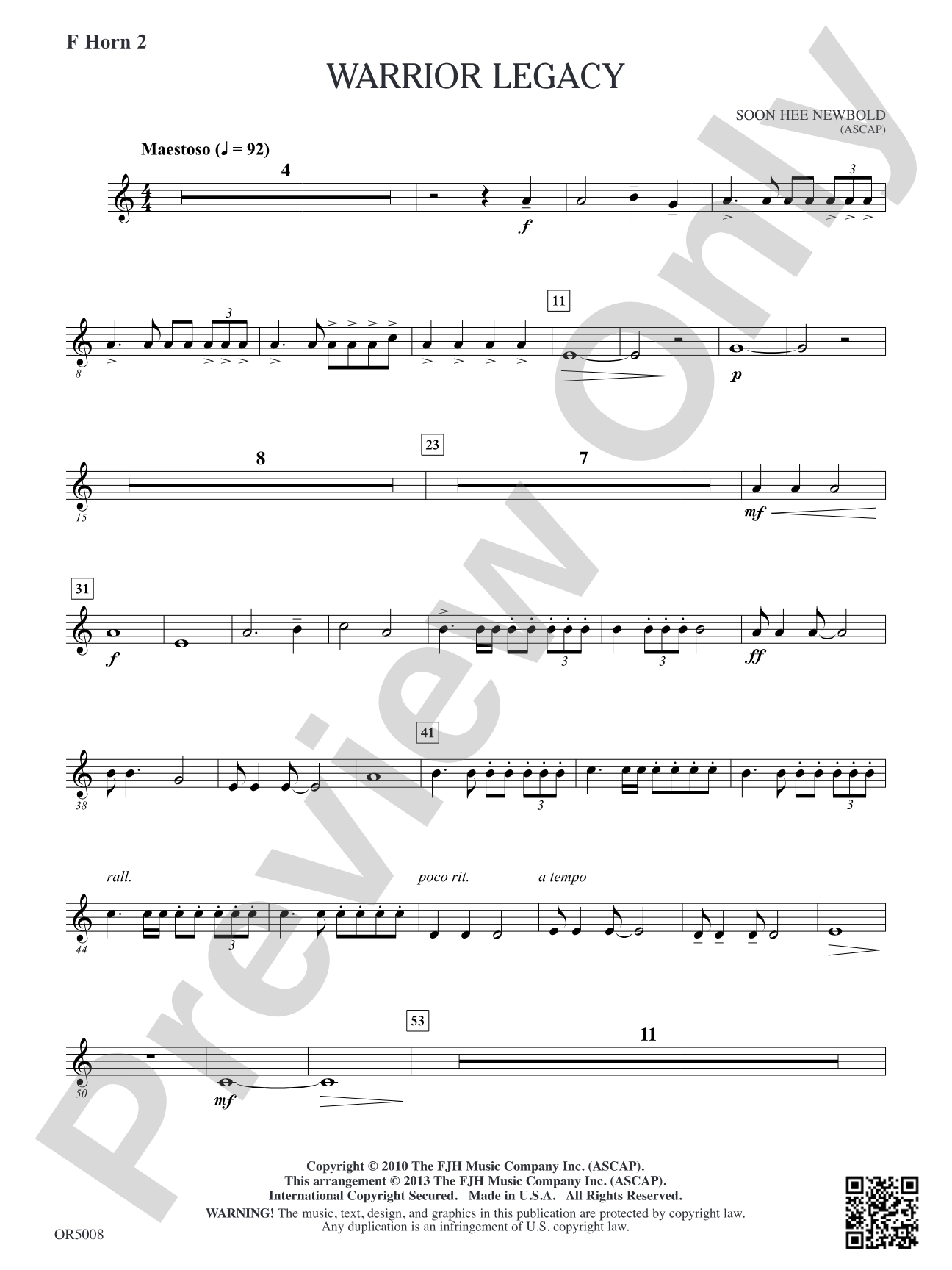

Warrior Legacy: F Horn 2
By Soon Hee Newbold
Grade: 3
Item: 98-PC-DOR5008_H2
$7.00
Pickup currently not available
Description
Explore the heroes and warriors of myth and legend in this epic work for full orchestra; moreover, you can choose to use additional wind parts (included with the set) to make this work suitable for combined strings and full band. The cinematic-type score features various solos throughout and a riveting 12/8 section to finish the epic story. Intense! Playable by full orchestra alone or by combined strings and full band! (not performable by concert band alone)


Don't just read it, hear it, play along with it, and watch your students grow with it. In MakeMusic Cloud, Warrior Legacy: F Horn 2 comes alive with professional accompaniment, adjustable tempo, and built-in practice tools that turn solo practice into real progress.
Open in the Player
Jump straight in and assign it today.
Start Your Free Trial
Open this title and explore the full library in minutes.
Sample Audio
1
Audio File
--:--
0:00
0:00
Sample Video
No sample videos found.
Additional Details
Series:
FJH Full Orchestra
Publisher:
The FJH Music Company, Inc.
SKU:
98-PC-DOR5008_H2
More about this title
About the Composer: Soon Hee Newbold

Soon Hee Newbold brings a global perspective to orchestral writing, shaped by decades of performance and composition across multiple continents. Her musical foundation began at five on piano and continued with violin at seven, launching a career as a concert artist in professional ensembles worldwide. Her orchestral works appear regularly at major venues including Carnegie Hall, the Kennedy Center, and Lincoln Center, performed by groups spanning from professional symphonies to elementary school orchestras. Beyond the concert stage, Newbold has worked as a filmmaker and composer in Hollywood, expanding her creative voice into film and recording projects.
As both conductor and clinician, Newbold is recognized for weaving cultural and ethnic musical traditions into her compositions, reflecting her extensive international experience. She has guest conducted and collaborated with orchestras and bands throughout the United States and abroad, including ensembles in the Netherlands, Belgium, Australia, Indonesia, Singapore, and China. Her work as a keynote speaker and clinician has made her a frequent presence at major music education conferences and festivals.
Why we love this
Newbold gives Grade 3 orchestras access to genuinely cinematic storytelling without oversimplifying the orchestration. The programmatic approach keeps students engaged with a clear narrative arc, while the optional wind parts solve a real scheduling challenge: orchestras can expand into a combined strings-and-band format for larger concert presentations or festivals. The 12/8 finale and distributed solos throughout the score demand musicality and precise ensemble balance from young players, making this feel like a real compositional challenge rather than a routine reading experience.
What to expect
Warrior Legacy unfolds like a film score for an adventure story, complete with heroic moments, dramatic solos, and an unforgettable rhythmic climax. The shifting meters and orchestral color changes create a sense of movement and stakes, drawing listeners into mythic encounters. By the 12/8 finale, the energy becomes relentless and propulsive, delivering the kind of visceral excitement that leaves audiences breathless.
Who it's for
Full orchestras at the Grade 3 level seeking a substantial concert work with programmatic appeal and optional expansion possibilities. Directors preparing for festival or contest performance will find the cinematic scoring and technical demands appropriately challenging without being inaccessible. This also suits orchestras that may combine with band programs for larger concert events or festivals, since the wind parts are included.
How to get the most out of it
- Balance the various solos against the ensemble by rehearsing them separately first, then gradually bringing them into full context. Young orchestra soloists often rush or play too softly when surrounded by tutti sections.
- Establish the 12/8 section in isolation before integrating it into the full piece. Lock the pulse in that meter well before the final rehearsals to avoid the rhythm section collapsing under pressure.
- When adding wind parts for a combined performance, coordinate the dynamics and articulation between strings and winds in the overlay sections during early rehearsals. Inconsistent attacks between the two groups will blur the cinematic effect.
- Use the programmatic content as a teaching tool. Have students identify the heroic themes and character moments in their parts before ensemble rehearsals begin, so they understand the narrative context for their musical lines.
How to use it
Position this as a finale or centerpiece for a concert built around a classical or mythological theme, pairing it with lighter works or educational pieces earlier in the program to maximize its dramatic impact. For festivals or contests, it works equally well as a showcase piece or opening selection, since the Grade 3 accessibility means solid execution is achievable while the cinematic scope still impresses adjudicators. Consider scheduling a combined performance with your band program in spring or at an all-school assembly, using the flexibility of the wind parts to create a fuller ensemble sound.
Skills your students will build
- Reading and executing mixed meters (12/8 against prevailing duple or triple meters)
- Balancing solo lines with ensemble accompaniment
- Maintaining rhythmic precision in complex rhythmic figures
- Responding to programmatic and narrative cues in the score
- Ensemble coordination across multiple simultaneous musical lines
- Dynamic control and orchestral color through varied instrumentation