
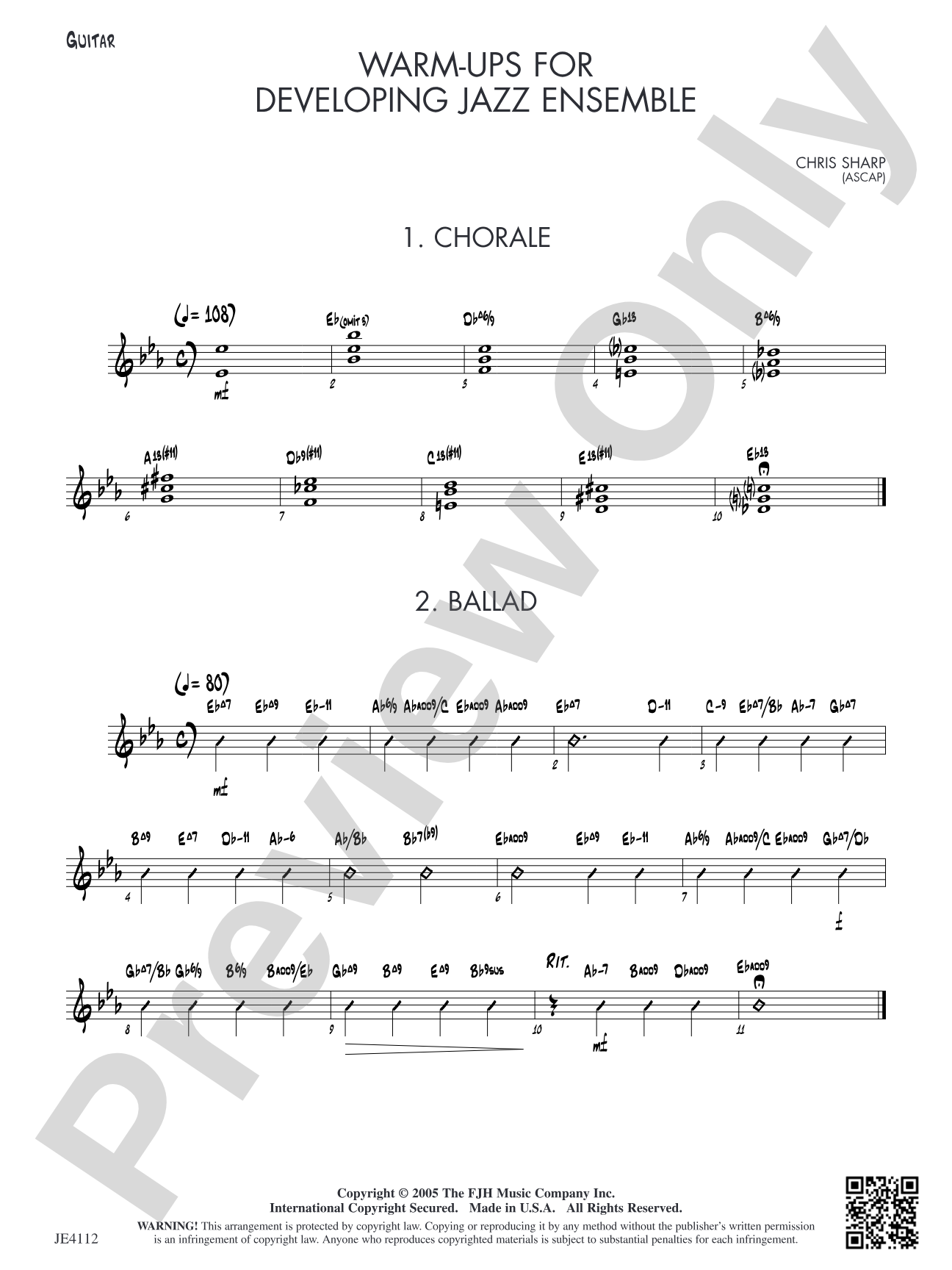

Warm-Ups for Developing Jazz Ensemble: Guitar
By Chris Sharp
Grade: 2-3
Item: 98-PC-DJE4112_G
$7.00
Pickup currently not available
Description
This collection of short exercises is a follow-up to last year's popular Warm-ups for Beginning Jazz Ensemble. Covering a wide variety of styles, the exercises include Chorale, Ballad, Laid Back, Killer Bop, Gimme Samba Dat, and Get Funky. Detailed program notes help you get the most out of your group. An excellent resource to put in the folders and use any time you need it!


Warm-Ups for Developing Jazz Ensemble: Guitar isn't in MakeMusic Cloud just yet...but it could be. Let us know you'd like to see it, and you'll help shape what comes next. In the meantime, start a free trial and dive into thousands of interactive titles your students can play along with today.
Request This Title
Tell us you want it.
Start Your Free Trial
Explore everything that's ready to play right now.
Sample Audio
1
Audio File
--:--
0:00
0:00
Sample Video
No sample videos found.
Additional Details
Series:
FJH Developing Jazz Ensemble
Publisher:
The FJH Music Company, Inc.
SKU:
98-PC-DJE4112_G
More about this title
About the Composer: Chris Sharp

Chris Sharp holds a Ph.D. and has built a career across performance, composition, and education. As a trombonist, he spent eleven years as a full-time musician and bandleader at Walt Disney World, while simultaneously working as an arranger and orchestrator for Disney parks globally since 1984, creating music for live shows, recordings, and national broadcasts. His freelance work extends to Universal Studios, the Boston Pops, the Dallas Brass, and service ensembles including the USAF Airmen of Note.
Sharp's educational credentials span the University of Florida and University of Miami. He has taught at middle school, high school, and college levels, and currently serves as Director of Bands at Polk State College in Winter Haven, where he also instructs music theory, music technology, and arranging. His compositions and arrangements for concert and jazz band appear regularly at major venues like the Midwest Clinic. He has been recognized multiple times with the ASCAPlus award and serves as a clinician, guest conductor, and adjudicator for organizations including Bands of America and Drum Corps International.
Why we love this
Sharp delivers exactly what developing ensembles need: focused, playable exercises that cover real jazz vocabulary without overwhelming young players. The six contrasting styles (Chorale, Ballad, Laid Back, Killer Bop, Gimme Samba Dat, Get Funky) expose your section to different grooves and articulations in manageable doses, and the included program notes give you the language to coach each style effectively. These land in folders and stay there because they're genuinely useful every single rehearsal.
What to expect
Moving through these exercises is like taking a guided tour of the jazz spectrum. You'll feel the deliberate space and introspection of the Chorale, sink into the groovy pocket of Laid Back, swing hard through Killer Bop, and land in contemporary funk and Latin feels. Each style has its own character and purpose, never feeling generic.
Who it's for
Jazz ensemble directors working with high school Grade 2-3 ensembles who want reliable, varied warm-up material that teaches style and technique in the same breath. Players benefit from systematic exposure to jazz language, and the exercises work equally well for opening rehearsals, sectionals, or as quick refreshers before performance.
How to get the most out of it
- Start with the Chorale to establish blend and dynamic control, then use the Ballad to work intonation and breathing in a more lyrical context before moving to the funkier styles.
- Isolate rhythm sections on the Laid Back and Get Funky exercises to lock the groove before full ensemble plays; unison time-feel transforms the whole sound.
- Study the written accents and articulation markings in Killer Bop carefully with your soloists and section leaders; Sharp's phrasing shapes the character.
- Use Gimme Samba Dat to address both Latin rhythmic precision and the brass section's tightness on syncopated hits.
How to use it
Print these once and keep them in student folders throughout the year. Pull them out as rehearsal starters to reset focus and tone without eating into sectional or full repertoire time. The variety also makes them ideal for jazz ensemble festival preparation, where exposure to multiple styles strengthens musicianship and arranging literacy.
Skills your students will build
- Swing articulation and phrasing in ballad and bebop contexts
- Latin rhythmic accuracy and cross-rhythm coordination
- Funk and contemporary groove feel with emphasis placement
- Intonation and blend across a variety of jazz sonorities
- Style recognition and stylistic switching within a single rehearsal
- Section unity on syncopated hits and ensemble articulation