

Warm-Up Fundamentals for Concert Band: B-flat Clarinet 1
By Gregg Gausline & Brian Balmages
Item: 98-PC-DB1494_C1
$7.00
Pickup currently not available
Description
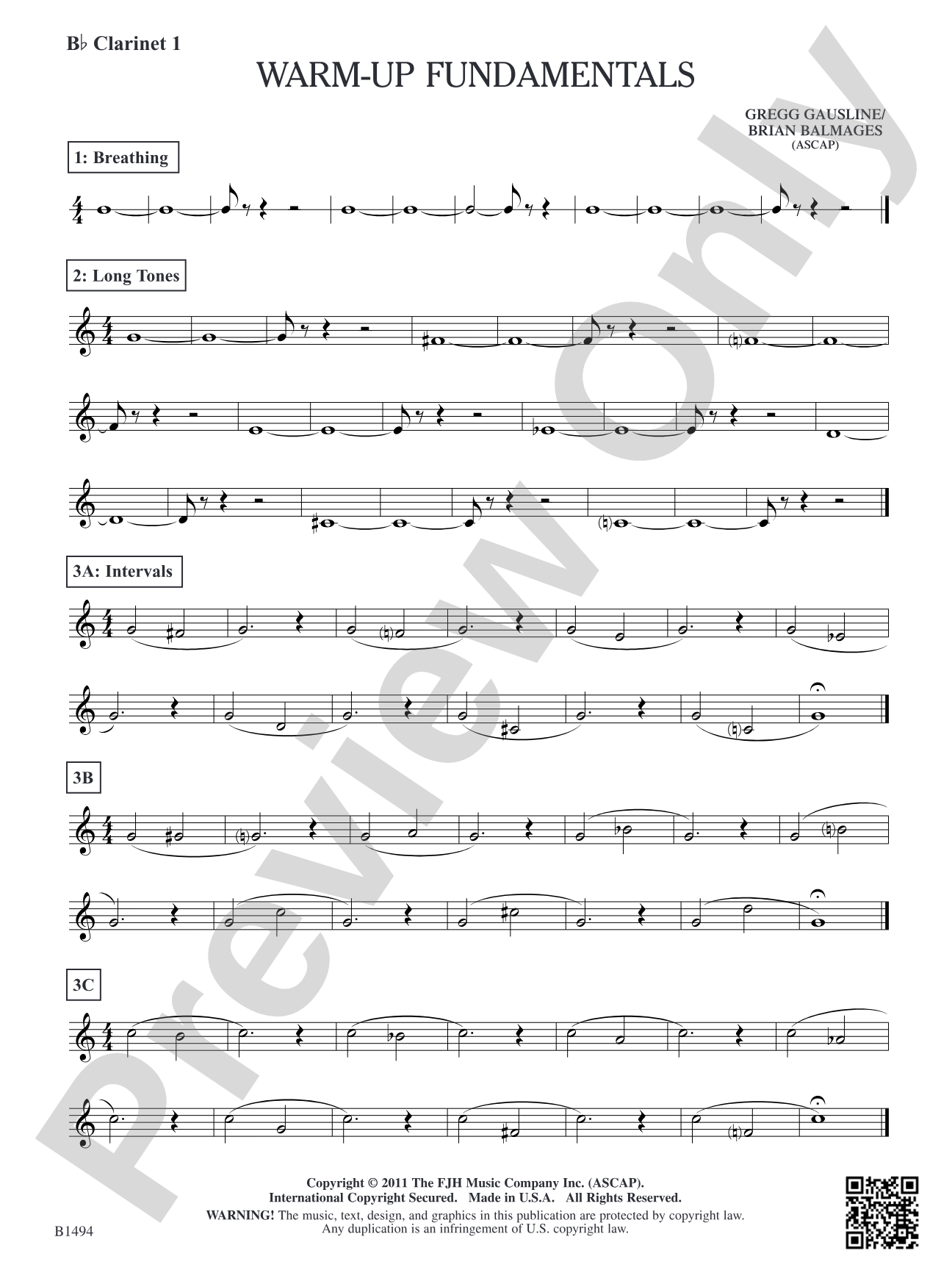
Warm-up Fundamentals was conceived as a tool for directors to use as part of a daily ensemble routine. It covers important fundamental concepts such as breathing, long tones, interval slurs, articulation, flexibility, chords and chorales. Each section breaks concepts down to their most fundamental elements before integrating them together. This gradual approach to the ensemble warm-up helps extend the practical applications of these exercises well into rehearsals and performances. Each instrument part fits on one folded piece of paper, so it’s extremely practical in size and can easily fit inside a folder without issue. These warm-ups are also ideal for guest conducting appearances such as honor bands, where conductors need to achieve a uniform sound in a short amount of time.


Warm-Up Fundamentals for Concert Band: B-flat Clarinet 1 isn't in MakeMusic Cloud just yet...but it could be. Let us know you'd like to see it, and you'll help shape what comes next. In the meantime, start a free trial and dive into thousands of interactive titles your students can play along with today.
Request This Title
Tell us you want it.
Start Your Free Trial
Explore everything that's ready to play right now.
Sample Audio
No sample audio found.
Sample Video
No sample videos found.
Additional Details
Series:
FJH Band
Publisher:
The FJH Music Company, Inc.
SKU:
98-PC-DB1494_C1
More about this title
About the Composer: Gregg Gausline
Gregg Gausline has established himself as a respected composer and educator within the concert band world, with a catalog that prioritizes practical, teachable music for young and developing ensembles. His work often addresses real pedagogical needs—pieces that sound musical while building specific technical skills—and he demonstrates deep understanding of how bands actually function in schools and rehearsal settings.
Balmages and Gausline have collaborated on multiple projects that serve the band director's toolkit, bringing together their complementary strengths in compositional craft and ensemble awareness. Their partnership reflects a shared commitment to creating resources that work in the daily life of a busy music program.
Why we love this
This resource cuts through the noise of generic warm-up routines by building each concept methodically, then showing how those fundamentals connect to real musicianship. Directors immediately see the payoff: students understand why they're doing long tones and chord work, not just executing them by rote. The practical format—single-page parts that live in folders—removes every excuse to skip a structured warm-up.
What to expect
Working through these fundamentals feels like building a house from a solid foundation. Each exercise connects logically to the next; breathing informs long tones, which support interval slurs, which prepare the articulation and flexibility work. By the end of a complete warm-up, the ensemble has addressed tone production, intonation, blend, and rhythmic precision without a single drill feeling disconnected from musical purpose.
Who it's for
Band directors at all levels who want a systematic, efficient warm-up that develops tone and technique while building ensemble cohesion. Student musicians benefit from exercises that feel purposeful and directly applicable to the music they're rehearsing. Guest conductors and clinicians working with honor bands or festival groups will find this especially valuable for achieving quick unity in limited rehearsal time.
How to get the most out of it
- Establish a consistent warm-up duration and place it at the same point in every rehearsal. Student brains work better with routine, and your ensemble will settle faster if warm-ups aren't a surprise.
- Use the sectional breakdown to diagnose specific issues. If intonation wavers during the chord section, isolate that concept across a few rehearsals rather than moving on.
- Rotate which section leads the interval slurs and articulation exercises. Hearing different voices carry the melody sharpens listening skills across the band.
- Record a rehearsal where you've worked these fundamentals, then play it back two weeks later. Students hear their own progress in tone control and ensemble blend.
How to use it
Make this your opening ritual for every rehearsal, from September through June. The consistency pays dividends in tone quality and ensemble focus, and the modular design means you can extend or shorten the routine depending on your schedule. For honor bands and guest conducting situations, a director can lead the complete warm-up in one session and immediately move into repertoire with a significantly unified sound.
Skills your students will build
- Breath control and sustained tone production
- Intonation within intervals and chords
- Slurring smoothly across the full range
- Clear articulation styles (legato, staccato, marcato)
- Flexibility and agility within a consistent sound
- Listening for blend and balance in an ensemble
- Understanding fundamental tone concepts and applying them to repertoire