
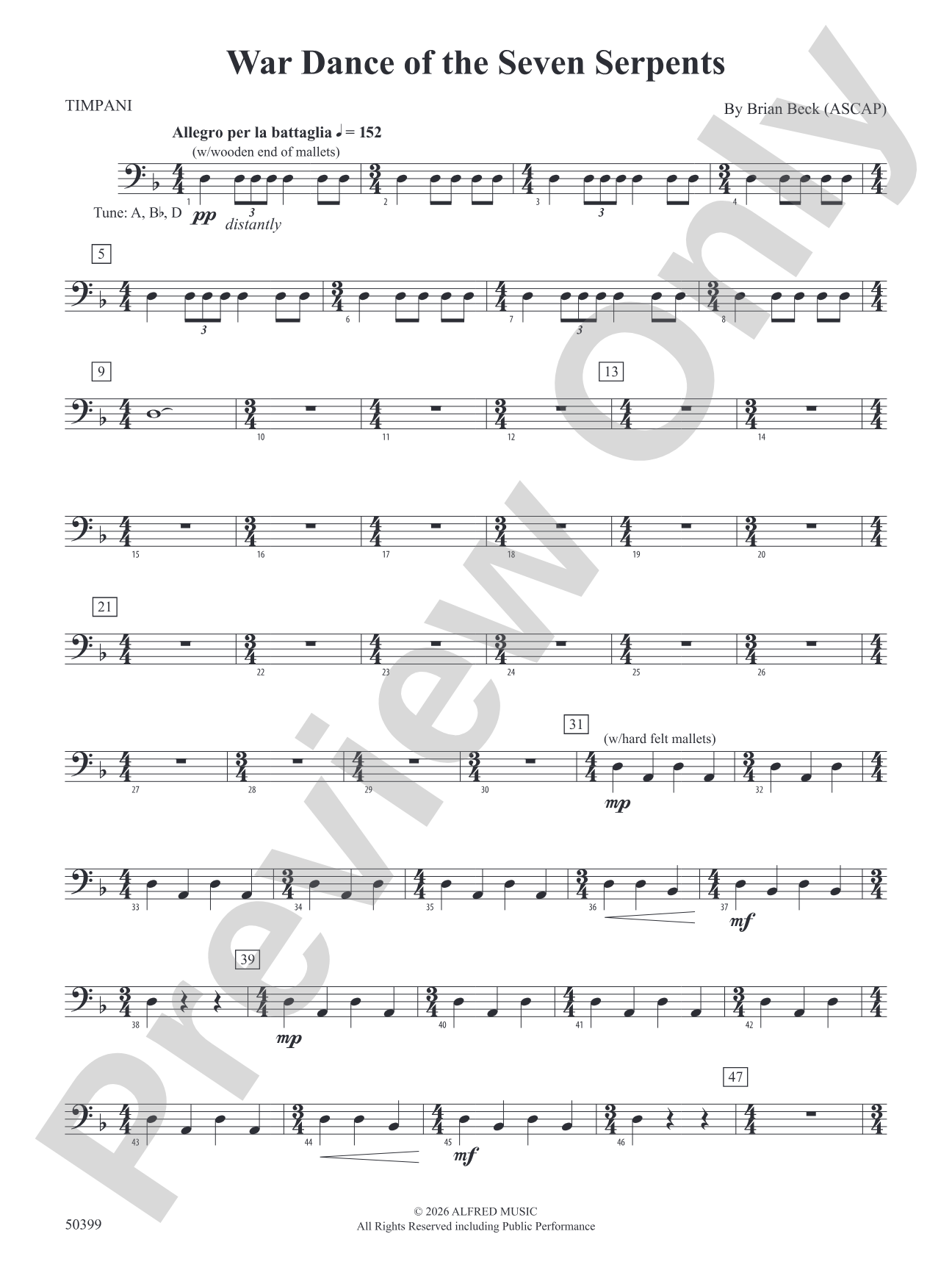

WAR DANCE OF SEVEN SERPENTS/DB: Timpani
By Brian Beck
Grade: 2
Item: 00-PC-0019675_TMP
$3.00
Pickup currently not available
Description
War Dance of the Seven Serpents, by Brian Beck, is a fantastic showcase for developing musicians. It exhibits many aspects, styles, and techniques included in more sophisticated music that challenge players while being sensitive to range, rhythm, and difficulty. Bound to become a staple in young band literature!
The piece and its title pay homage to the classical works of Gustav Holst and Silvestre Revueltas. "War" is derived from "Mars," from Holst's The Planets, as well as many of this piece's driving rhythms. "Seven" refers to the overall meter of the piece (4+3=7). "Serpents" alludes to Revueltas' Sensemayá, a piece (also in 7/4) that tells a story of a ritual involving a snake.


The piece and its title pay homage to the classical works of Gustav Holst and Silvestre Revueltas. "War" is derived from "Mars," from Holst's The Planets, as well as many of this piece's driving rhythms. "Seven" refers to the overall meter of the piece (4+3=7). "Serpents" alludes to Revueltas' Sensemayá, a piece (also in 7/4) that tells a story of a ritual involving a snake.
Don't just read it, hear it, play along with it, and watch your students grow with it. In MakeMusic Cloud, WAR DANCE OF SEVEN SERPENTS/DB: Timpani comes alive with professional accompaniment, adjustable tempo, and built-in practice tools that turn solo practice into real progress.
Open in the Player
Jump straight in and assign it today.
Start Your Free Trial
Open this title and explore the full library in minutes.
Sample Audio
1
Audio File
--:--
0:00
0:00
Sample Video
Additional Details
Series:
Developing Band
Publisher:
Alfred Music
SKU:
00-PC-0019675_TMP
More about this title
About the Composer: Brian Beck

Brian Beck is a composer and arranger whose works appear on honor band programs, festival stages, and prescribed music lists across the country. His compositions have earned recognition from The Instrumentalist and J.W. Pepper, and several pieces have been featured in GIA Publications' Teaching Music Through Performance In Band series. Beck has also served as director of bands at both middle and high schools in Texas, where his programs consistently earned superior ratings at UIL contests and competed at the Midwest Band and Orchestra Clinic.
Beck holds degrees in music education from Texas A&M University-Commerce and the University of Houston. He remains active as a freelance clinician and composer for instrumental and vocal ensembles, and his works span multiple prescribed music lists including the Texas UIL, Ohio Band List, and Birch Bay Band Title List.
Why we love this
Beck constructs a piece that respects where young musicians actually are developmentally while introducing them to compositional sophistication. The 7/4 meter and stylistic references to Holst and Revueltas signal serious musical ambition without overwhelming players; they'll find the work rewarding to prepare and audiences will recognize genuine artistry in the result.
What to expect
Rhythmically propulsive and ceremonial. The piece carries the weight of ritual without becoming ponderous; you feel the meter's asymmetry as something purposeful rather than awkward. There's a driving quality that recalls Holst's orchestral power but filtered through accessible instrumentation and cleaner harmonic textures.
Who it's for
Grade 2 concert bands looking for repertoire that challenges without overextending, and directors who want to introduce developing musicians to the kinds of compositional sophistication they'll encounter at higher levels. This works equally well for middle school bands building toward more complex literature and younger high school groups.
How to get the most out of it
- Establish the pulse clearly in 7/4 before rehearsal begins. Count it as 4+3 to help students feel the meter's natural weight distribution.
- Balance the driving rhythmic elements so they propel without becoming mechanical. The piece draws energy from Holst's Mars, so look for forward motion rather than percussive precision.
- Pay attention to range management early in sectionals. Beck has written with young players in mind, but confirming comfortable registers prevents tone quality issues in performance.
- Use the homage elements as teaching moments. Brief context about Holst's Planets and Revueltas' Sensemayá helps students understand why they're encountering 7/4 and what inspired the compositional choices.
How to use it
Program this as a festival or contest selection where the 7/4 meter and cultural references will intrigue adjudicators while the Grade 2 accessibility keeps the rehearsal load reasonable. It also pairs well on concert programs with music in traditional meters, letting audiences hear how composers expand beyond 4/4 and how developing players rise to that challenge.
Skills your students will build
- Reading and performing in 7/4 meter (4+3 subdivision)
- Maintaining ensemble precision through asymmetrical rhythmic patterns
- Sustaining tone quality across the full range without strain
- Understanding how contemporary composers reference classical sources