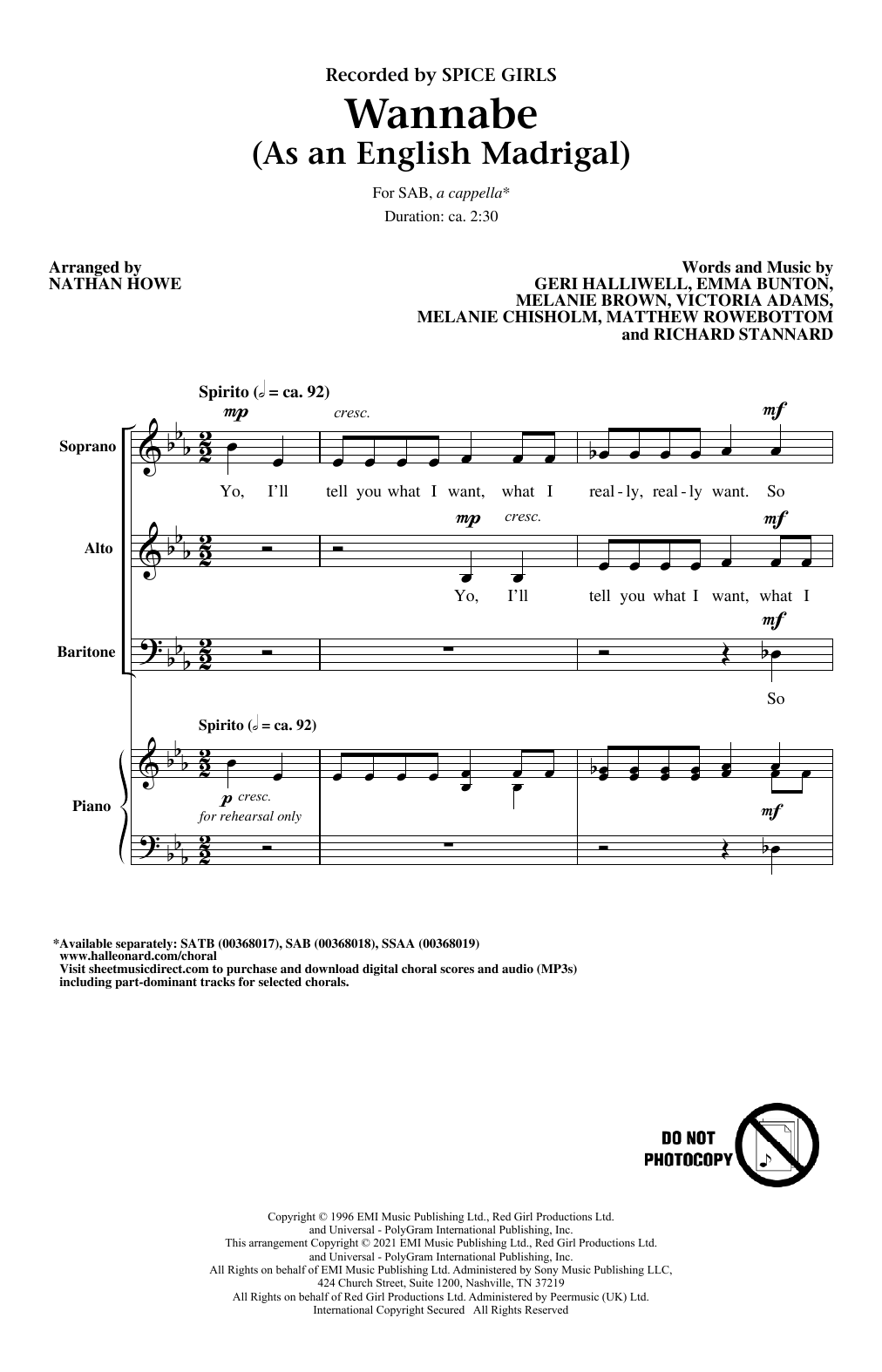
Wannabe (As an English Madrigal) (arr. Nathan Howe) Sheet Music Preview

Wannabe (As an English Madrigal) (arr. Nathan Howe): SAB Choral Octavo

By Emma Bunton / By Melanie Brown / By Geri Halliwell / By Victoria Adams / By Melanie Chisholm / By Richard Stannard / By Matthew Rowebottom / As performed by Spice Girls / Arranged by Nathan Howe

Item: 35-DS00477914

Digital Download
$2.99
Description

Wannabe (As an English Madrigal) (arr. Nathan Howe): SAB Choral Octavo isn't in MakeMusic Cloud just yet...but it could be. Let us know you'd like to see it, and you'll help shape what comes next. In the meantime, start a free trial and dive into thousands of interactive titles your students can play along with today.

Sample Audio
No sample audio found.
Sample Video
Additional Details
Publisher: Hal Leonard
Page Count: 18
SKU: 35-DS00477914

More about this title

About the Composer: Emma Bunton

Emma Bunton rose to prominence as a member of the Spice Girls, one of the most commercially successful girl groups of the 1990s. As both a vocalist and songwriter, she contributed to the creation of some of pop music's most recognizable hooks and melodies, helping define the sound of an era that continues to resonate in popular culture.

Why we love this

Nathan Howe's arrangement transforms a pop anthem into a madrigal, creating a natural bridge between what your singers know and the compositional traditions you want them to explore. The juxtaposition of contemporary melody with Renaissance-inspired texture invites singers to hear familiar material with fresh ears, while the SAB voicing keeps it accessible for mixed ensembles.

What to expect

Playful and intellectually engaging, this arrangement invites both performers and listeners into a conversation between pop culture and classical form. The familiar melody gains unexpected depth when heard through the lens of madrigal writing, creating moments of both genuine humor and musical insight.

Who it's for

This works beautifully for choirs seeking contemporary repertoire that also teaches compositional history. Middle school through adult singers will appreciate performing a song they recognize while discovering how different musical languages can coexist in a single piece.

How to get the most out of it

  • Balance the parts carefully so the madrigal texture emerges without any voice obscuring the iconic melody; the hook should still register even when woven into three-part harmony.
  • Observe phrase breathing marks as written to maintain the polyphonic independence that gives the arrangement its character and prevents it from collapsing into block chords.
  • Shape the dynamics to highlight the contrapuntal moments, allowing listeners to follow the interplay of lines rather than experience the piece as a unison progression.

How to use it

Include this in a concert exploring how classic pop songs interact with earlier musical traditions, or use it as an intermission piece to lighten the mood without sacrificing musical substance. It also works as a teaching tool within a unit on madrigals or polyphonic writing, letting students engage with the concept through music they actually want to sing.

Skills your students will build

  • Reading independent melodic lines in a three-part texture
  • Maintaining ensemble cohesion while tracking a personal part
  • Understanding how harmonic function can underpin a contemporary melody
  • Distinguishing between homophonic and polyphonic approaches to the same material

You May Also Like