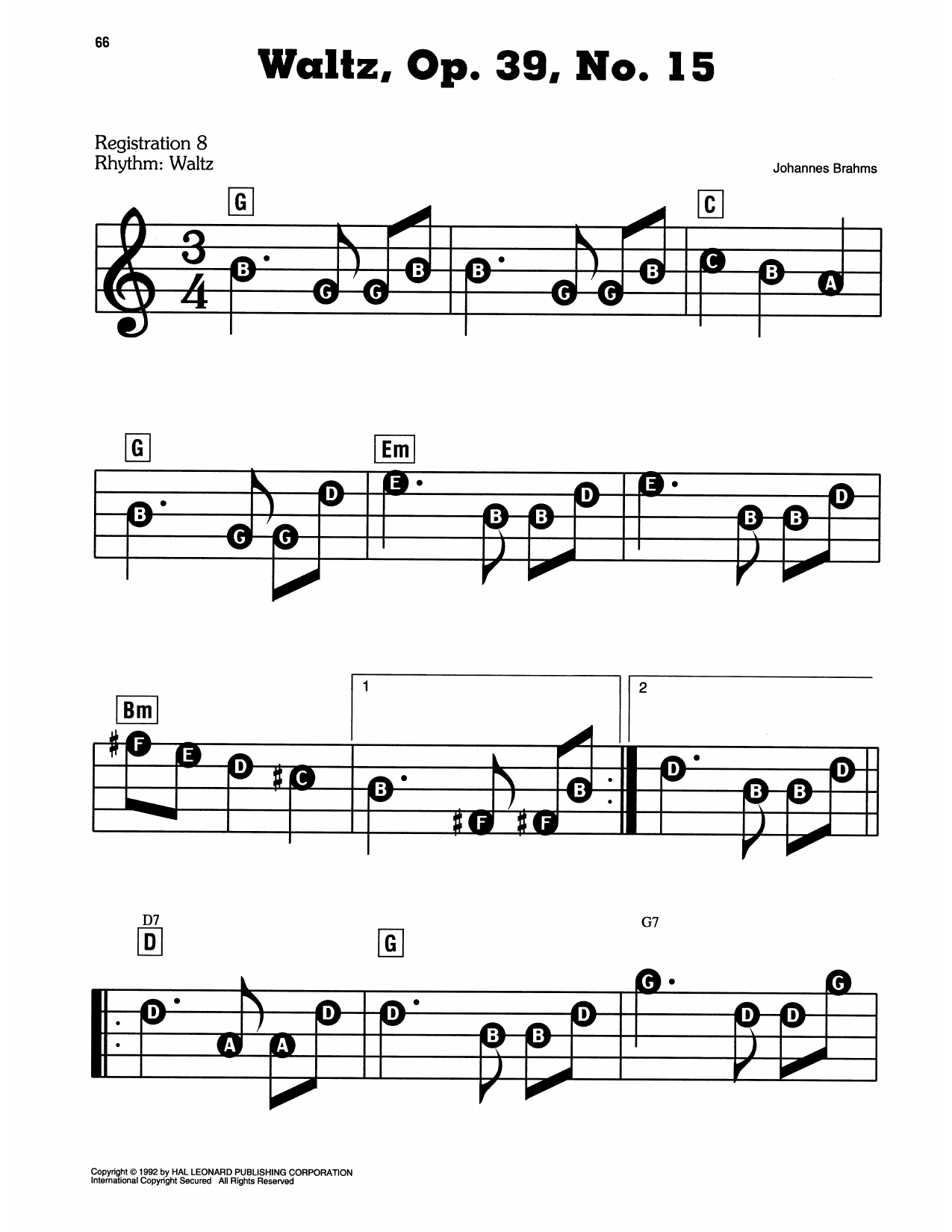
Waltz, Op. 39, No. 15 Sheet Music Preview

Waltz, Op. 39, No. 15: E-Z Play Today

By Johannes Brahms

Item: 35-DS01874722

Digital Download
$4.99
Description

Waltz, Op. 39, No. 15: E-Z Play Today isn't in MakeMusic Cloud just yet...but it could be. Let us know you'd like to see it, and you'll help shape what comes next. In the meantime, start a free trial and dive into thousands of interactive titles your students can play along with today.

Sample Audio
No sample audio found.
Sample Video
Additional Details
Publisher: Hal Leonard
Page Count: 2
SKU: 35-DS01874722

More about this title

About the Composer: Johannes Brahms

Johannes Brahms (1833–1897) stands as one of the great synthesizers of classical form and Romantic expression. A master of symphonic thinking who refused to write opera, he devoted himself to perfecting every genre from chamber music to orchestral works, always with an ear for structural clarity and emotional depth.

For students and teachers, Brahms represents the bridge between strict formal training and genuine musical substance. His melodies sing naturally within logical harmonic progressions, his rhythms sit comfortably in the hand, and his pieces reward both careful practice and genuine musicality.

Why we love this

This E-Z Play arrangement makes a genuine Brahms gem accessible without sacrificing the piece's charm or musical integrity. The simplified presentation lets students focus on tone and phrasing rather than wrestling with complex notation, yet they're playing actual Brahms rather than a watered-down substitute.

What to expect

Elegant and surprisingly tender for a dance form, this waltz moves with the grace of a ballroom rather than the energy of a Viennese carnival. There's a lyrical quality that makes you want to sing along, yet the piece never sacrifices structural integrity for sentimentality.

Who it's for

Students working toward independence at the early intermediate level will benefit from the simplified notation while still engaging with a masterwork. Teachers seeking a genuine piece for recital, festival, or program material without stumbling into endless simplified "arrangements" of dubious value.

How to get the most out of it

  • Shape each phrase with a slight rubato, allowing the melody to breathe naturally. Brahms's waltzes expect this flexibility rather than mechanical steadiness.
  • Keep the accompaniment light and transparent so the melody emerges clearly. A heavy left hand will bury the character of the piece.
  • Listen for the underlying song quality beneath the dance rhythm. This isn't meant to sound percussive; let it sing through.
  • Balance energy with relaxation. The waltz pulse should feel natural, not labored.

How to use it

Pair this with other short Romantic character pieces for a recital segment that spans composers, or program it alongside student compositions to show how classical forms continue to inspire. Its modest length and accessible character make it ideal for showcasing student growth without overwhelming their confidence.

Skills your students will build

  • Maintaining steady waltz rhythm (3/4 pulse and accompaniment pattern)
  • Shaping melodic phrases with subtle dynamic variation
  • Balancing melody and accompaniment independently
  • Understanding song form and phrase structure
  • Applying rubato expressively within a formal structure

You May Also Like