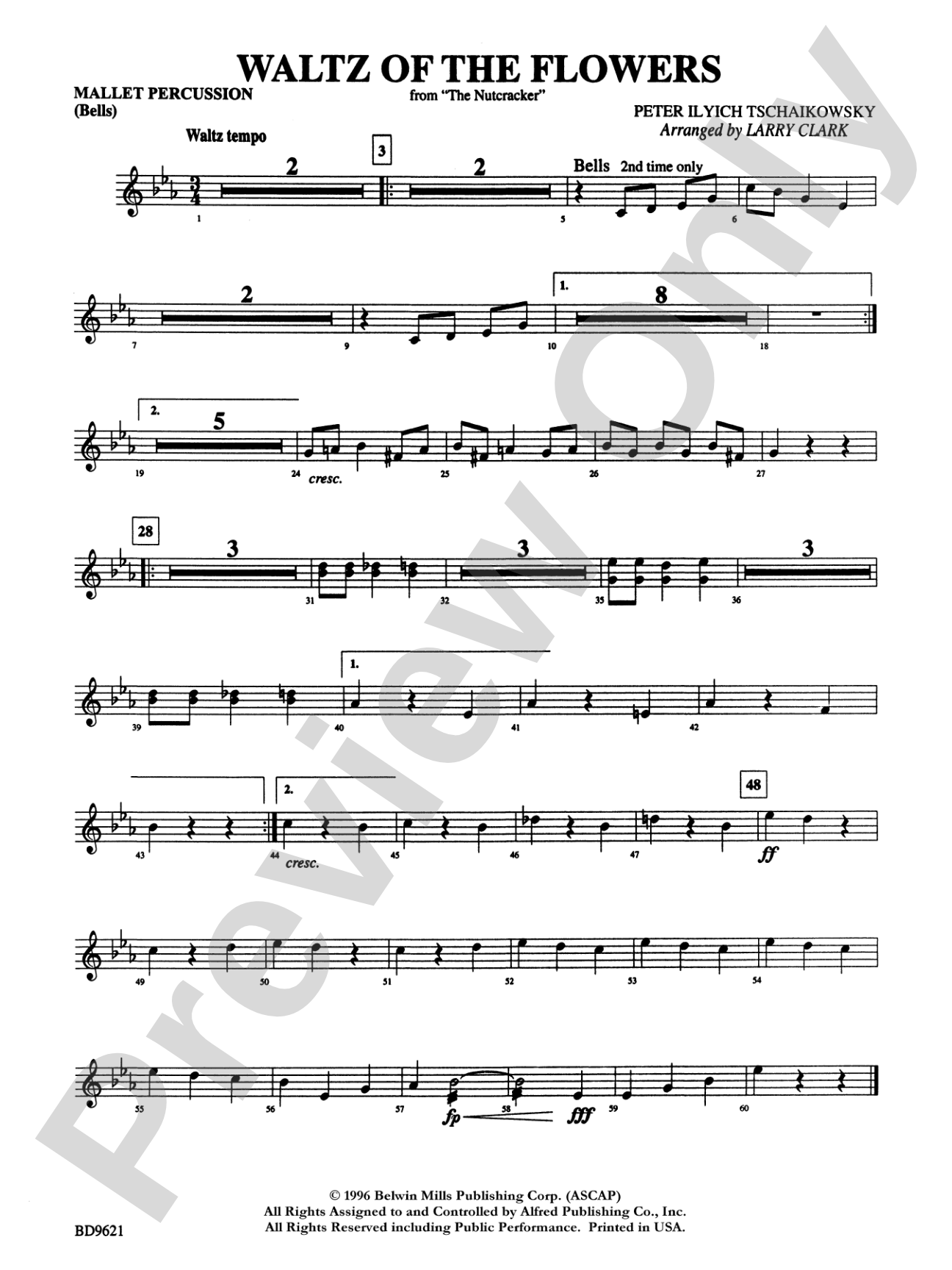
Waltz of the Flowers (from The Nutcracker Suite): Mallets Sheet Music Preview

Waltz of the Flowers (from The Nutcracker Suite): Mallets

By Peter Ilyich Tchaikovsky / arr. Larry Clark

Grade: 1 (Very Easy)

Item: 00-PC-0002027_M1

Digital Download
$3.00
Description
From Tchaikovsky's ballet The Nutcracker comes this fresh scoring for young band or wind ensemble. The technical demands have been reduced, but the musical content is strongly in evidence. With a charming flow from beginning to end, this work will find its way into thousands of holiday concerts and programs at other times of the year. Delightful! (duration 1:27)

Don't just read it, hear it, play along with it, and watch your students grow with it. In MakeMusic Cloud, Waltz of the Flowers (from The Nutcracker Suite): Mallets comes alive with professional accompaniment, adjustable tempo, and built-in practice tools that turn solo practice into real progress.

Sample Audio
0:00
0:00
Sample Video
Additional Details
Series: Belwin Beginning Band
Publisher: Alfred Music
Page Count: 124
SKU: 00-PC-0002027_M1

More about this title

About the Composer: Peter Ilyich Tchaikovsky

Peter Ilyich Tchaikovsky (1840-1893) stands as one of the most performed composers in the concert world, and for good reason. His gift for melody and emotional directness speaks across centuries and skill levels. The Nutcracker Suite, premiered in 1892, has become synonymous with the winter season and remains a gateway into classical music for millions of listeners.

Tchaikovsky's orchestral writing balances accessibility with sophistication. His melodies are instantly memorable, yet the harmonic language and instrumentation kept his work vital among professional musicians. For young band directors, his music offers an ideal bridge between simple charts and genuine artistic expression. Arrangements like this one preserve the soul of the original while making it achievable for developing musicians.

Why we love this

This arrangement respects both the Grade 1 reader and the listening audience. Larry Clark has stripped away technical complications without sacrificing Tchaikovsky's signature lyricism or the piece's structural integrity. You get a real concert piece that sounds polished and complete, not a reduced version that feels like a stepping stone.

What to expect

Graceful and swirling, with the gentle sparkle of a music box played by hands warm enough to sustain the melody. The familiar waltz rhythm creates immediate recognition, while Tchaikovsky's gift for orchestral color (even at reduced technical demands) keeps the sound engaging and never childish.

Who it's for

Beginning and early intermediate band directors who need a legitimate concert work for winter programming that their students can actually play well. This is equally suited to groups preparing holiday concerts and those simply looking for accessible Romantic-era repertoire that doesn't compromise on musical content.

How to get the most out of it

  • Balance the melody across your woodwind section. The opening lines need warmth and presence, so ensure clarinet and flute are blending rather than competing for the ear.
  • Keep the waltz tempo steady and slightly lilting. A mechanical 3/4 loses the character entirely; let the pulse breathe naturally within the beat.
  • Pay attention to phrase endings. Tchaikovsky's melodies have built-in breathing points. Shape them intentionally so the piece flows without feeling rushed.
  • Use dynamic contrasts to create architecture. Even at Grade 1 difficulty, contrast between sections (mf to f, p to mf) gives shape and sustains interest over the full 1:27 duration.

How to use it

Position this as an opening or encore in a winter concert, where its charm and brevity work to advantage. It also functions well as a bridge between a heavier concert work and something lighter, or as the centerpiece of a thematic program around The Nutcracker or classical ballet music.

Skills your students will build

  • Playing in 3/4 time with correct waltz rhythm and style
  • Balancing melody and accompaniment within the same section
  • Sustaining phrasing across multiple measures at Grade 1 level
  • Reading parts that maintain musical integrity while remaining technically approachable
  • Following conductor through standard concert band literature structure

You May Also Like