
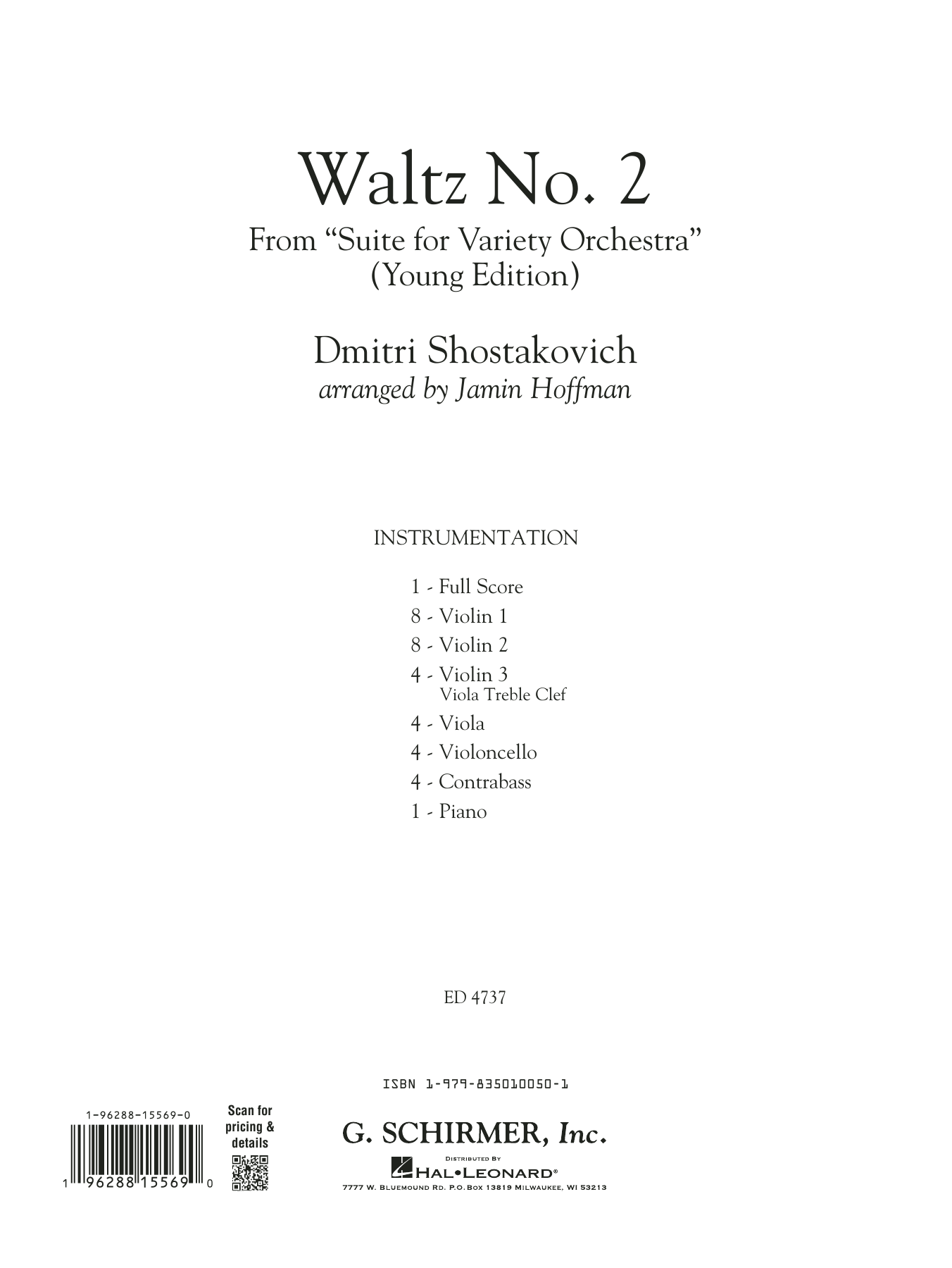

Waltz No. 2 (from Suite for Variety) (Young Edition): String Orchestra Conductor Score & Parts
By Dmitri Shostakovich / Edited by Jamin Hoffman
Grade: 3-4
Item: 35-PK01624018
$55.00
Pickup currently not available
Buy Extra Parts (Digital PDF Download)
Parts Added to Cart!
Description
This sardonic waltz, taken from the Suite for Variety Orchestra, may be Shostakovich's most well-known piece. It has appeared in movie soundtracks, commercials, and even soccer fields! Slightly simplified and arranged for a young string orchestra, Hoffman's arrangement swings from B minor to D Major and back again. When performed in Europe, it's traditional for audiences to sway and sing along-- a tradition that begs to be transported "across the pond!"


Waltz No. 2 (from Suite for Variety) (Young Edition): String Orchestra Conductor Score & Parts isn't in MakeMusic Cloud just yet...but it could be. Let us know you'd like to see it, and you'll help shape what comes next. In the meantime, start a free trial and dive into thousands of interactive titles your students can play along with today.
Request This Title
Tell us you want it.
Start Your Free Trial
Explore everything that's ready to play right now.
Sample Audio
No sample audio found.
Sample Video
No sample videos found.
Additional Details
Publisher:
Hal Leonard
SKU:
35-PK01624018
More about this title
About the Composer: Dmitri Shostakovich
Dmitri Shostakovich (1906-1975) was a Soviet composer whose works navigated the treacherous landscape of 20th-century Russian politics while maintaining uncompromising artistic vision. His output spans 15 symphonies, 15 string quartets, concertos, ballets, and film scores that blend modernist technique with dark humor and emotional depth.
Shostakovich's gift for melody and orchestration made him accessible to broad audiences, yet his music often conceals layers of irony and social commentary. His ability to write for every ensemble type, from full orchestra to solo instruments, made him one of the most versatile composers of his era. For music educators, his works offer students exposure to sophisticated harmonic thinking wrapped in music that genuinely engages performers and listeners.
Why we love this
This arrangement captures the essential swagger of Shostakovich's original while remaining within reach of young orchestras. The harmonic movement between B minor and D Major creates genuine sophistication without requiring advanced technical facility, and the piece's inherent wit translates immediately to audiences. Best of all, it arrives with built-in European tradition: your students aren't just playing a famous waltz; they're participating in a living performance practice where audiences actively engage with the music.
What to expect
Urbane and playful, with an undercurrent of dark comedy. The waltz swings between moody introspection and bright, almost sardonic movement, creating a musical personality that feels both timeless and distinctly modern. There's a wink in every phrase.
Who it's for
String orchestras at the intermediate level who need repertoire that sounds substantial and sophisticated without overwhelming young players. Directors seeking pieces that engage audiences actively and create memorable concert moments will find this invaluable; the piece arrives with genuine cultural tradition already attached.
How to get the most out of it
- Shape the phrasing with attention to the minor-to-major tonal shifts. These key changes are the heart of Shostakovich's sardonic voice, not merely harmonic color.
- Bring the rhythmic lilt of the waltz forward without dragging. Shostakovich's wit depends on dancers actually being able to move.
- Balance your string sections so that principal lines sing through clearly. The orchestration often features soloistic writing that risks disappearing in ensemble texture.
- Invite your audience to sway and hum along during performance. This piece thrives on that participatory energy and transforms both the room and your students' relationship to the music.
How to use it
Include this as an accessible entry point to Shostakovich within a concert of 20th-century works, or pair it with lighter classical repertoire for a mixed program that keeps audiences animated. Its fame in film and popular culture makes it an excellent bridge piece when introducing students to concert music; many audience members will recognize it immediately, creating instant connection. The piece also works beautifully as an encore or closing selection, especially if you embrace the swaying tradition.
Skills your students will build
- Reading and executing tonal shifts between parallel major and minor keys
- Maintaining rhythmic precision in waltz meter with stylistic lift
- Balancing ensemble texture while supporting principal melodic lines
- Interpreting performance traditions and cultural context in classical music
- Shaping longer phrases with harmonic awareness rather than mechanical counting