
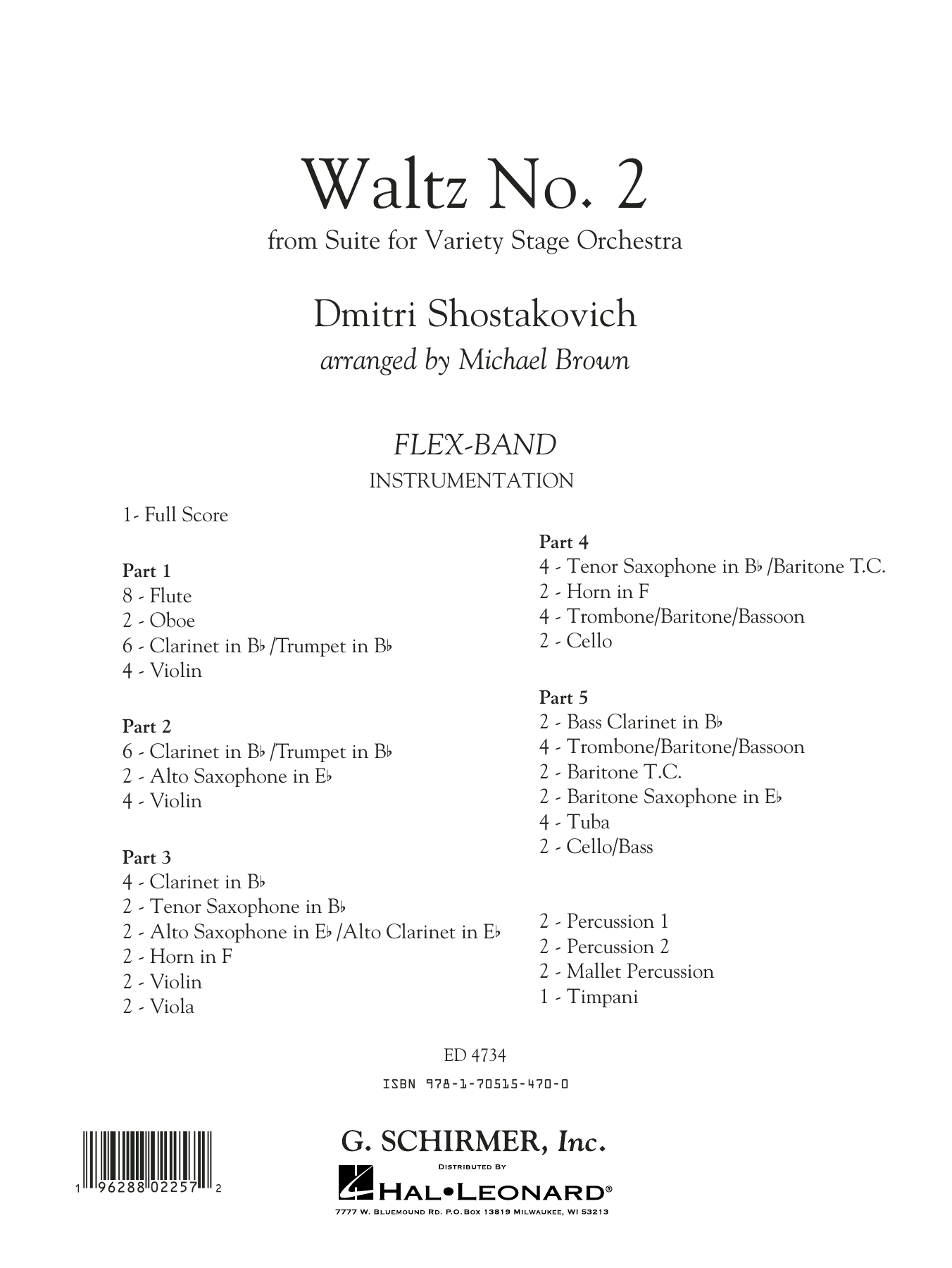

Waltz No. 2 (from Suite for Variety Stage Orchestra) (arr. Michael Brown): Flex Ensemble Conductor Score & Parts
By Dmitri Shostakovich / Arranged by Michael Brown
Grade: 3
Item: 35-PK00528971
$65.00
Pickup currently not available
Buy Extra Parts (Digital PDF Download)
Parts Added to Cart!
Description
This popular waltz melody from Shostakovich's "Suite for Variety Stage Orchestra" is well-known throughout the world and often used in TV and films. Here is a well-paced version scored for flexible instrumentation.


Waltz No. 2 (from Suite for Variety Stage Orchestra) (arr. Michael Brown): Flex Ensemble Conductor Score & Parts isn't in MakeMusic Cloud just yet...but it could be. Let us know you'd like to see it, and you'll help shape what comes next. In the meantime, start a free trial and dive into thousands of interactive titles your students can play along with today.
Request This Title
Tell us you want it.
Start Your Free Trial
Explore everything that's ready to play right now.
Sample Audio
No sample audio found.
Sample Video
No sample videos found.
Additional Details
Publisher:
Hal Leonard
SKU:
35-PK00528971
More about this title
About the Composer: Dmitri Shostakovich
Dmitri Shostakovich (1906-1975) was a Russian composer of towering significance who shaped twentieth-century music through fifteen symphonies, fifteen string quartets, and dozens of other works. His music balances modernist complexity with melodic directness, and he wrote extensively for theater, film, and ballet. His pieces for lighter ensembles like the Suite for Variety Stage Orchestra reveal his gift for creating immediately memorable themes that work brilliantly across different instrumental combinations.
For music educators, Shostakovich's accessibility matters deeply. His melodies stick in the ear, his harmonic language is rich without being obscure, and his orchestration principles teach invaluable lessons about color and balance. Even his lighter works carry the craftsmanship of a master.
Why we love this
Michael Brown's arrangement respects the lilt and elegance of Shostakovich's original waltz while making it work for ensembles that may lack a full orchestra. At Grade 3, it sits in that sweet spot where students encounter real harmonic content and ensemble balance challenges without getting bogged down in technical extremes. The flexible instrumentation means you're not waiting for that one oboe player to show up.
What to expect
The opening melody unfolds with the graceful, slightly melancholic character that made this waltz recognizable in films and television. It moves with unhurried elegance, never asking for speed or aggression, but instead rewarding careful phrasing and attention to balance between the melody line and its supporting harmonies.
Who it's for
Directors programming a concert that needs a sophisticated classical moment without requiring a chamber orchestra. Strong Grade 3 ensembles looking for repertoire that teaches musicianship alongside technical growth, particularly those with flexible instrumentation needs.
How to get the most out of it
- Shape the melody with a slight lean into the first beat of each measure; the waltz rhythm lives in that emphasized downbeat, and your principal melody player needs permission to breathe there
- Keep the harmonic accompaniment light and transparent, especially in the inner voices. Shostakovich's original scoring favors clarity over density, and student ensembles often muddy this piece by playing too much too loudly
- Balance the recorded accompaniment so it supports rather than overwhelms. Your ensemble's own sound should sit naturally in front of the backing track
How to use it
Place this as a contrasting work alongside contemporary pieces or heavier classical selections. It works beautifully as a transition moment in a concert that moves between styles, and its familiar quality makes audiences settle in with immediate pleasure. It's also an excellent choice for young musicians beginning to understand how one simple, perfect melody can carry an entire piece.
Skills your students will build
- Phrasing longer melodic lines with lyrical sensitivity
- Balancing melody and accompaniment across flexible instrumentation
- Understanding waltz rhythm and its expressive possibilities
- Listening for blend and transparency in harmonic textures