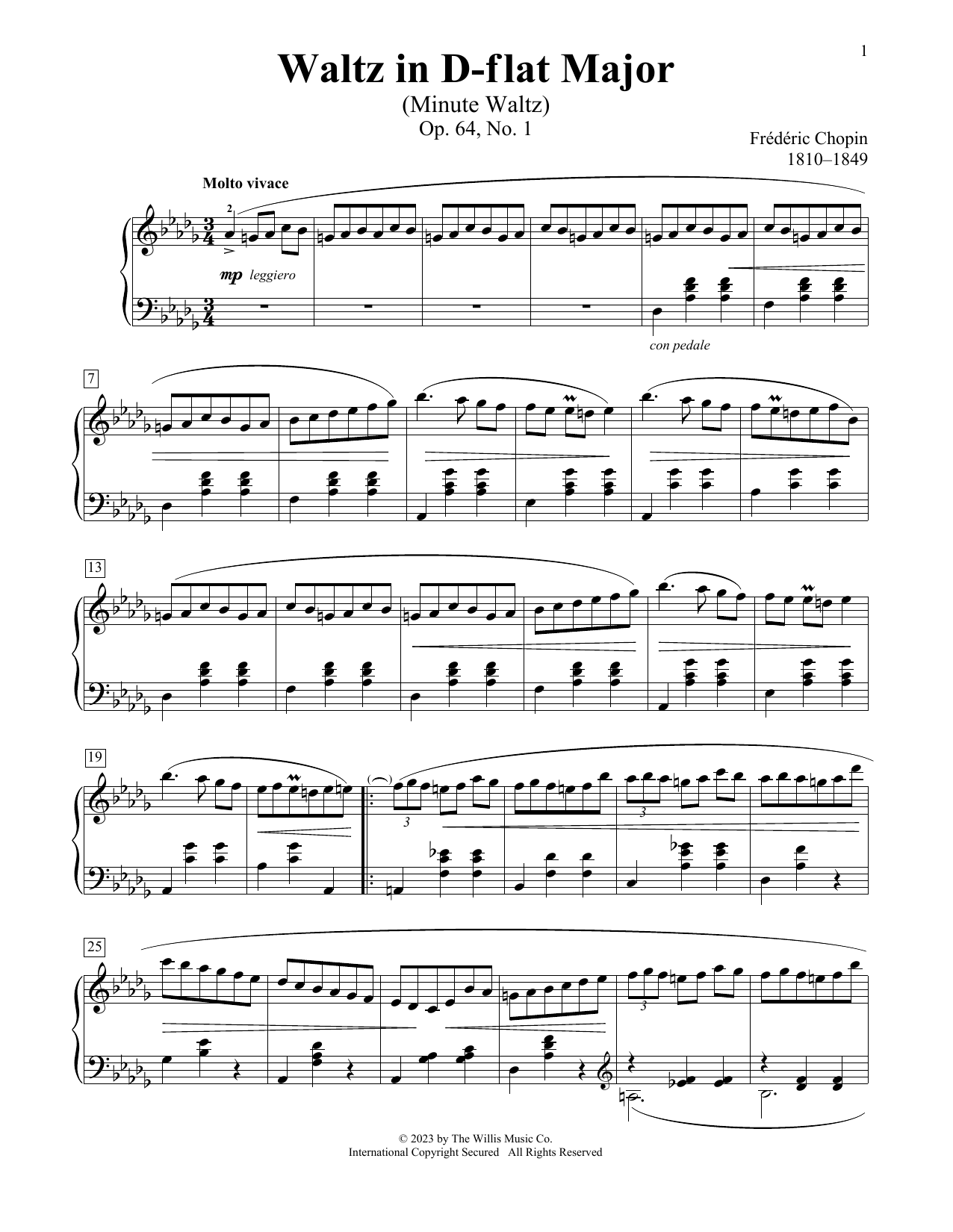
Waltz In D-Flat Major ("Minute Waltz"), Op. 64, No. 1 Sheet Music Preview

Waltz In D-Flat Major ("Minute Waltz"), Op. 64, No. 1: Educational Piano

Edited by Charmaine Siagian / Edited by Sonya Schumann

Item: 35-DS01340316

Digital Download
$4.99
One moment…
Description

Discover MakeMusic Cloud: thousands of interactive titles your students can play along with today.

Sample Audio
No sample audio found.
Sample Video
Additional Details
Publisher: Hal Leonard
Page Count: 4
SKU: 35-DS01340316

More about this title

About the Creator: Frédéric Chopin

Frédéric Chopin (1810–1849) was a Polish composer and virtuoso pianist whose music fundamentally shaped the Romantic era. His output, though modest in volume, revolutionized what the piano could express; he wrote almost exclusively for the instrument, understanding its mechanics and emotional palette with unmatched intimacy.

Chopin's twenty-one waltzes span his entire compositional life and reveal his gift for wedding aristocratic elegance with profound lyricism. The Op. 64 set, published in 1856 after his death, contains some of his most performed work, balancing technical sparkle with emotional depth that feels both effortless and inevitable.

Why we love this

Students encounter this waltz as a genuine stepping stone into Romantic repertoire, not a simplification. The piece demands musical maturity—control of rubato, sensitive voicing, and the ability to make quick passages sing—while remaining accessible at the intermediate level.

What to expect

Elegant and intimate rather than grand. The piece moves with the lightness of a parlor dance, yet its harmonic sophistication and delicate ornamentation whisper of deeper feeling. There is grace in simplicity here, and charm without sentimentality.

Who it's for

Intermediate pianists seeking their first genuine Chopin encounter will find this manageable yet substantial. Advanced early-stage students benefit from its technical and interpretive demands, and teachers value it as a bridge between pedagogical repertoire and concert material.

How to get the most out of it

  • Shape each phrase toward its harmonic goal rather than metrically. The waltz rhythm can become mechanical; listening past the three beats to the longer melodic arc prevents this.
  • Balance the accompaniment with restraint. Left-hand figures should anchor the dance without overwhelming the melody's gossamer quality.
  • Commit to a tempo and trust it. Constant fluctuation undermines the waltz's essential character; subtle rubato within a steady pulse serves the music better.

How to use it

This waltz fits naturally in student recitals at the late intermediate level, offering a crowd-pleasing alternative to the usual Baroque or early Classical selections. It also pairs beautifully with other Romantic piano works in a thematic concert, giving students exposure to a composer who deserves more presence in educational settings.

Skills your students will build

  • Controlling rubato within a steady harmonic framework
  • Balancing melody against an accompaniment pattern
  • Executing quick scalar passages with clarity and independence of hands
  • Interpreting Romantic-era expressive markings and articulations
  • Managing the technical demands of rapid hand position shifts

You May Also Like