
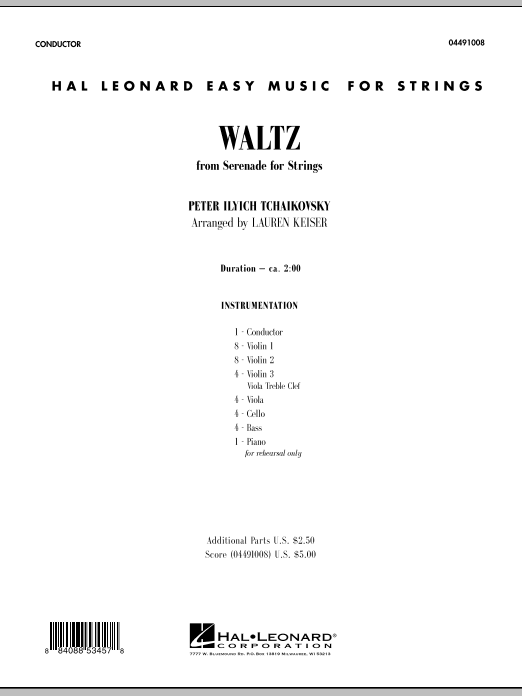

Waltz (from Serenade For Strings): String Orchestra Conductor Score & Parts
By Pyotr Il'yich Tchaikovsky / Arranged by Lauren Keiser
Grade: 2
Item: 35-PK00159080
$40.00
Pickup currently not available
Buy Extra Parts (Digital PDF Download)
Parts Added to Cart!
Description
Taken from the second movement of the "Serenade" (and similar to the minuets of his idol, Mozart), Tchaikovsky's "Valse" also resembles many of his own ballet movements. Lauren Keiser's skilled adaptation is designed for teaching this important style and genre to young players. Dur: 2:00


Waltz (from Serenade For Strings): String Orchestra Conductor Score & Parts isn't in MakeMusic Cloud just yet...but it could be. Let us know you'd like to see it, and you'll help shape what comes next. In the meantime, start a free trial and dive into thousands of interactive titles your students can play along with today.
Request This Title
Tell us you want it.
Start Your Free Trial
Explore everything that's ready to play right now.
Sample Audio
No sample audio found.
Sample Video
No sample videos found.
Additional Details
Publisher:
Hal Leonard
SKU:
35-PK00159080
More about this title
About the Composer: Pyotr Il'yich Tchaikovsky
Tchaikovsky stands as one of the most performed composers in the orchestral canon, and for good reason. His gift for melody and his mastery of orchestration made him a bridge figure between Romantic excess and Classical form, earning him deep admiration from musicians across generations. His ballets—Swan Lake, The Nutcracker, and Sleeping Beauty—remain cornerstones of the dance world, while his orchestral works continue to captivate audiences and inspire young musicians.
For string players specifically, Tchaikovsky's writing is revelatory. He understood the expressive capabilities of the violin, viola, and cello with uncommon intimacy, crafting passages that sing naturally under the bow. His Serenade for Strings remains one of the most beloved pieces in the string repertoire, and this movement in particular offers young orchestras a chance to experience authentic Romantic style while building real musical maturity.
Why we love this
Keiser's arrangement strips away the opulence without losing the lyricism, making this accessible for Grade 2 ensembles while preserving the character that makes Tchaikovsky essential listening. You get genuine Romantic style in a package your section leaders can actually execute, which means your students experience real success with real repertoire rather than a watered-down approximation.
What to expect
Elegant and unhurried, with the kind of flowing lyricism that makes young musicians feel like they're playing something that matters. The waltz rhythm imparts lightness and grace, while the harmonic language creates moments of genuine tenderness that linger even after the final note.
Who it's for
Grade 2 string orchestras ready to explore Romantic style with conviction. Directors seeking a bridge between simple pedagogical arrangements and genuine artistic repertoire will find this invaluable for building musicianship and ensemble culture.
How to get the most out of it
- Shape the melody with a clear, singing tone throughout; resist the temptation to rush the waltz rhythm even slightly. A relaxed, lilting pulse serves the music far better than precision alone.
- Balance the parts carefully in measures where the accompaniment supports a counter-melody. The inner voices shouldn't disappear, but they shouldn't compete with the primary line either.
- Let the vibrato bloom naturally on sustained notes, particularly at phrase endings. This piece rewards warmth and resonance in ways that straighter playing cannot achieve.
- Listen across sections as the harmony shifts. Young orchestras often lose awareness of how the harmonic motion unfolds when they focus too narrowly on their individual parts.
How to use it
Program this as a centerpiece for a Classical or Romantic-era concert, where it can sit comfortably alongside lighter Mozart or anchor a longer Tchaikovsky focus. The two-minute duration makes it ideal for young musician showcases or as the thoughtful interlude in a mixed concert program.
Skills your students will build
- Singing phrasing and lyrical bow control in Romantic style
- Waltz rhythm and pulse awareness
- Balancing melody and accompaniment roles within a homophonic texture
- Dynamic shaping across full phrases rather than measure-to-measure
- Vibrato as a musical tool, not a technical afterthought