Waltz for Izabela Sheet Music Preview

Waltz for Izabela: Piano

By Ezra Donner

Level: Intermediate

Item: 00-PS-0017761

Digital Download
$5.99
Description
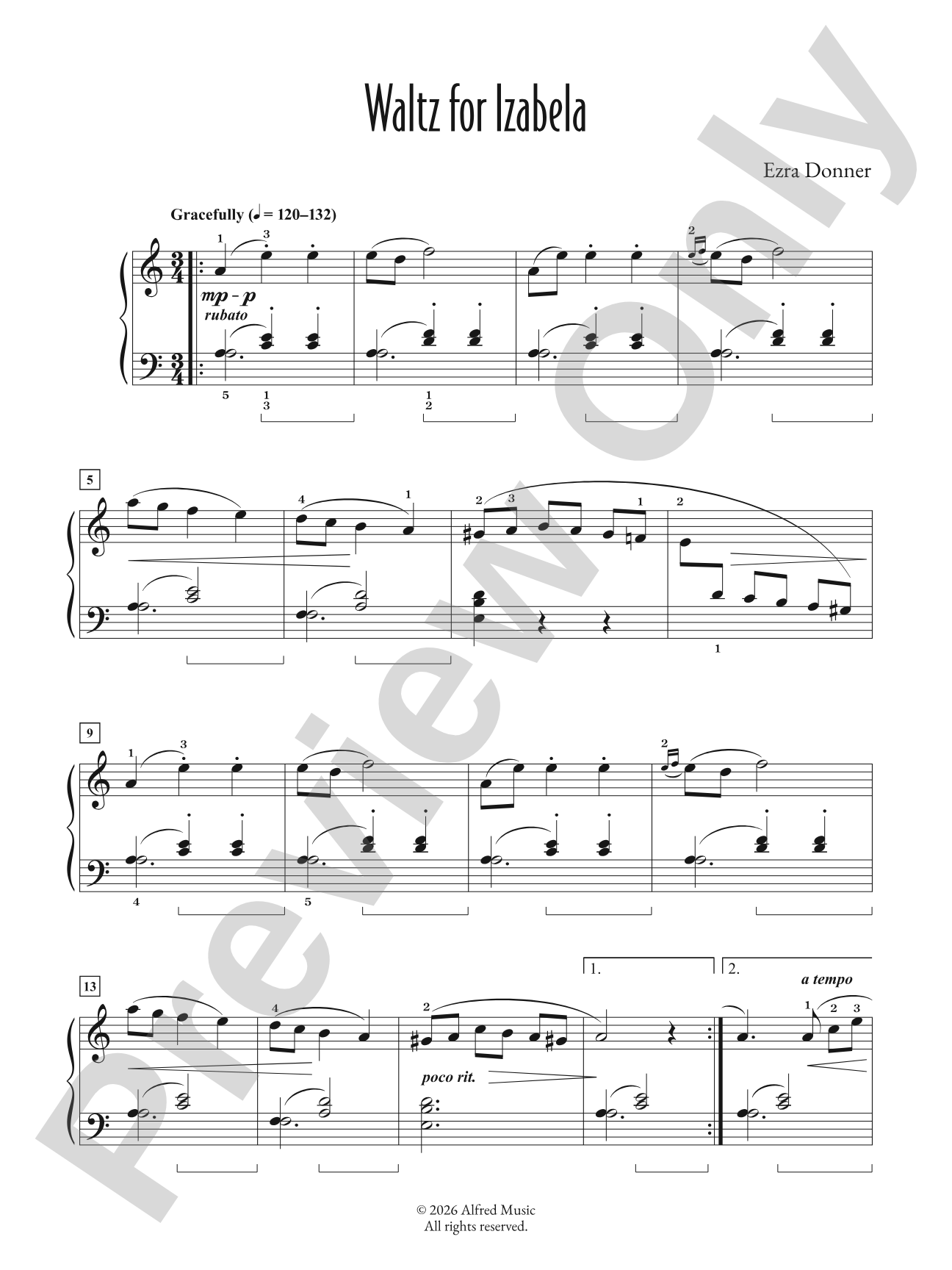
This melancholic waltz unfolds with a lyrical, longing melody reminiscent of Chopin. Grace-note figures delicately ornament the theme while flowing scale passages provide elegant motion within the A section before a hopeful contrasting middle section.

Waltz for Izabela: Piano isn't in MakeMusic Cloud just yet...but it could be. Let us know you'd like to see it, and you'll help shape what comes next. In the meantime, start a free trial and dive into thousands of interactive titles your students can play along with today.

Sample Audio
0:00
0:00
Sample Video
Additional Details
Series: Signature Series
SKU: 00-PS-0017761

More about this title

About the Composer: Ezra Donner

Ezra Donner

Ezra Donner left Buffalo at sixteen to build a life in music, a commitment that has taken him across North America and Europe as a composer, performer, conductor, and teacher. His catalog spans roughly 100 works for solo piano, chamber and orchestral ensembles, and theatrical works, with performances by ensembles including the Chamber Orchestra of New York, New Voices Opera, and Pittsburgh Camerata, plus solo recitals at venues such as Carnegie Hall.

Beyond composition, Donner has held conducting positions with the University of Michigan Gilbert and Sullivan Society (2015-2024), Horizon Performing Arts (since 2025), and various church and festival roles. He has received recognition from The American Prize Competition, the Respighi Prize Competition, and the G. Gershwin International Music Competition. His creative reach extends to visual art as well; he has produced over 250 drawings and paintings and maintains an active presence sharing recordings of his work on YouTube.

Why we love this

Donner writes in a language that honors Romantic sensibility without pastiche. The piece captures genuine longing through specific compositional choices: grace notes that feel integral to the melody rather than decorative, scale passages that propel the harmony forward rather than merely fill space, and a middle section that offers real emotional contrast rather than formulaic relief. Pianists at the intermediate level rarely encounter waltzes this musically substantial.

What to expect

A waltz suffused with yearning, the kind that seems to look backward even as it moves forward. The melody unfolds with the grace and vulnerability of a confession, ornamented by delicate flourishes that catch the light, while the supporting passages flow like water finding its path. When the middle section arrives, there is a momentary warmth, a suggestion of hope, before the piece returns to its wistful character.

Who it's for

Intermediate pianists who are comfortable with Romantic idioms and ready to move beyond studies into repertoire that rewards musical interpretation. This piece serves students who have solid technique but are developing the expressive maturity to inhabit a character and sustain a lyrical line.

How to get the most out of it

  • Allow the grace notes to breathe as part of the melodic shape, not as quick ornaments squeezed in before the beat. They shape the phrase's emotional arc.
  • Shape the scale passages in the A section with gentle dynamic swells that mirror the overall contour of each phrase, keeping the motion elegant rather than mechanical.
  • Bring out the hopeful quality of the middle section through lighter voicing and a slight lift in tempo or character, creating genuine contrast with the opening's melancholy.
  • Pedal thoughtfully through the flowing figuration to maintain clarity; change the pedal with the harmony rather than sustaining indiscriminately through the waltz rhythm.

How to use it

Program this as a centerpiece in a recital of Romantic or contemporary Romantic-influenced works, or pair it with other character pieces by Donner or his contemporaries to showcase a unified aesthetic. It works equally well as the lyrical anchor in a mixed-era program, offering contrast to more dramatic or technically virtuosic pieces and giving audiences a moment of reflection.

Skills your students will build

  • Pedaling for resonance and clarity in Romantic-style figuration
  • Shaping scalar passages and flowing accompaniment patterns with musical direction
  • Interpreting grace notes as expressive gestures rather than technical ornaments
  • Sustaining a legato melodic line while managing a flowing accompaniment in waltz time
  • Creating tonal contrast between sections to deepen emotional narrative

You May Also Like