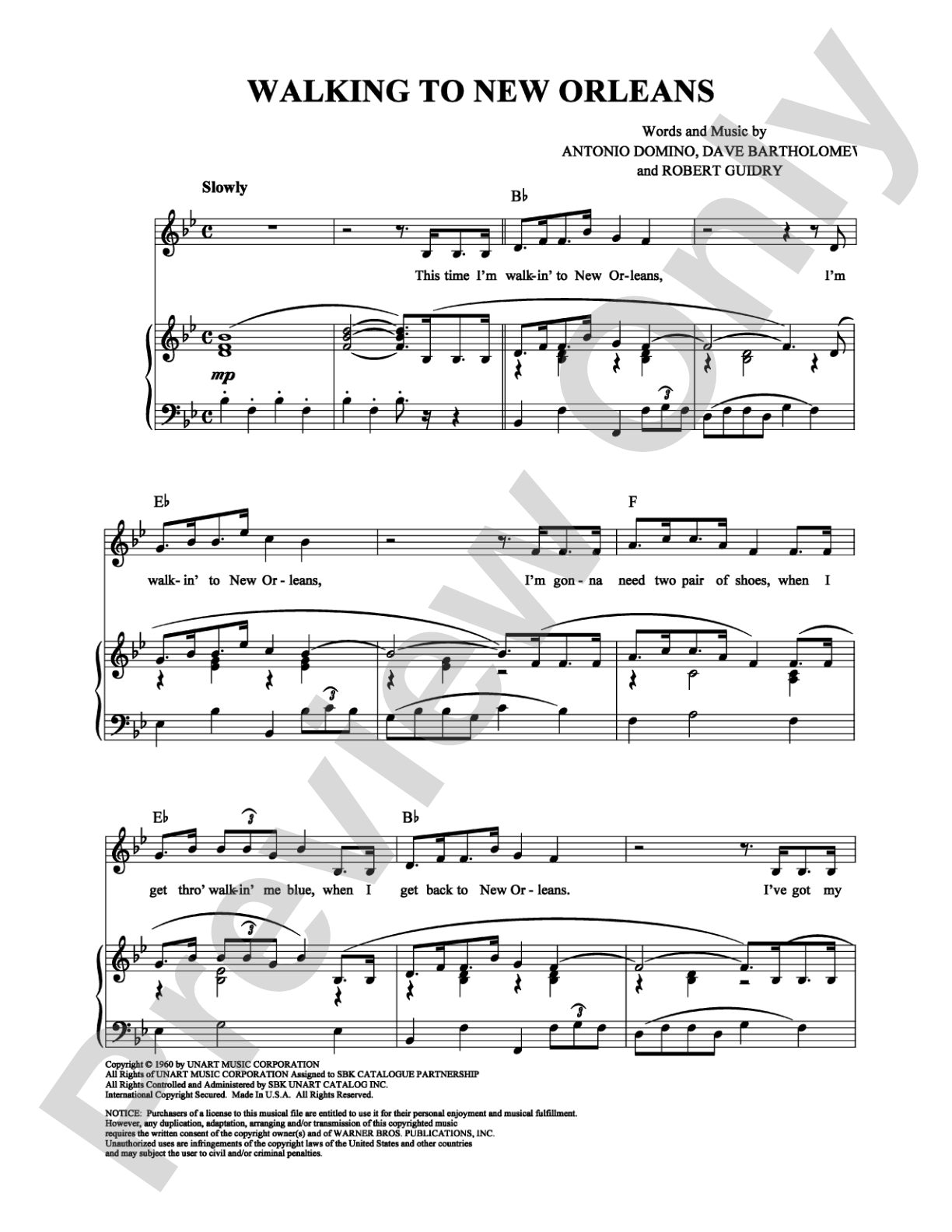
Walking to New Orleans: Piano/Vocal/Chords Digital Sheet Music

Walking to New Orleans: Piano/Vocal/Chords Digital Sheet Music

Fats Domino, Dave Bartholomew, Robert Guidry

Item: 00-PS-0010187

Digital Download
$2.95
Description

Walking to New Orleans: Piano/Vocal/Chords Digital Sheet Music isn't in MakeMusic Cloud just yet...but it could be. Let us know you'd like to see it, and you'll help shape what comes next. In the meantime, start a free trial and dive into thousands of interactive titles your students can play along with today.

Sample Audio
No sample audio found.
Sample Video
Additional Details
SKU: 00-PS-0010187

More about this title

About the Artist: Fats Domino

Antoine Dominique Domino Jr. (1928-2017) shaped the sound of early rock and roll by blending rhythm and blues with infectious piano grooves and a warm, accessible vocal style. His recording career spanned from the late 1940s through the 1960s, producing dozens of hits that made him one of the best-selling artists of the rock and roll era and a foundational influence on popular music.

For music educators, Fats Domino's catalog offers direct access to authentic rock and roll history. His songs demonstrate how strong melodic writing, rhythmic clarity, and straightforward chord structures can drive songs that lasted generations. Teachers and pianists return to his work to study how a skilled piano player can anchor a recording and lead a band with groove rather than flash.

Why we love this

This is genuine American rock and roll, grounded in boogie-woogie piano and a melody that sits comfortably in the middle of the voice. Singers appreciate how the rhythm drives naturally once you lock into the swing, and pianists get to play actual piano figures that echo what made Domino's recordings work rather than simplified vocal line accompaniments.

What to expect

Walking to New Orleans has the warmth and ease of a late-night jam session. The melody sits in a sweet spot that lets singers focus on feel and phrasing rather than range, while the piano figures suggest movement and destination. There's joy here without any pretense.

Who it's for

Singers and pianists performing duets or in small ensembles will find a straightforward, rewarding piece that teaches interpretation within a strong groove. Solo pianists can use this as a study in how to play a vocal melody while maintaining the character and rhythm that makes the song work. It works equally well for recitals, community performances, or rehearsals where authentic American roots music matters.

How to get the most out of it

  • Keep the piano groove steady and slightly laid-back; the rhythm should float rather than push. This style lives in the pocket, not on top of the beat.
  • Let the vocal melody breathe over the chord changes instead of rushing through phrases. Fats Domino's phrasing was conversational and unhurried.
  • Use chord voicings that suggest the bluesy, gospel-inflected harmony typical of early rock and roll; don't flatten it into pure pop neutrality.
  • Lock the left hand of the piano into a consistent rhythmic pattern that supports the vocal without competing for attention in the same register.

How to use it

Program this alongside other classic rock and roll standards from the 1950s to make clear the piano-driven origins of the genre. It pairs naturally with vocal recitals that emphasize American songwriting, or with jazz and popular music ensembles exploring the roots of modern styles. Pianists can use it as a bridge piece that connects boogie-woogie technique to contemporary accompaniment.

Skills your students will build

  • Reading chord symbols and realizing voicings in a blues and rock and roll harmonic context
  • Maintaining a steady groove while accompanying a melody line
  • Phrasing a vocal melody over a rhythmic accompaniment without rushing or dragging
  • Understanding swing feel and laid-back timing in the rock and roll tradition
  • Playing left-hand patterns that support rather than overshadow the vocal part

You May Also Like