Walking on Air - Piano Duo (2 Pianos, 4 Hands) Sheet Music Preview

Walking on Air - Piano Duo (2 Pianos, 4 Hands): Piano Duets & Four Hands

By Robert D. Vandall

Level: Late Elementary

Item: 00-PB-0000797

Digital Download
$5.95
Description
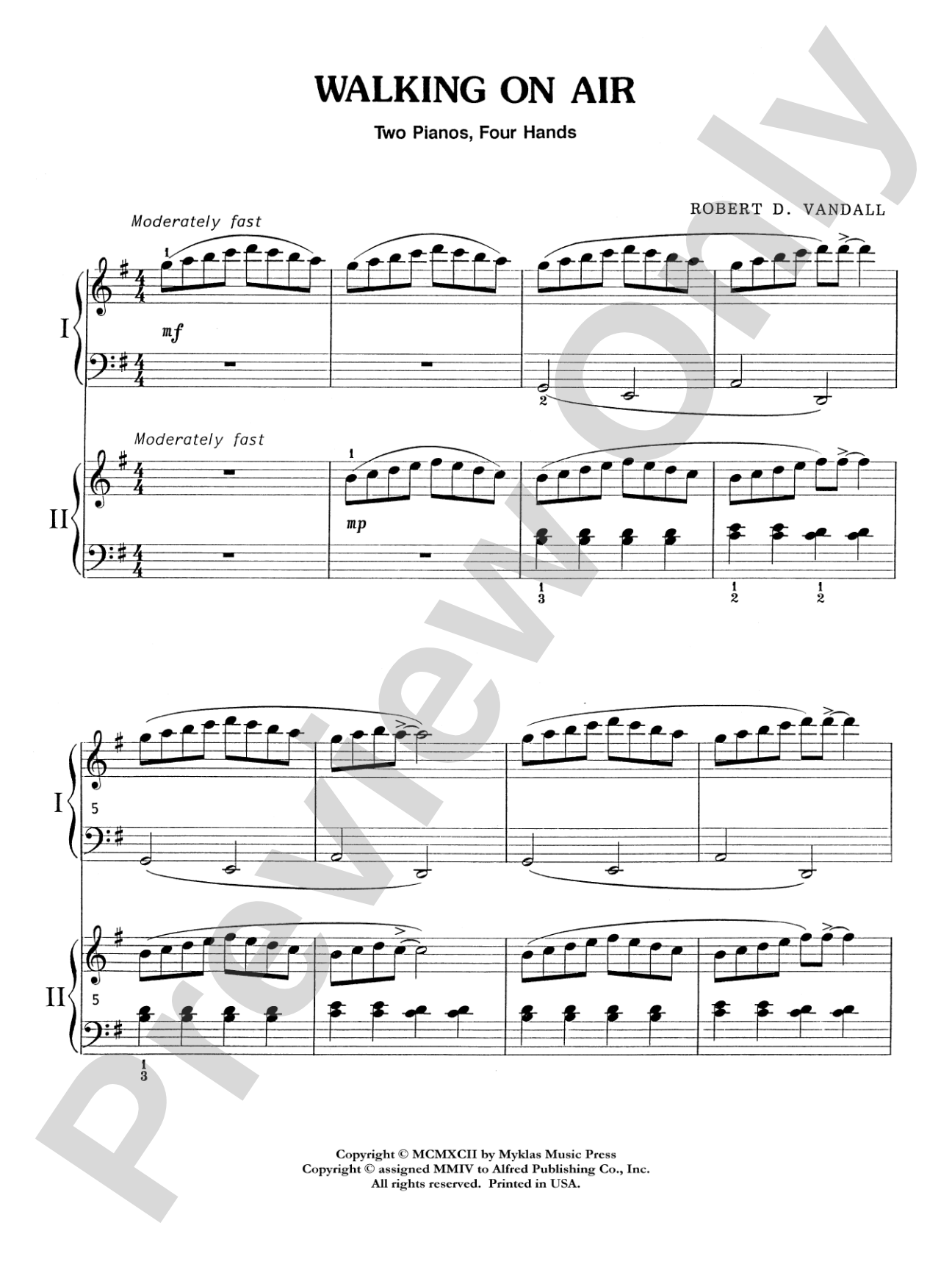
Moderately fast five-finger passages are predominant in this late elementary piano ensemble---two pianos, four hands. In ABA form, the piece begins in G major and modulates to C major for the rhythmically accented middle section before a return to the original key. Two copies are included. A Federation Festivals 2024-2028 selection.

Walking on Air - Piano Duo (2 Pianos, 4 Hands): Piano Duets & Four Hands isn't in MakeMusic Cloud just yet...but it could be. Let us know you'd like to see it, and you'll help shape what comes next. In the meantime, start a free trial and dive into thousands of interactive titles your students can play along with today.

Sample Audio
No sample audio found.
Sample Video
Additional Details
Series: The Myklas Ensemble Series
Publisher: Alfred Music
Page Count: 8
SKU: 00-PB-0000797

More about this title

About the Composer: Robert D. Vandall

Robert D. Vandall is a prolific composer and arranger whose catalogue spans nearly five decades of piano literature for students and teachers. Known for writing music that balances technical accessibility with genuine musical substance, Vandall has contributed significantly to festival repertoire and ensemble collections across all levels.

Why we love this

Vandall captures the special energy of two pianists working together without demanding synchronized precision that derails younger students. The modulation to C major reinvigorates the middle section rhythmically, giving both players a distinct character to perform before returning home, which creates natural points for ensemble awareness to develop.

What to expect

Walking on Air captures a lightness of touch and forward momentum that feels buoyant and assured. The five-finger writing sits comfortably under the hands, while the key modulation and rhythmic accents in the middle section inject harmonic color and energy without demanding leaps or complicated voicing.

Who it's for

Two late elementary pianists preparing for festival performance or looking to expand their duet repertoire with music that builds both musicality and ensemble skills. Students at this level gain confidence performing alongside a peer while navigating moderate tempo and straightforward rhythmic figures.

How to get the most out of it

  • Map out the key centers together before rehearsal. Both players benefit from hearing how G major feels distinct from C major, which helps anchor the form aurally and prevents drifting during the transition.
  • Balance the five-finger passages by listening across the two pianos rather than playing into your own instrument. The texture works best when both players hear themselves as part of a single ensemble sound.
  • Let the rhythmic accents in the middle section breathe. These gestures define the B section's character, so emphasize them without rushing; they anchor the tempo and guide your partner.

How to use it

Feature this as a festival entry or spring recital selection where it can stand alongside other duet works at the same level. Its ABA structure and moderate length make it work well in a program of early ensemble pieces that showcase student partnerships.

Skills your students will build

  • Reading and performing in two different major keys (G major and C major) within one piece
  • Listening to a partner while maintaining independence as a separate piano line
  • Maintaining rhythmic independence in five-finger passages while following ensemble tempo
  • Recognizing and executing harmonic modulation through performance
  • Responding to rhythmic accents as compositional markers of form

You May Also Like