
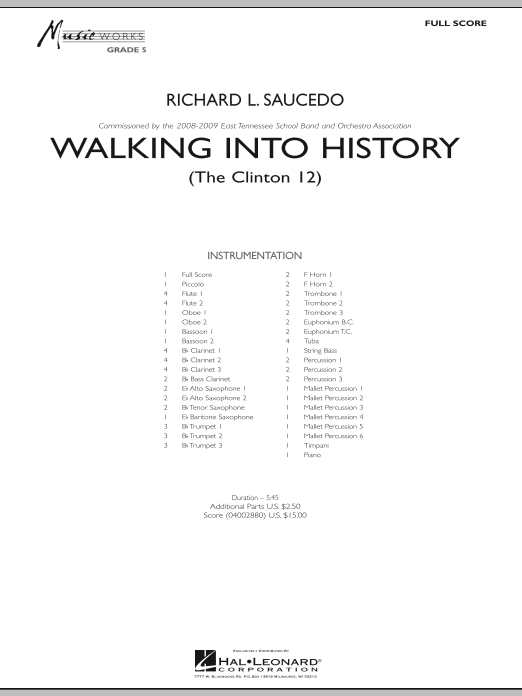

Walking into History (The Clinton 12): Concert Band Conductor Score & Parts
By Richard Saucedo
Grade: 5
Item: 35-PK00126874
$95.00
Pickup currently not available
Buy Extra Parts (Digital PDF Download)
Parts Added to Cart!
Description
In August 1956, Clinton, Tennessee was the the site of one of the most significant events of the American Civil Rights movement as 12 courageous teenagers walked into history becoming the first students to desegregate a state-supported high school in the south. Commissioned by the East Tennessee School Band and Orchestra Association, Richard Saucedo captures the mood of this monumental event along with its sense of anger and frustration, but also with feelings of hope and determination as the nation struggles to defeat bigotry and fear. Dur: 5:45 (Grade 5)


Walking into History (The Clinton 12): Concert Band Conductor Score & Parts isn't in MakeMusic Cloud just yet...but it could be. Let us know you'd like to see it, and you'll help shape what comes next. In the meantime, start a free trial and dive into thousands of interactive titles your students can play along with today.
Request This Title
Tell us you want it.
Start Your Free Trial
Explore everything that's ready to play right now.
Sample Audio
No sample audio found.
Sample Video
No sample videos found.
Additional Details
Publisher:
Hal Leonard
SKU:
35-PK00126874
More about this title
About the Composer: Richard Saucedo
Richard Saucedo is a composer and educator whose works engage students with meaningful historical narratives and contemporary social themes. His commissions for school ensembles consistently balance accessibility with musical substance, creating pieces that challenge young musicians while remaining performable at the intended grade level.
Why we love this
Saucedo refuses sentimentality here, instead building a score that mirrors the actual emotional complexity of that August morning in Clinton. The piece captures anger and fear without wallowing in them, making space for the quiet dignity and resolve that defined those twelve students. This is concert band repertoire that trusts your students to handle real history.
What to expect
The music moves between moments of anxious energy and passages of quiet resolve, capturing both the weight of the moment and the courage required to face it. Dissonance and chromatic movement underscore the tension, while soaring melodic lines emerge to suggest hope pushing through fear.
Who it's for
Grade 5 bands ready to tackle repertoire that combines technical demands with historical significance. This works equally well for ensembles building their fall concert or preparing a program centered on American history and social justice themes.
How to get the most out of it
- Balance the contrasting sections carefully; the music shifts between agitation and moments of quiet conviction, and each needs its own tonal identity to avoid the piece feeling monotonous.
- Give attention to the low brass and woodwind foundation in the slower passages. These underpinnings often carry the emotional weight when the upper voices thin out.
- Research the specific historical context with your ensemble before rehearsals begin. Players perform with more conviction when they understand what they're expressing.
- The 5:45 length allows for minimal cuts if you're programming a full concert. Resisting the urge to trim reinforces the composer's structural intention.
How to use it
Program this alongside other works that explore resilience or pivotal historical moments. The five-minute length fits naturally into a thematic concert without requiring pairing with lighter material for balance, though thoughtful sequencing with other meaningful repertoire deepens the impact.
Skills your students will build
- Interpreting emotional and historical subtext within a musical score
- Balancing contrasting tonal colors across sustained sections
- Executing chromatic voice leading and dissonance with precision
- Phrasing longer melodic lines without losing shape over multiple systems
- Ensemble blend across dynamic changes that shift the textural center