
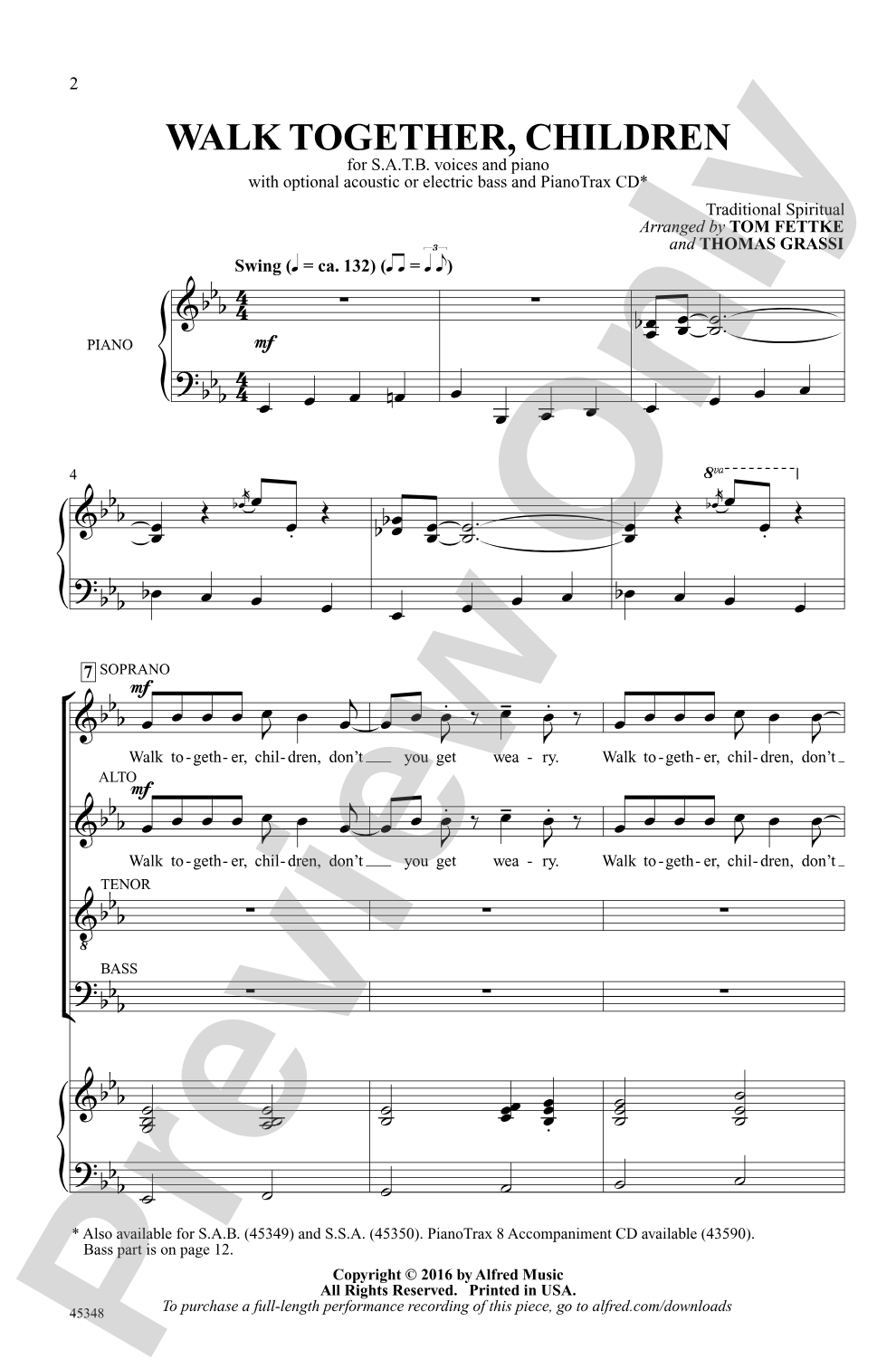
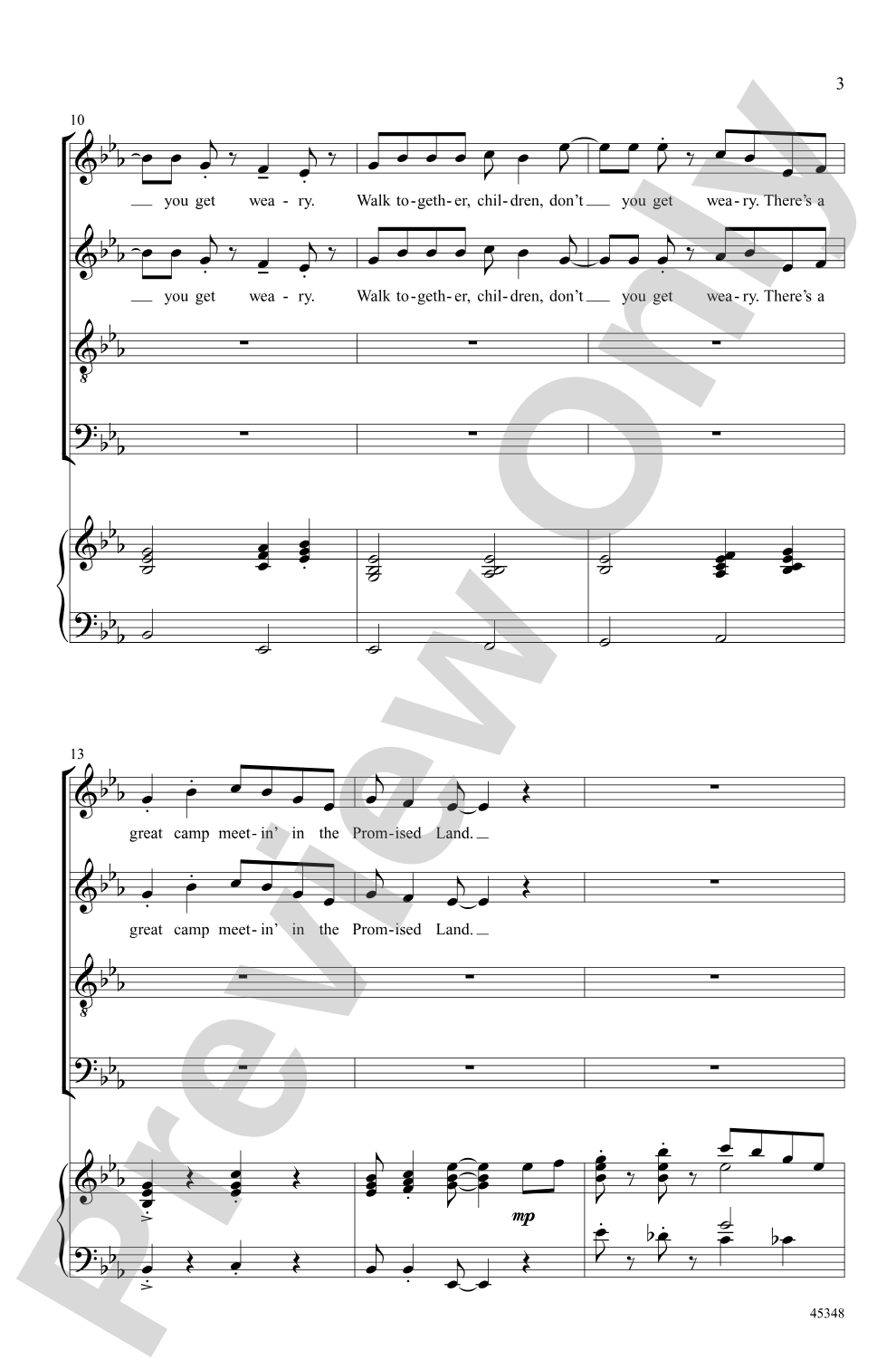
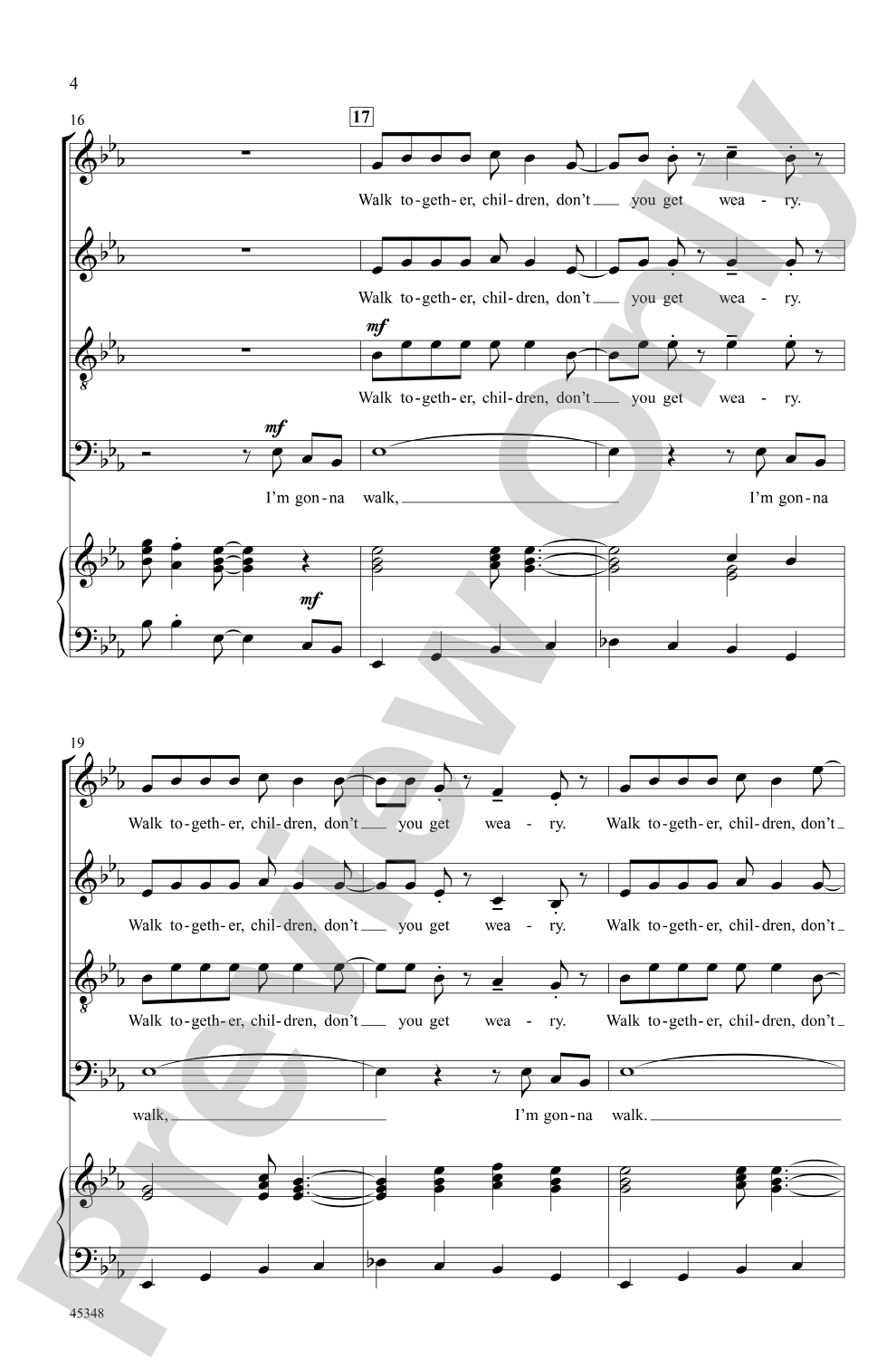

Walk Together, Children: SATB Choral Octavo
Traditional Spiritual / arr. Tom Fettke and Thomas Grassi
Item: 00-PO-0003607
$1.90
Minimum order quantity: 20 copies
Pickup currently not available
Related Items
Walk Together, Children: PianoTrax Digital Download |
$9.99
|
View | |
Walk TogTether, Children: SAB Choral Octavo |
$1.90
|
View | |
Walk Together, Children: SSA Choral Octavo |
$1.90
|
View | |
Walk Together, Children: SATB Choral Octavo |
$1.90
|
View | |
Walk Together, Children: SAB Choral Octavo |
$1.90
|
View | |
Walk Together, Children: SSA Choral Octavo |
$1.90
|
View |
Description
A walking bass line, built on the blues scale, hints at jazz in the introduction of this fantastically fun arrangement of the traditional spiritual. Each of three verses develops further as the piece grows to its exciting final chords. An acoustic or electric bass part is included in the publication.


Walk Together, Children: SATB Choral Octavo isn't in MakeMusic Cloud just yet...but it could be. Let us know you'd like to see it, and you'll help shape what comes next. In the meantime, start a free trial and dive into thousands of interactive titles your students can play along with today.
Request This Title
Tell us you want it.
Start Your Free Trial
Explore everything that's ready to play right now.
Sample Audio
1
Audio File
--:--
0:00
0:00
Sample Video
Additional Details
Series:
Alfred Choral Designs
Publisher:
Alfred Music
Page Count:
12
SKU:
00-PO-0003607
Instrumentation:
with Acoustic or Electric Bass
More about this title
About the Arranger: Tom Fettke
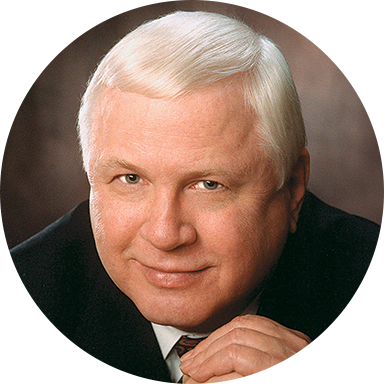
Tom Fettke has spent over five decades creating choral music for churches and schools, with hundreds of published works and recordings to his name. His compositions and arrangements have become standards in worship and educational settings; The Majesty and Glory of Your Name alone continues to be performed by thousands of choirs worldwide. He holds degrees from Oakland City College and California State University at Hayward, along with a California Lifetime Music Credential in Secondary Music. His career spans decades as a vocal music teacher in California public schools, church choir director and minister of music, and director of choral activities for the Redwood Christian School System.
Fettke served as creator and senior editor of The Hymnal for Worship and Celebration, which has placed over three million copies in church pews since 1986, and as senior editor of The Celebration Hymnal, recognized as one of the most innovative ministry resources in church history. He now resides in Nashville, Tennessee with his wife Jan, and is the grandfather of nine and great-grandfather of two.
Why we love this
The walking bass line built on the blues scale gives this spiritual an unexpected rhythmic sophistication that energizes singers without overwhelming them. Each verse builds intentionally, creating a natural arc toward those exciting final chords. You get a fully realized arrangement that feels contemporary and engaging while honoring the song's roots.
What to expect
The spiritual's familiar melody meets a blues-informed harmonic language that swings gently without losing its soulful character. As the piece unfolds, the layering and development build momentum toward a satisfying, energetic conclusion.
Who it's for
This arrangement suits SATB choirs of any age or experience level who want to perform a spiritual with contemporary energy and jazz-inflected harmony. It works equally well in school choir concerts, church services, and community choral programs.
How to get the most out of it
- Keep the walking bass line steady and slightly prominent during the introduction; it's the harmonic anchor and the source of the arrangement's groove.
- Balance the SATB voices to let all four parts remain audible through the verse development, even as the texture thickens.
- Rehearse the bass part early and separately if you're using an acoustic or electric player; lock the rhythm section in place before layering the choir.
- Shape the dynamics across the three verses so each one feels like a step forward, not a repetition.
How to use it
Program this on a concert featuring spirituals, American roots music, or African American choral traditions; it pairs well with other traditional spirituals because the arrangement feels fresh without departing from the genre. The acoustic or electric bass part also makes it a natural bridge between a cappella or purely vocal programs and those that incorporate instrumental musicians.
Skills your students will build
- Singing over a walking bass line and maintaining independence from instrumental accompaniment
- Balancing multiple vocal lines in four-part texture as harmonic density increases
- Blues-scale listening and intonation in contemporary harmonic contexts
- Phrasing and dynamic shaping across repeated verses that develop in intensity