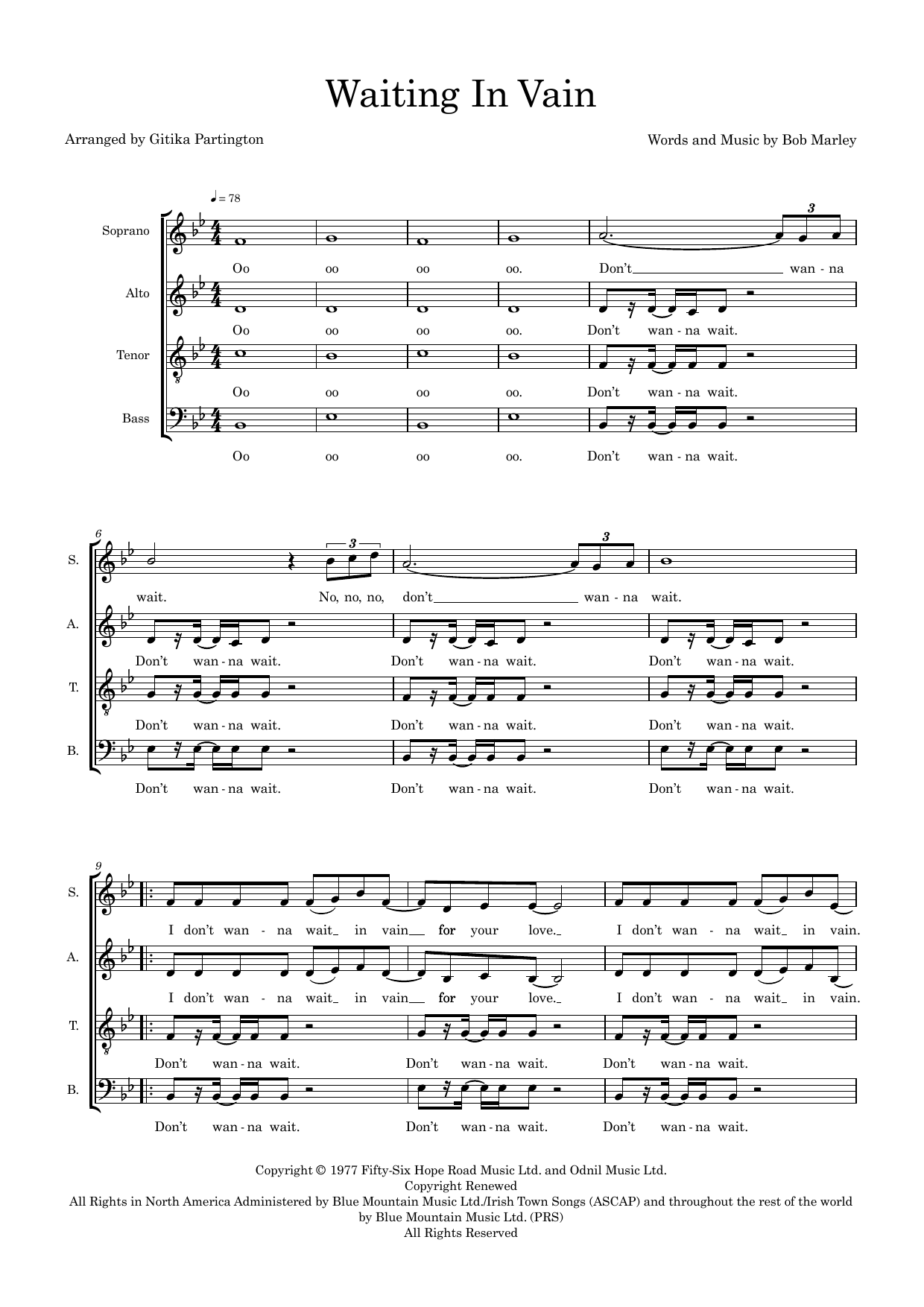
Waiting In Vain (arr. Gitika Partington) Sheet Music Preview

Waiting In Vain (arr. Gitika Partington): SSATB Choral Octavo

As performed by Bob Marley / Arranged by Gitika Partington

Item: 35-DS01080995

Digital Download
$1.99
Description

Waiting In Vain (arr. Gitika Partington): SSATB Choral Octavo isn't in MakeMusic Cloud just yet...but it could be. Let us know you'd like to see it, and you'll help shape what comes next. In the meantime, start a free trial and dive into thousands of interactive titles your students can play along with today.

Sample Audio
No sample audio found.
Sample Video
Additional Details
Publisher: Hal Leonard
Page Count: 11
SKU: 35-DS01080995

More about this title

About the Artist: Bob Marley

Bob Marley (1945-1981) stands as one of the most influential songwriters of the 20th century, whose work transcended reggae to reach global audiences across every musical idiom. His compositions are studied in music classrooms worldwide not only for their cultural significance but for their sophisticated harmonic language, lyrical economy, and ability to convey profound emotion through deceptively simple melodic structures. Marley's legacy continues to inspire arrangers who recognize that his songs possess the depth and flexibility to serve diverse educational contexts, from general music classes exploring world music to choral programs seeking material that speaks authentically to student singers.

Why we love this

Gitika Partington's arrangement honors the original's melodic grace while creating rich harmonic textures that feel organic to the song rather than imposed upon it. The SSA/SSAA voicing accommodates mixed-voice choirs at various experience levels, and the 11-page setting allows enough space for genuine musical development without overwhelming student singers. Choosing this arrangement signals to your singers that popular music deserves the same musical respect and attention to craft as any classical standard.

What to expect

The arrangement captures the bittersweet patience of the original song. It's wistful without wallowing, hopeful without being saccharine. Singers will feel the emotional weight of the lyric while discovering that harmony can deepen vulnerability rather than obscure it.

Who it's for

Choirs at the intermediate to advanced level will find this accessible without being elementary. It works equally well in secular community settings, school programs seeking culturally relevant repertoire, and concert contexts where you want to stretch beyond the typical choral canon while remaining within reach of your singers.

How to get the most out of it

  • Establish the gentle, patient rhythmic pocket early in rehearsal. This song lives in restraint rather than energy; rushing the tempo or overdriving the rhythm section destroys its contemplative quality.
  • Balance the soprano and alto lines carefully during moments where they diverge. Neither voice should dominate; they're meant to complement and enhance each other's melodic contours.
  • Shape phrases around the lyrical content rather than the bar lines. Let the text breath guide where you place slight ritards and breath points, especially in passages expressing longing or resignation.
  • Encourage singers to listen across parts for harmonic resonance. When sopranos, altos, and tenors lock into chord quality together, the arrangement's beauty becomes immediately apparent to the whole ensemble.

How to use it

This works beautifully as a concert closer on a program built around themes of resilience, love, or social consciousness. It can also stand as a bridge piece between classical and contemporary music selections, demonstrating to audiences that artistry isn't confined to a particular genre or era. Consider pairing it with other reggae-influenced pieces or world music arrangements to create a thematic set.

Skills your students will build

  • Singing sustained legato lines over rhythmically active accompaniment
  • Balancing blend across three or four separate vocal lines with equal importance
  • Interpreting lyrical content to inform musical phrasing and dynamic shaping
  • Understanding reggae rhythmic feels and how they translate to choral writing

You May Also Like