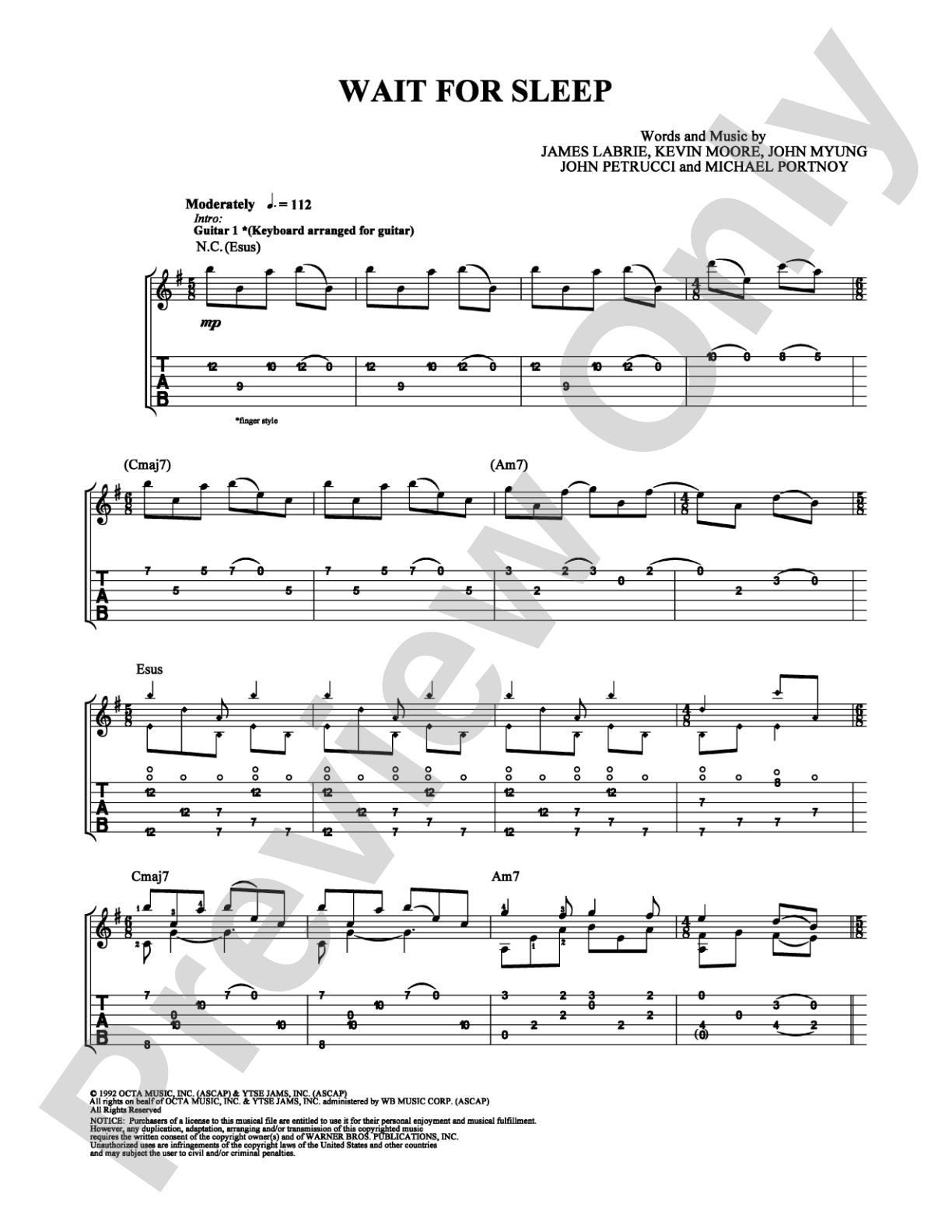
Wait For Sleep: Guitar TAB Digital Sheet Music

Wait For Sleep: Guitar TAB Digital Sheet Music

John Petrucci, Dream Theater, John Myung, Michael Portnoy, James Labrie, Kevin Moore

Item: 00-PS-0005920

Digital Download
$2.99
Description

Wait For Sleep: Guitar TAB Digital Sheet Music isn't in MakeMusic Cloud just yet...but it could be. Let us know you'd like to see it, and you'll help shape what comes next. In the meantime, start a free trial and dive into thousands of interactive titles your students can play along with today.

Sample Audio
No sample audio found.
Sample Video
Additional Details
SKU: 00-PS-0005920

More about this title

About the Artist: Dream Theater

Dream Theater emerged from the progressive metal scene in the late 1980s and have spent decades expanding the technical and compositional boundaries of rock music. Their catalog spans complex time signatures, intricate instrumental passages, and emotionally resonant songwriting that rewards careful listening and skilled execution.

For musicians and educators, Dream Theater's work represents a bridge between classical technique and contemporary rock idiom. Their arrangements demand precision, musicianship, and a willingness to sit with sophisticated harmonic language, qualities that transfer directly to any serious guitarist's development.

Why we love this

"Wait For Sleep" gives guitarists access to progressive rock composition written at a professional level, complete with the metric complexity and harmonic sophistication Dream Theater is known for. The TAB format makes this technically advanced material learnable without requiring instant fluency in standard notation, so students can focus on the guitar-specific challenges of the arrangement. It's a piece that rewards careful practice and delivers genuine musical satisfaction once the passages click into place.

What to expect

The piece unfolds with the deliberate pacing and intricate detail characteristic of Dream Theater's ballad writing. Progressive and measured, it invites you into a musical landscape that rewards close listening and patient work, building from delicate passages to fuller harmonic textures that feel earned rather than immediate.

Who it's for

This is for intermediate to advanced guitarists seeking to expand their technical and harmonic vocabulary through professional rock repertoire. Students in private lessons, guitar ensembles, or self-directed study will find a substantial challenge that models how complexity and musicality work together in contemporary composition.

How to get the most out of it

  • Study the time signature and meter changes before diving into note-for-note accuracy; knowing where the phrase boundaries land rhythmically will anchor your execution of the faster passages.
  • Use the TAB to map out fingering efficiency on each string before locking in tempo; Dream Theater's lines often reward unconventional picking angles that TAB can reveal faster than standard notation.
  • Record yourself playing along with the original recording at half speed, then gradually increase tempo; this method lets you absorb the phrasing and articulation nuances that make progressive rock playing distinctive.
  • Pay attention to dynamics and touch; even technically precise playing sounds mechanical without the dynamic shaping that Dream Theater's guitar work demands.

How to use it

"Wait For Sleep" works as a recital solo for advanced guitarists, either as a standalone showcase piece or as part of a program exploring contemporary progressive rock. It also serves well in a guitar ensemble or chamber setting if students are learning it at comparable levels, providing repertoire that illustrates how rock composition can achieve the structural sophistication of classical forms.

Skills your students will build

  • Reading and executing complex time signatures and meter changes
  • Navigating extended harmonic progressions and chord voicings specific to progressive rock
  • Fingerpicking and hybrid picking techniques for fluid melodic passages
  • Dynamics and touch control across varying registers and textures
  • Phrase architecture and pacing in longer compositional forms

You May Also Like