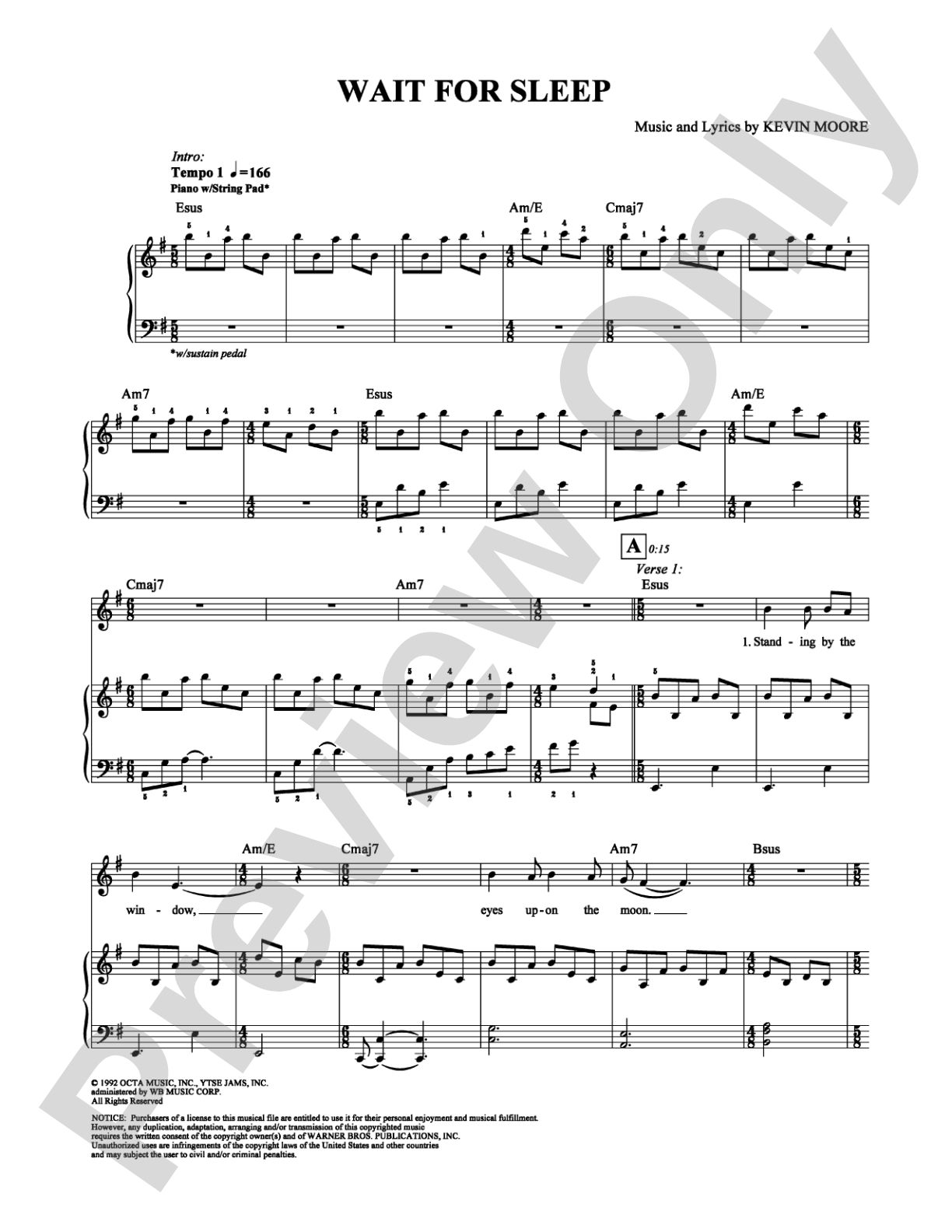
Wait For Sleep: Piano/Vocal/Chords Digital Sheet Music

Wait For Sleep: Piano/Vocal/Chords Digital Sheet Music

Dream Theater, Kevin Moore

Item: 00-PS-0003017

Digital Download
$3.99
Description

Wait For Sleep: Piano/Vocal/Chords Digital Sheet Music isn't in MakeMusic Cloud just yet...but it could be. Let us know you'd like to see it, and you'll help shape what comes next. In the meantime, start a free trial and dive into thousands of interactive titles your students can play along with today.

Sample Audio
No sample audio found.
Sample Video
Additional Details
SKU: 00-PS-0003017

More about this title

About the Artist: Dream Theater

Dream Theater emerged from the progressive metal scene in the late 1980s and has spent over three decades expanding what rock music can express. The band's virtuosity, complex arrangements, and willingness to blend genres have made them influential figures in progressive rock and metal education circles, where their work demonstrates how technical mastery and emotional storytelling can coexist.

Known for ambitious concept albums and intricate song structures, Dream Theater has attracted musicians and students across all skill levels who are drawn to their catalog as a vehicle for developing advanced playing technique and harmonic understanding. Their compositions challenge performers to navigate sophisticated time signatures, layered textures, and dynamic range.

Why we love this

This is a contemporary rock piece with genuine harmonic sophistication and emotional depth that speaks to musicians tired of simplistic pop arrangements. The piano/vocal/chords format makes it accessible for students still building technique while the song's layered production values reward careful dynamic control and interpretive musicianship. It's the kind of song that bridges mainstream appeal and genuine musical substance.

What to expect

Contemplative and introspective, with the kind of emotional directness that progressive rock often reaches for when moving away from purely instrumental complexity. The arrangement balances vulnerability with underlying instrumental sophistication, creating space for quiet reflection even within the band's characteristically dense harmonic world.

Who it's for

Pianists and vocalist pairs comfortable with contemporary rock styles and intermediate harmonic language who want to tackle an arrangement with real musical substance. Solo pianists preparing a pop-rock recital will find this a strong vehicle for showcasing both technical facility and interpretive range. Music theory students benefit from studying the chord voicings and progressions that define Dream Theater's signature sound.

How to get the most out of it

  • Map the chord changes before performance to identify transition points where the harmony shifts; this clarity prevents stumbling through unexpected progressions.
  • Balance vocal line against piano texture by listening to which elements carry the melody at each phrase; some sections may require subtle left-hand reduction to let the voice breathe.
  • Establish a steady tempo early in rehearsal, as the song's emotional arcs depend on consistent pulse even when the arrangement feels expansive.
  • Explore dynamics across the full range of the song; progressive rock pieces often build intensity gradually, so mark your soft passages as deliberately as your louder ones.

How to use it

Include this in a contemporary rock or pop-rock showcase to represent the thinking musician's approach to the genre. It works equally well as a recital piece for an intermediate pianist-vocalist pair or as a solo piano selection that demonstrates genre fluency beyond classical tradition. Consider pairing it with other progressive rock vocal pieces to highlight how the genre has influenced modern songwriting across skill levels.

Skills your students will build

  • Voice-piano balance in contemporary harmonic contexts
  • Chord voicing interpretation and reharmonization
  • Expressive dynamics across extended song forms
  • Reading and performing from chord charts
  • Emotional phrasing in minor-key progressions

You May Also Like