
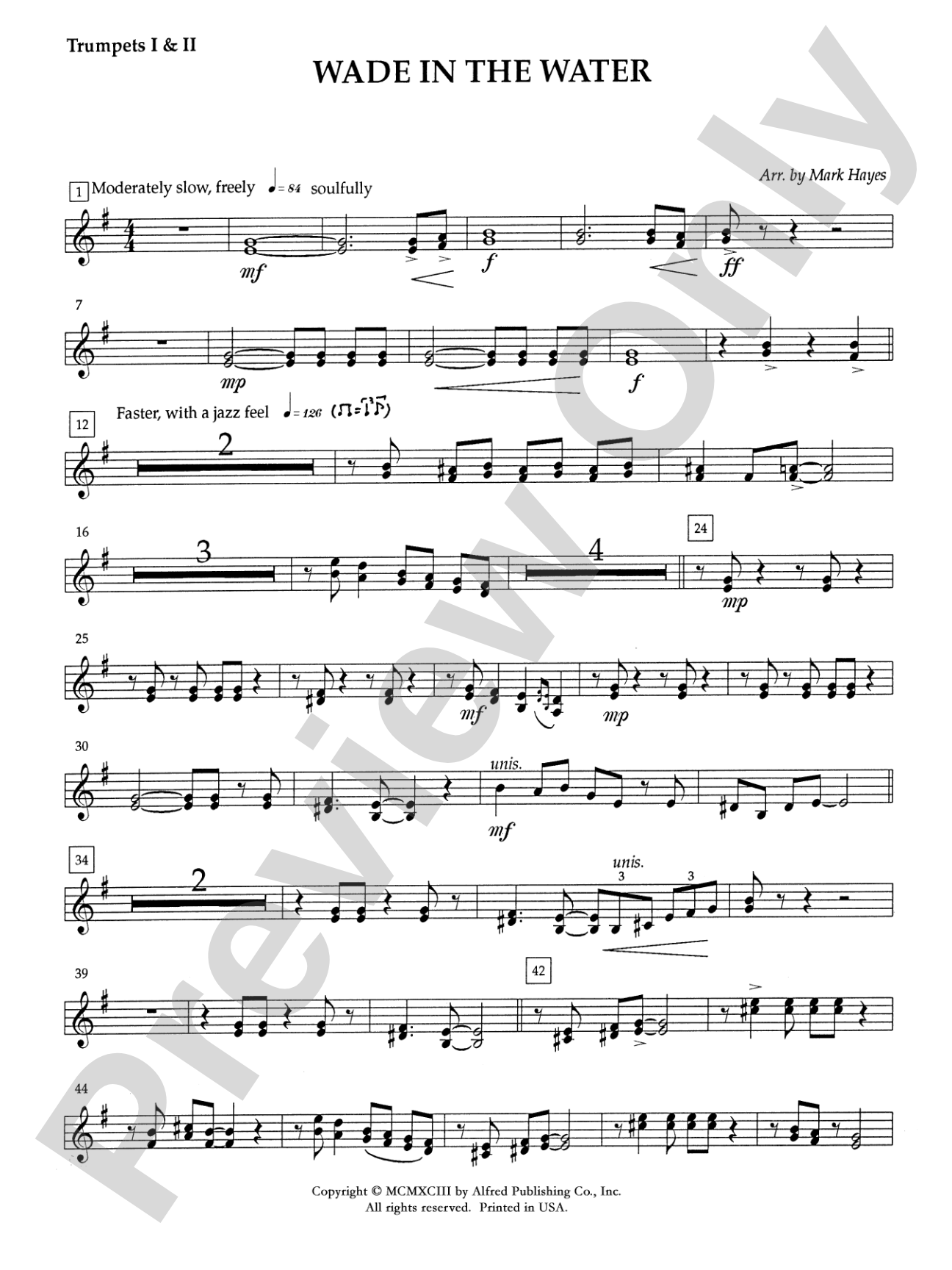

Wade in the Water: 1st B-flat Trumpet: Choral SoundPax
Traditional Spiritual / arr. Mark Hayes
Item: 00-PC-0001925_T1
$3.00
Pickup currently not available
Description
The classic arrangement returns in a new SAB voicing! This work opens with a choral fanfare-like section and progresses through several swinging sections to a climactic finish. This is Mark Hayes at his very best. Many opportunities for brief solos. And the optional instrumental accompaniment (or SoundTrax CD) is outstanding.


Don't just read it, hear it, play along with it, and watch your students grow with it. In MakeMusic Cloud, Wade in the Water: 1st B-flat Trumpet: Choral SoundPax comes alive with professional accompaniment, adjustable tempo, and built-in practice tools that turn solo practice into real progress.
Open in the Player
Jump straight in and assign it today.
Start Your Free Trial
Open this title and explore the full library in minutes.
Sample Audio
1
Audio File
--:--
0:00
0:00
Sample Video
No sample videos found.
Additional Details
Series:
Alfred Choral Designs
Publisher:
Alfred Music
Page Count:
24
SKU:
00-PC-0001925_T1
Instrumentation:
2 trumpets, tenor sax, trombone, rhythm, score
More about this title
About the Arranger: Mark Hayes
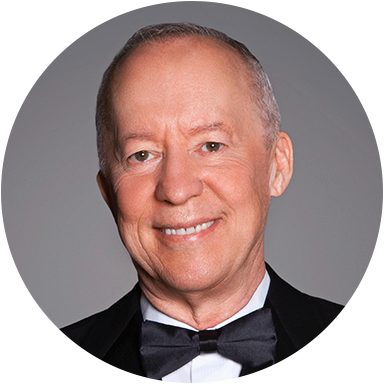
Mark Hayes has established himself as one of the most prolific voices in contemporary choral and sacred music, with over 1,750 published works across concert, liturgical, and theatrical genres. A pianist and conductor of international standing, he holds a summa cum laude degree in piano performance from Baylor University and has guest conducted at Lincoln Center, the National Cathedral, and Carnegie Hall. His sacred works, including the Te Deum, Magnificat, Gloria, and Requiem, have been performed worldwide; he conducted the Requiem's world premiere at Lincoln Center in 2013 and later presented it at St. Ignatius Basilica in Rome as part of the Vatican-sponsored Festival Pro Musica E Arte Sacra.
Beyond choral music, Hayes has composed orchestral works commissioned for major anniversaries, orchestrated musical theater productions, and written over 100 piano books spanning gospel, classical, jazz, and Broadway idioms. In 2010, Baylor University's Center for Christian Music Studies recognized him with the Award for Exemplary Leadership in Christian Music. Based in Kansas City, Missouri, Hayes continues to balance an international conducting and composing schedule with his deep commitment to creating accessible, artistic music for performers and audiences.
Why we love this
Hayes captures the spiritual energy and storytelling power of this spiritual without sacrificing musical sophistication. The SAB voicing opens the piece to broader choir ranges while the optional brass instrumentation transforms it into a fully realized concert arrangement that audiences will remember long after the final note.
What to expect
The piece unfolds with the grandeur of a spiritual transformed into a choral celebration, swinging and lyrical in turn. Opening fanfare gives way to sections of surprising grace and rhythmic drive, building toward a powerful conclusion that honors the tradition while delivering a thoroughly modern choral experience.
Who it's for
SAB choirs seeking a spiritual arrangement with genuine concert depth and flexibility. This works beautifully for high school and community choirs looking for a repertoire piece that engages audiences, accommodates soloists, and benefits from optional brass support without requiring it.
How to get the most out of it
- Balance the fanfare-like opening so the choral texture reads clearly; this is the moment to establish energy and draw the audience into the narrative arc.
- Feature the solo opportunities generously. Hayes has written brief passages that showcase individual voices and break up the full-choir sections with vulnerability and intimacy.
- If using the instrumental parts, ensure the rhythm section locks tightly; the swinging sections depend on crisp ensemble precision to land their rhythmic vitality.
- Shape the climactic finish by building dynamic intensity gradually through the preceding sections rather than jumping to full volume suddenly.
How to use it
Program this as a centerpiece on a spiritual-themed concert, or place it strategically to provide contrast against a cappella or more restrained repertoire. The optional brass adds visual and sonic excitement that can anchor a secular concert program or serve as the climactic finale in a mixed sacred-secular concert.
Skills your students will build
- Singing independently in three-part harmony while maintaining awareness of a driving rhythmic pulse
- Balancing solo and ensemble roles in the same piece
- Interpretation of swing rhythms and style-specific articulation in a choral context
- Ensemble cohesion when performing alongside optional brass accompaniment