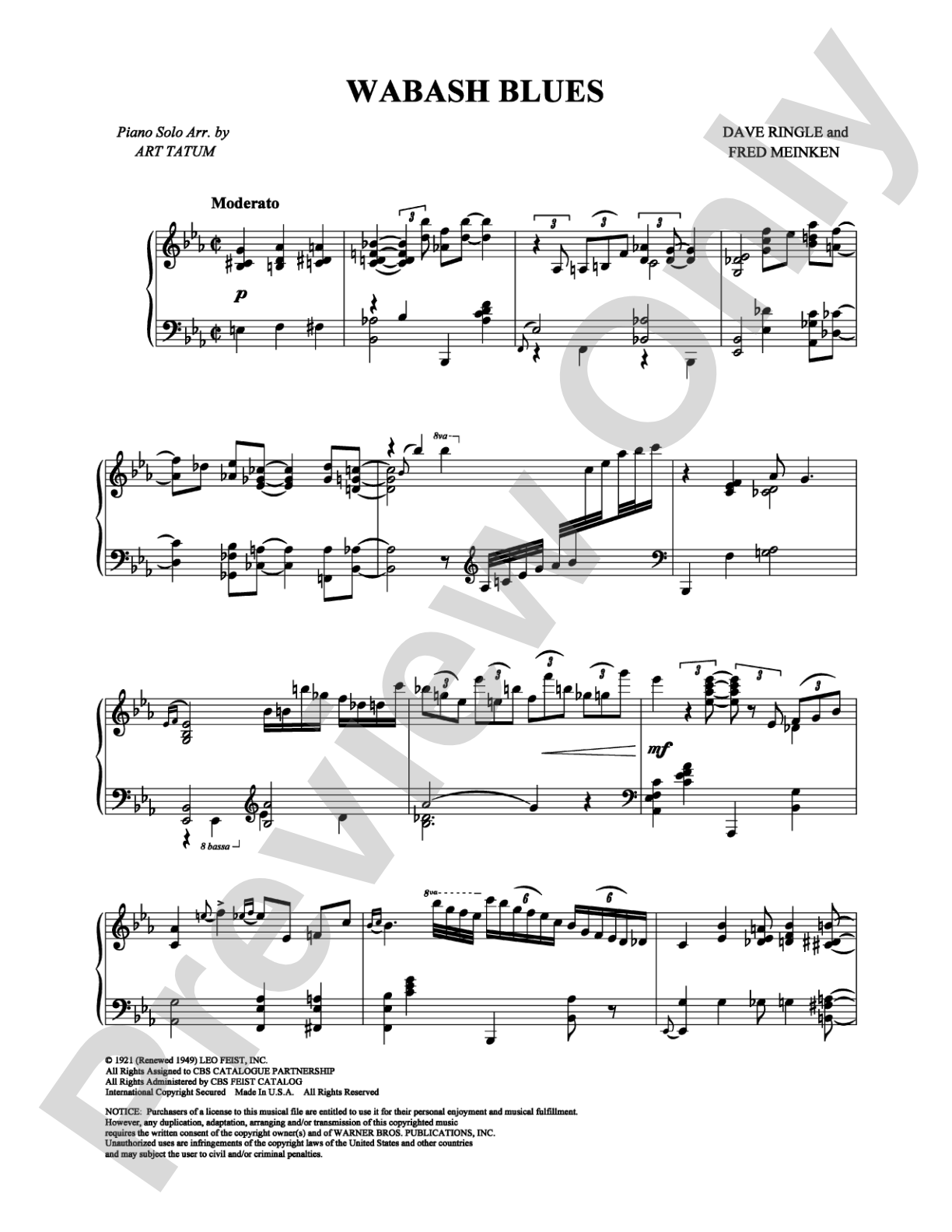
Wabash Blues: Piano Digital Sheet Music

Wabash Blues: Piano Digital Sheet Music

Art Tatum, Dave Ringle, Fred Meinken

Item: 00-PS-0009846

Digital Download
$3.99
Description

Wabash Blues: Piano Digital Sheet Music isn't in MakeMusic Cloud just yet...but it could be. Let us know you'd like to see it, and you'll help shape what comes next. In the meantime, start a free trial and dive into thousands of interactive titles your students can play along with today.

Sample Audio
No sample audio found.
Sample Video
Additional Details
SKU: 00-PS-0009846

More about this title

About the Artist: Art Tatum

Art Tatum (1909-1956) stands as one of jazz piano's most influential innovators, a virtuoso whose harmonic sophistication and technical command redefined what the instrument could express within the idiom. Largely self-taught and blind from infancy, Tatum developed a revolutionary approach to stride piano and swing that influenced generations of jazz pianists, from Oscar Peterson to Keith Jarrett. His recordings remain essential listening for anyone studying jazz piano history and remain the gold standard for understanding how classical technique and jazz sensibility intersect.

Why we love this

Tatum's interpretation of Wabash Blues showcases the stride piano tradition at its most sophisticated; his reharmonizations and improvised passages provide an authoritative model for understanding how swing-era pianists approached standard blues changes. Learning from Tatum's recorded version helps students internalize the vocabulary of jazz piano far more effectively than from simplified transcriptions, and his handling of tempo rubato and phrasing offers lessons that transfer directly to any jazz standards repertoire.

What to expect

The piece carries the relaxed swagger of classic stride blues, with Tatum's left hand providing a steady but propulsive foundation while his right hand dances through chromatic flourishes and unexpected harmonic turns. There is an underlying sense of ease and inevitability to the performance, as though these complex reharmonizations and fleet-fingered runs were the most natural way to speak the blues.

Who it's for

Advanced jazz pianists and serious students preparing for jazz standards study, competition, or recital performance will benefit most from engaging directly with Tatum's arrangement. Teachers introducing jazz history and transcription work will find this a rich text for analysis and discussion around harmonic language, stride technique, and swing interpretation.

How to get the most out of it

  • Study the recorded performance alongside the score to absorb Tatum's phrasing and tempo flexibility; his rubato and space between phrases are essential elements of his interpretation, not notational details.
  • Work the left-hand stride patterns in isolation at a slow tempo before attempting to lock them with the right-hand melody and harmonic embellishments.
  • Pay close attention to Tatum's reharmonization choices throughout; they demonstrate how to navigate blues changes with chromatic passing chords and upper extensions while maintaining clarity of line.
  • Allow room for the improvisational character of the performance; Tatum's interpretation serves as a foundation, not a rigid blueprint.

How to use it

Feature this on a recital program as a solo centerpiece demonstrating jazz piano mastery, or pair it with other Tatum interpretations of standards to show how a single artist approaches multiple compositions. It also serves as powerful supplementary material in a jazz history or jazz piano elective course, offering students the chance to study and perform a historically significant arrangement from one of the idiom's undisputed masters.

Skills your students will build

  • Stride piano technique (left-hand accompaniment patterns and their coordination with right-hand melody)
  • Jazz reharmonization and harmonic substitution within blues changes
  • Rubato and swing phrasing appropriate to 1930s-40s jazz interpretation
  • Transcription and analysis of recorded jazz performances
  • Improvisation and ornamentation within a blues form

You May Also Like