Vox Dicentis: Clama Sheet Music Preview

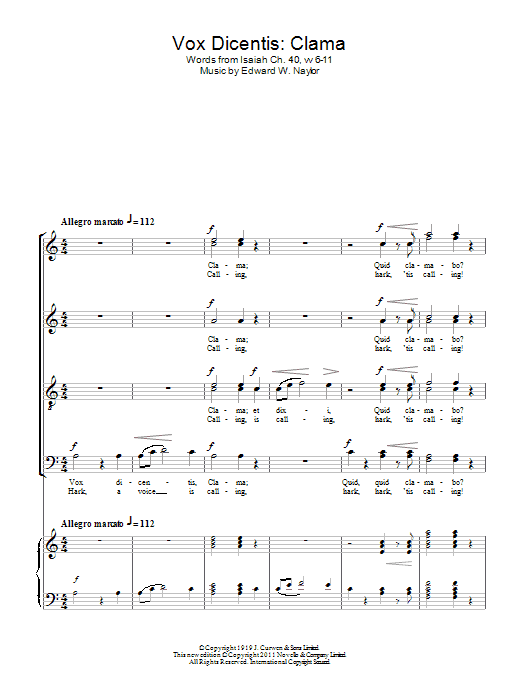
Vox Dicentis: Clama: SATB Choral Octavo

As performed by Edward W. Naylor

Item: 35-DS00185757

Digital Download
$2.99
Description

Vox Dicentis: Clama: SATB Choral Octavo isn't in MakeMusic Cloud just yet...but it could be. Let us know you'd like to see it, and you'll help shape what comes next. In the meantime, start a free trial and dive into thousands of interactive titles your students can play along with today.

Sample Audio
No sample audio found.
Sample Video
Additional Details
Publisher: Hal Leonard
Page Count: 32
SKU: 35-DS00185757

More about this title

About the Artist: Edward W. Naylor

Edward W. Naylor (1839-1927) was an English organist and composer who held prestigious positions at cathedral institutions throughout his career. His sacred and secular choral works earned respect for their craftsmanship and vocal writing, contributing significantly to the English choral tradition of the Victorian and Edwardian eras.

Naylor's compositional voice blended liturgical sensibility with secular sophistication. His choral octavos remain valuable additions to concert programs, valued by conductors for their musicality and reasonable demands on ensemble resources.

Why we love this

Naylor's setting of this text offers a refreshing alternative to the usual suspects in the secular choral repertoire, with vocal lines that feel genuinely singable across all four parts without sacrificing musical interest. The 32-page scope allows for substantial musical development and narrative arc, giving your choir something meaty to sink their teeth into without the page-turning marathon of larger works.

What to expect

The music unfolds with Victorian elegance and restraint, creating an intimate character despite the full four-part writing. There's a contemplative quality that invites both singers and listeners into concentrated listening.

Who it's for

This octavo works well for intermediate to advanced SATB choirs seeking concert repertoire beyond the most frequently performed works. It pairs effectively with singers who have developed basic ensemble blend but are ready to navigate more sophisticated harmonic language.

How to get the most out of it

  • Balance the parts carefully during sectional rehearsals; Naylor's part-writing assumes singers can maintain their line independence even when upper voices carry melody.
  • Attend to text clarity in the opening phrases, where the piece establishes its emotional foundation.
  • Consider the harmonic color changes as structural markers; they often signal shifts in the text's meaning and can guide your interpretation.
  • Shape phrases with awareness of the overall arc rather than bar-by-bar; Naylor's musical sentences often span multiple systems.

How to use it

Consider this as a standalone concert piece or as part of a thematic program exploring English choral music. Its substantial length and secular focus make it particularly useful for building a second half of a concert that needs intellectual weight without sacred programming.

Skills your students will build

  • Part independence and harmonic awareness in four-part writing
  • Sustained phrase shaping across longer melodic spans
  • Interpretation of Victorian-era harmonic language and text expression
  • Ensemble balance and blend in music with distributed textural responsibilities

You May Also Like