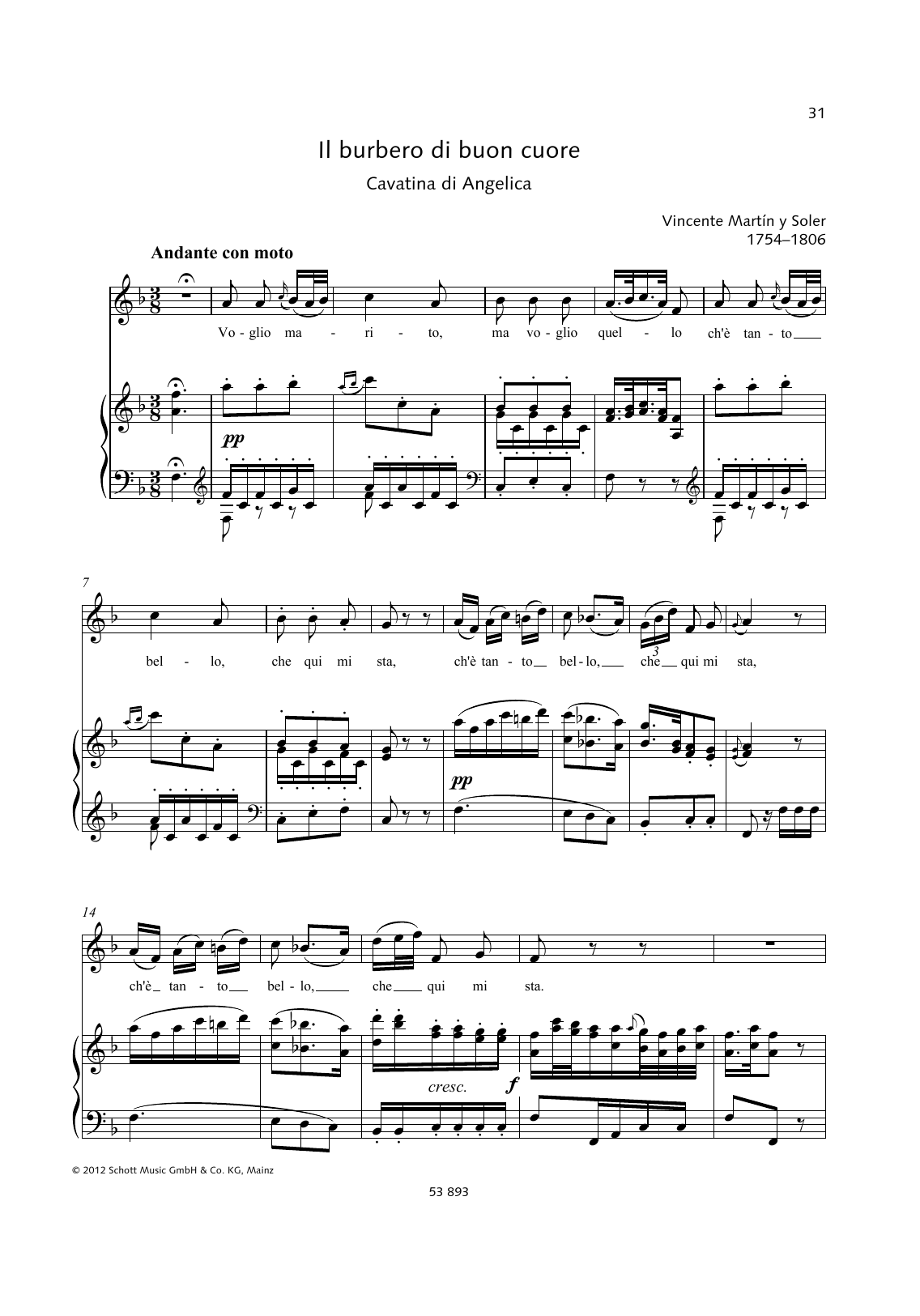
Voglio Marito Sheet Music Preview

Voglio Marito: Piano Vocal

By Vincente Martin Y Soler / Arranged by Claudia Eder / Arranged by Wolfgang Birtel

Item: 35-DS00370134

Digital Download
$4.99
Description

Voglio Marito: Piano Vocal isn't in MakeMusic Cloud just yet...but it could be. Let us know you'd like to see it, and you'll help shape what comes next. In the meantime, start a free trial and dive into thousands of interactive titles your students can play along with today.

Sample Audio
No sample audio found.
Sample Video
Additional Details
Publisher: Hal Leonard
Page Count: 3
SKU: 35-DS00370134

More about this title

About the Composer: Vincente Martin Y Soler

Vincente Martín y Soler (1754-1806) was a Spanish composer who spent much of his career in Italy and Vienna, becoming a central figure in the late 18th-century operatic world. His gift for memorable melody and graceful orchestration made him a favorite of audiences across Europe, and his works were frequently performed alongside those of Mozart and Paisiello.

Why we love this

This aria captures the sunny charm of Spanish comedic opera with a melody that sits perfectly for singers developing security in a classical style. The piano reduction preserves the essential harmonic motion while remaining manageable, making it ideal for coaching singers who need exposure to 18th-century vocal writing without the complexity of more demanding operatic fare.

What to expect

Spirited and flirtatious, with the rhythmic vitality of Spanish vernacular song. The music sparkles with bright orchestral figurations and maintains an infectious momentum that keeps both singer and listener engaged throughout.

Who it's for

Singers building foundational confidence in classical opera repertoire, particularly mezzo-sopranos and altos exploring the lighter side of 18th-century comic style. This three-page aria works well for intermediate vocalists seeking material that demands clean technique without excessive range demands.

How to get the most out of it

  • Maintain a light, conversational tone throughout; the humor of the text should shape your phrasing rather than feel imposed on top of the music.
  • Shape the melodic line with gentle peak points rather than pushing sustained notes, allowing the text to drive the emotional shape.
  • Coordinate with the pianist on the harmonic rhythm so accompaniment figures support vocal breathing points naturally.

How to use it

Pair this aria with other 18th-century vocal works to create a survey of national comic opera styles, or feature it as a recital piece that showcases classical elegance with an accessible, entertaining character. It works particularly well on a program that includes Rossini or early Donizetti.

Skills your students will build

  • Classical phrasing over regular harmonic progressions
  • Maintaining vocal line clarity across simple and compound time divisions
  • Rhythmic coordination between voice and keyboard accompaniment
  • Interpretation of 18th-century comedic intent through text and melody

You May Also Like