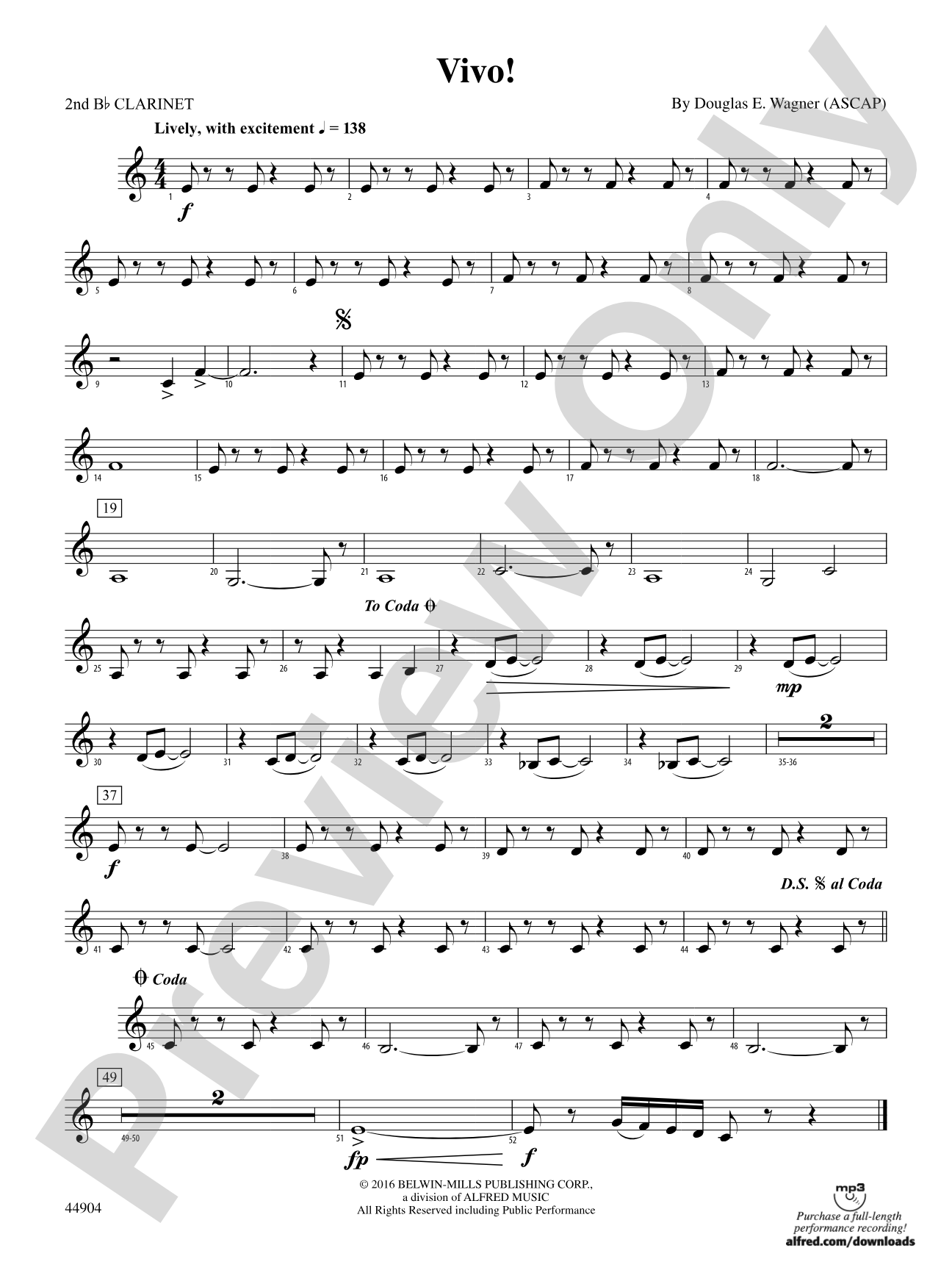
Vivo!: 2nd B-flat Clarinet Sheet Music Preview

Vivo!: 2nd B-flat Clarinet

By Douglas E. Wagner

Grade: 2 (Easy)

Item: 00-PC-0017395_C2

Digital Download
$3.00
Description
Written in the style of a Broadway overture, here's a colorfully scored original work in A-B-A form. Spirited rhythms, soaring melodies, and delightful tonality shifts provide the joyfully musical materials for a most satisfying and happy-sounding program offering that sounds more difficult than it plays. Perfect for contest or concert as well as an uplifting opener or closer for any program. (2:00)

Don't just read it, hear it, play along with it, and watch your students grow with it. In MakeMusic Cloud, Vivo!: 2nd B-flat Clarinet comes alive with professional accompaniment, adjustable tempo, and built-in practice tools that turn solo practice into real progress.

Sample Audio
0:00
0:00
Sample Video
Additional Details
Series: Belwin Young Band
Publisher: Alfred Music
Page Count: 126
SKU: 00-PC-0017395_C2

More about this title

About the Composer: Douglas E. Wagner

Douglas E. Wagner

Douglas E. Wagner grew up in Chicago and studied music at Butler University, earning both undergraduate and graduate degrees. After three decades directing school music programs, he stepped away from the classroom to focus entirely on composing and arranging. Since 1973, Wagner has published over 3,500 works spanning choral, band, orchestral, handbell, organ, piano, and vocal literature; his music has reached an estimated seventeen million performances worldwide and appears regularly in concert halls, broadcasts, and festival programs across the United States and internationally.

Wagner now makes his home in Indianapolis with his wife, Sandy, and continues to be one of the most prolific and performed composers in American music education.

Why we love this

Wagner captures the energy of a Broadway opening number while keeping the technical demands realistic for Grade 2 ensembles. The piece genuinely sounds like a polished, theatrical production without requiring advanced reading skills or virtuosic technique, which means your band will build confidence through immediate success. Programming this as a season opener or closer gives any concert a professional sheen and sends students home smiling.

What to expect

Vivo captures the theatrical energy of a Broadway overture transported into the concert band idiom. Bright harmonic shifts and bouncy rhythmic figures create a joyful, forward-moving sound that feels polished and celebratory without demanding technical sophistication.

Who it's for

Directors programming Grade 2 concert bands who want a piece that sounds impressive without overwhelming developing musicians. This works equally well for contest preparation, festival programming, or building band morale with an uplifting, contemporary-sounding work.

How to get the most out of it

  • Lean into the rhythmic precision of those spirited figures; they're what create the Broadway feeling. Clean articulation across the sections turns simplicity into polish.
  • Balance the soaring melodies by keeping accompanying voices lean and rhythmically locked. The harmonic color depends on clarity, not thickness.
  • Use the A-B-A form as a structural anchor during rehearsals. Mark the key shifts clearly so students understand when the harmonic landscape changes.
  • Shape the dynamic contours generously. A Grade 2 piece can still build excitement through thoughtful crescendos and well-placed accent patterns.

How to use it

Open your concert with this piece to establish an energetic, professional tone from the downbeat. Its two-minute runtime and satisfying musical shape also make it an ideal closer when you want the audience to leave feeling uplifted. This works particularly well at contest, where it showcases your band's musicality and precision in accessible material.

Skills your students will build

  • Reading and performing in A-B-A formal structures
  • Executing precise rhythmic figures within a Broadway style idiom
  • Balancing melody and accompaniment across parts
  • Responding to harmonic color shifts and tonal variety changes
  • Maintaining rhythmic precision while shaping musical phrases

You May Also Like