
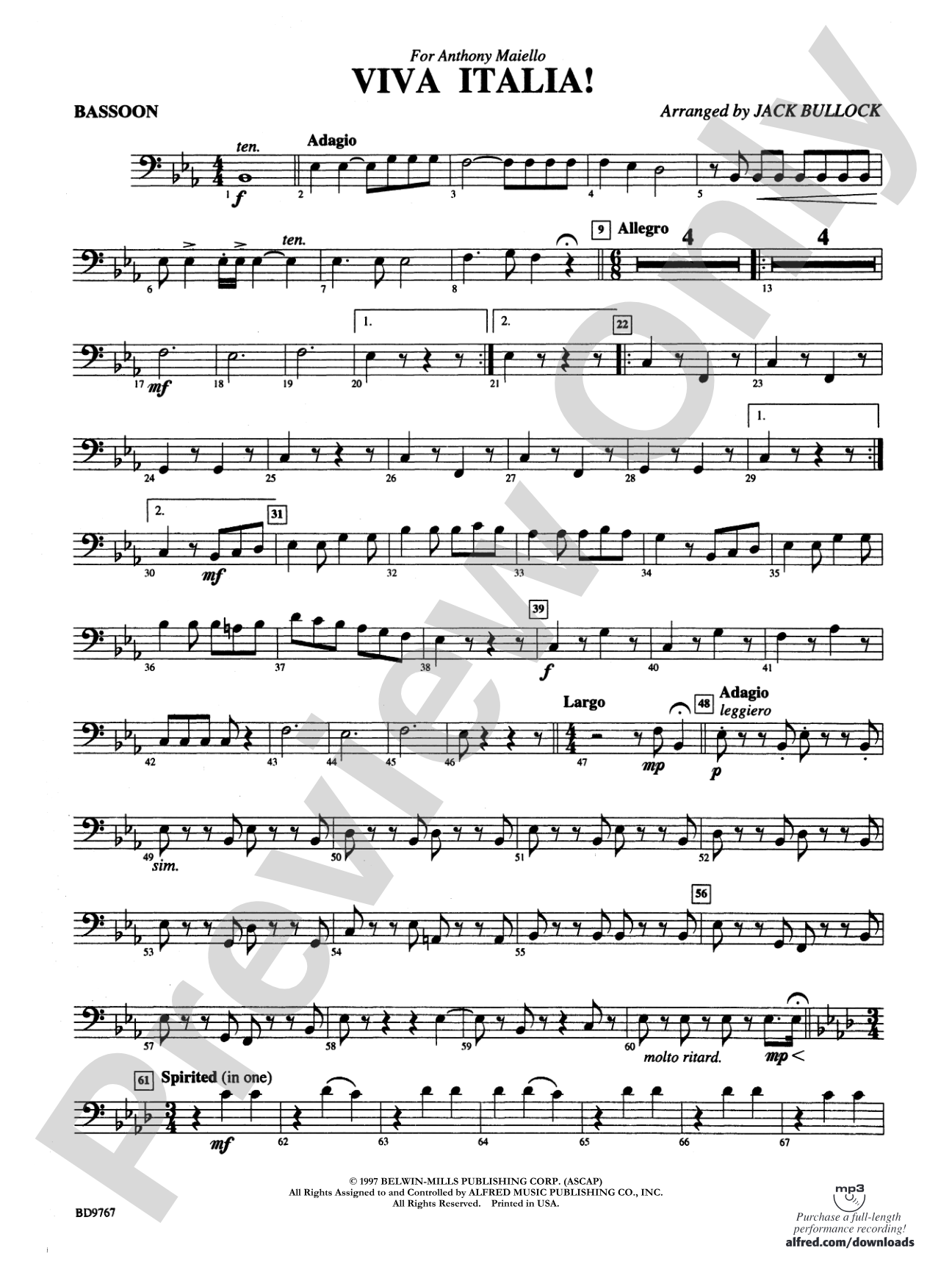

Viva Italia!: Bassoon
Arr. Jack Bullock
Grade: 3 (Medium Easy)
Item: 00-PC-0015192_B1
$3.00
Pickup currently not available
Description
Much of the music of Italy is as rich and vibrant as the collective personality of its people. Five melodies, "O Sole Mio," "Tarantella," Prelude to Act III of La Traviata," "The Carnival of Venice," and "Funiculi, Funicula," are combined to give your audience the flavor, charm and zest of a magnificent land, its people and their culture. Capriciously entertaining! (duration 4:18)


Don't just read it, hear it, play along with it, and watch your students grow with it. In MakeMusic Cloud, Viva Italia!: Bassoon comes alive with professional accompaniment, adjustable tempo, and built-in practice tools that turn solo practice into real progress.
Open in the Player
Jump straight in and assign it today.
Start Your Free Trial
Open this title and explore the full library in minutes.
Sample Audio
1
Audio File
--:--
0:00
0:00
Sample Video
No sample videos found.
Additional Details
Series:
Belwin Concert Band
Publisher:
Alfred Music
Page Count:
252
SKU:
00-PC-0015192_B1
More about this title
About the Arranger: Jack Bullock

Jack Bullock brings decades of hands-on experience across performance, composition, and music education to his arranging work. A trumpet performer who played with the Miami Philharmonic Orchestra and Miami Opera Company, as well as regional and touring ensembles, Bullock understands how musicians of varying levels approach repertoire. He holds three degrees in music education and has published over 600 compositions and arrangements spanning concert band, orchestra, jazz ensemble, and marching band.
Bullock's teaching career spanned two decades in school music classrooms and included seven years at Ithaca College's School of Music, where he served as assistant band director and later chaired the Music Education Department. His contributions extend to curriculum development, including co-authorship of the Belwin 21st Century Band Method. He has presented clinics and workshops throughout the United States, Canada, and England, and maintains ASCAP membership since 1980.
Why we love this
This arrangement captures the exuberance of Italian popular music without sacrificing musicality or ensemble balance. The Grade 3 setting keeps the writing accessible while preserving the character and identity of each melody, making it an ideal choice for bands that want to deliver a genuinely entertaining concert moment rather than something purely pedagogical. Five iconic melodies woven together this way offer variety and charm in a single four-minute package.
What to expect
Sunny, spirited, and genuinely fun. The arrangement channels the rhythmic vitality and melodic warmth of Italian street culture and concert hall traditions, swinging from the contemplative beauty of Verdi's Prelude to the infectious energy of a tarantella. Audiences recognize these melodies instantly and hear them refreshed rather than re-hashed.
Who it's for
Intermediate to developing concert bands seeking a crowd-pleasing program piece that doesn't demand virtuosic technique. This works equally well for bands strengthening their fundamentals or for established groups adding a lighter, culturally rich moment to a concert.
How to get the most out of it
- Shape each melody distinctly even as they share the arrangement's overall architecture. The transition from one Italian tune to the next should feel like a new scene, not a continuation.
- Balance the inner voices that support the primary melody line. Too much weight on harmony parts will blur the distinctiveness Bullock has built into each section.
- Tempo consistency matters more than pushing for dramatic changes between melodies. A steady pulse lets the character of each tune shine without requiring conducting gymnastics.
- Use the recorded accompaniment (if available) to establish style reference, but rehearse without it to ensure your band's own rhythmic cohesion, especially in the tarantella section where energy and precision work together.
How to use it
Program this as a centerpiece for a pops concert or as a cultural enrichment piece within a concert exploring world music traditions. Its four-minute duration and celebratory mood make it ideal for opening a second half or bridging between heavier dramatic works. The piece also serves well in community concerts where accessibility and audience engagement matter as much as musical substance.
Skills your students will build
- Balancing primary melody against accompanimental voices
- Executing clear transitions between related but distinct musical ideas
- Managing rhythmic accuracy in syncopated and dance-like passages
- Maintaining consistent tone color across changing articulations and dynamics