
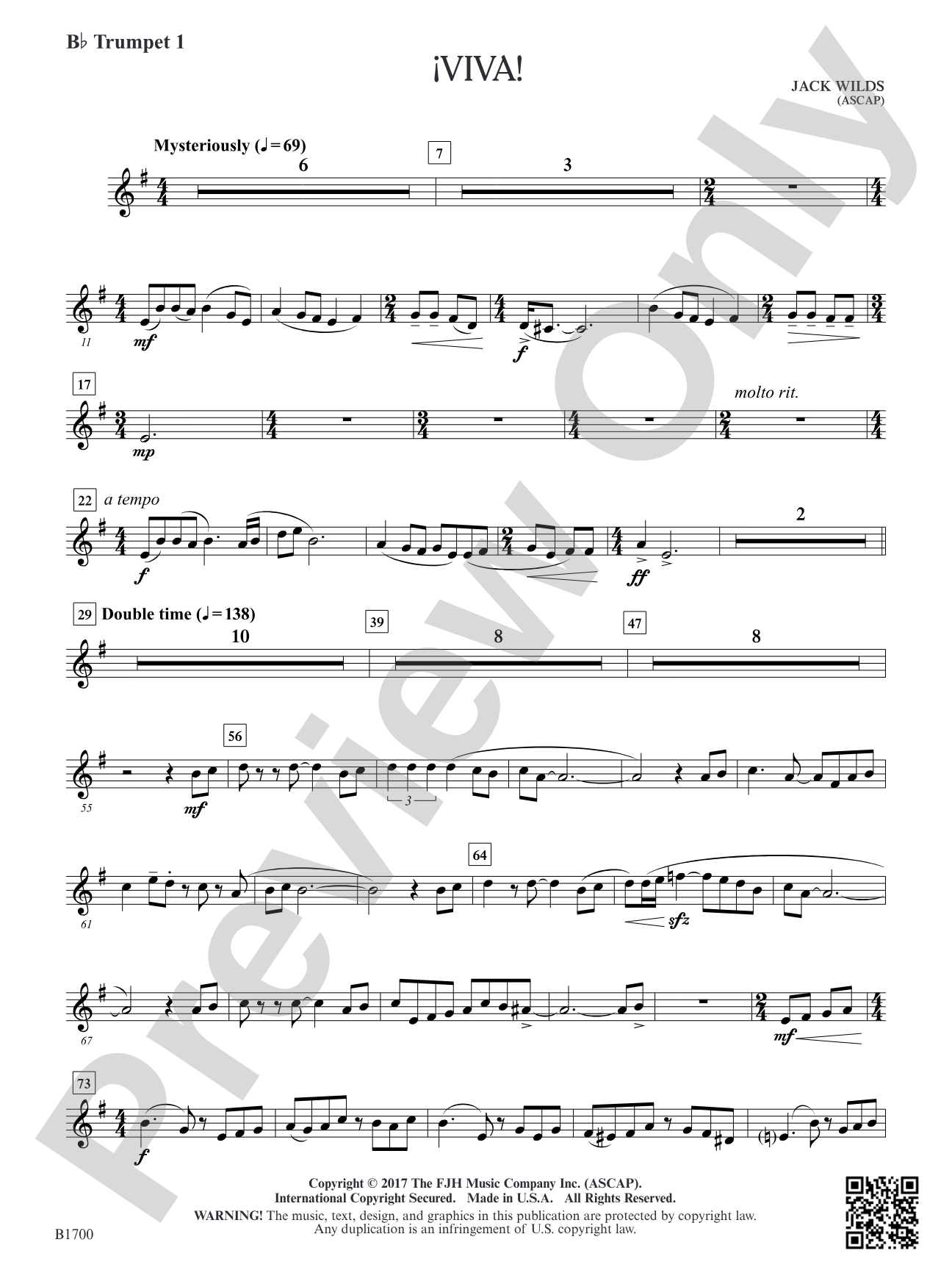

Viva!: B-flat Trumpet 1
By Jack Wilds
Grade: 3
Item: 98-PC-DB1700_T1
$7.00
Pickup currently not available
Description
Experience a wild party in a border town along the Rio Grande! The music imagines a traveler emerging from the desert to join the festivities as the music continues to build to a raucous and invigorating conclusion. A fantastic closer and exceptional way to feature your percussionists!


Don't just read it, hear it, play along with it, and watch your students grow with it. In MakeMusic Cloud, Viva!: B-flat Trumpet 1 comes alive with professional accompaniment, adjustable tempo, and built-in practice tools that turn solo practice into real progress.
Open in the Player
Jump straight in and assign it today.
Start Your Free Trial
Open this title and explore the full library in minutes.
Sample Audio
1
Audio File
--:--
0:00
0:00
Sample Video
Additional Details
Series:
FJH Concert Band
Publisher:
The FJH Music Company, Inc.
SKU:
98-PC-DB1700_T1
More about this title
About the Composer: Jack Wilds

Jack Wilds brings a rare combination of teaching experience and artistic ambition to his compositional work. A former public school band director, he has published over 40 pieces for developing musicians and regularly appears on festival required repertoire lists across multiple continents. His music draws inspiration from visual art, literature, philosophy, and rigorous musical craft, creating pieces that challenge performers while remaining deeply accessible.
Wilds teaches composition, theory, ear training, and music technology at Texas State University and serves as Co-Director of Music at First Presbyterian Church in San Marcos. His chamber works have been performed by the Attacca Quartet, members of the New York Philharmonic and Atlanta Symphony, and ensembles at the International Trombone Festival, the American Trombone Workshop, and the International Horn Symposium. He studied composition with Michael Ippolito, Chris Trapani, and Donald Grantham.
Why we love this
Wilds has written a genuine showstopper that works equally well as a contest selection or a concert finale. The percussion writing is inventive and generous without overshadowing the ensemble sound, and the Grade 3 scoring allows developing bands to access the infectious energy and sophisticated harmonic language that define his best work. The multicultural framing gives you an entry point for meaningful program notes and cultural context.
What to expect
The score captures the visual and sensory chaos of a border town celebration, complete with the arrival of an outsider swept into the festivities. Energy compounds steadily until the ensemble reaches a rollicking, almost jubilant conclusion that feels earned and genuinely joyful rather than mere noise.
Who it's for
Concert bands in the Grade 2-4 range will find this piece exactly at their sweet spot: challenging enough to hold their attention, but well-written enough to come together with committed rehearsal. Directors seeking a closing number that gives percussionists real work and every section something memorable will return to this again and again.
How to get the most out of it
- Build the percussion section gradually through rehearsal so individual players understand their rhythmic relationships before the full ensemble locks in; this prevents the typical muddy climax and lets the raucous conclusion land with clarity.
- Balance the melodic voices against the rhythmic figures in the accompaniment. The party atmosphere depends on hearing the tune while the driving accompaniment pushes forward.
- Shape the phrase arc through the building sections by adjusting dynamics in consultation with your wind players; even in a "wild" finale, intentional phrasing prevents the ensemble from flatting or losing control.
How to use it
Program this as your concert closer when you want to send the audience out energized and remind them why your students love playing together. It also works brilliantly as a competition selection at the Grade 3 level, where judges appreciate writing that is both musically sophisticated and genuinely fun to hear.
Skills your students will build
- Sustaining energy and intonation through accelerating tempos and dynamic layers
- Reading and executing syncopated rhythms across ensemble parts
- Balancing ensemble texture when multiple rhythmic patterns overlap
- Interpreting multicultural musical idioms and their stylistic implications
- Collaborative listening between melodic and rhythmic roles