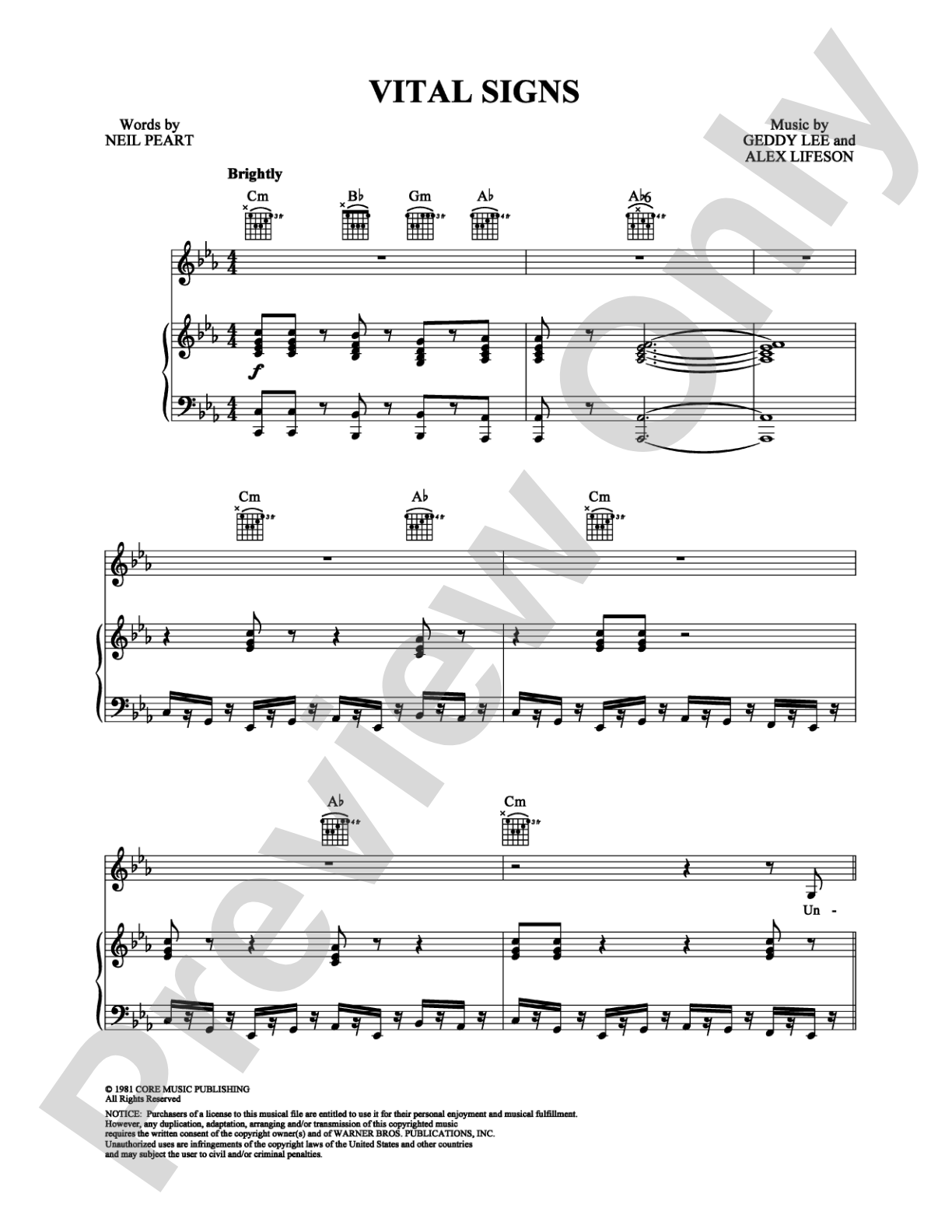
Vital Signs: Piano/Vocal/Chords Digital Sheet Music

Vital Signs: Piano/Vocal/Chords Digital Sheet Music

Rush, Geddy Lee, Alex Lifeson

Item: 00-PS-0000413

Digital Download
$3.99
Description

Vital Signs: Piano/Vocal/Chords Digital Sheet Music isn't in MakeMusic Cloud just yet...but it could be. Let us know you'd like to see it, and you'll help shape what comes next. In the meantime, start a free trial and dive into thousands of interactive titles your students can play along with today.

Sample Audio
No sample audio found.
Sample Video
Additional Details
SKU: 00-PS-0000413

More about this title

About the Artist: Rush

Rush formed in Toronto in 1968 and became one of rock's most technically demanding and intellectually ambitious bands. Bassist and keyboardist Geddy Lee, guitarist Alex Lifeson, and drummer Neil Peart (who also wrote the band's lyrics) built a catalog defined by complex time signatures, philosophical depth, and uncompromising musicianship that influenced generations of progressive rock musicians and serious students across all genres.

Why we love this

Rush's catalog offers pianists and vocalists a rare combination of technical rigor and emotional authenticity. Programming this piece signals respect for students' intelligence and ambition while giving them access to music that demands real musicianship without sacrificing accessibility in arrangement.

What to expect

Vital Signs pulses with an almost clinical precision that somehow becomes deeply human. The music balances mechanical synth-driven rhythm against organic emotion, creating a sound that feels both engineered and urgent.

Who it's for

This arrangement serves vocalists and pianists preparing contemporary repertoire for recitals, auditions, or performance classes. It's particularly valuable for students studying rock and pop music in conservatory or university settings where Rush's musicianship provides real pedagogical substance.

How to get the most out of it

  • Anchor the left hand around the harmonic progression rather than thinking measure by measure; Rush's keyboard parts often move through larger harmonic blocks that make sense once you hear the whole shape.
  • Balance vocal melody against the keyboard foundation; the arrangement should support the vocal line without overwhelming it, even during instrumental passages.
  • Respect the rhythmic precision the piece demands, but avoid mechanical playing—the groove only works when pocket and pocket come from genuine ensemble listening between voice and piano.

How to use it

Include this in a recital exploring the intersection of popular music and serious musicianship, or pair it with other progressive rock arrangements to showcase how contemporary idioms demand the same technical and interpretive sophistication as classical repertoire.

Skills your students will build

  • Reading and performing syncopated rhythmic figures across voice and keyboard
  • Coordinating melody and harmonic accompaniment in asymmetrical phrasing
  • Sustaining musical character through repetitive harmonic patterns
  • Interpreting rock and pop idioms with technical precision and vocal control

You May Also Like