
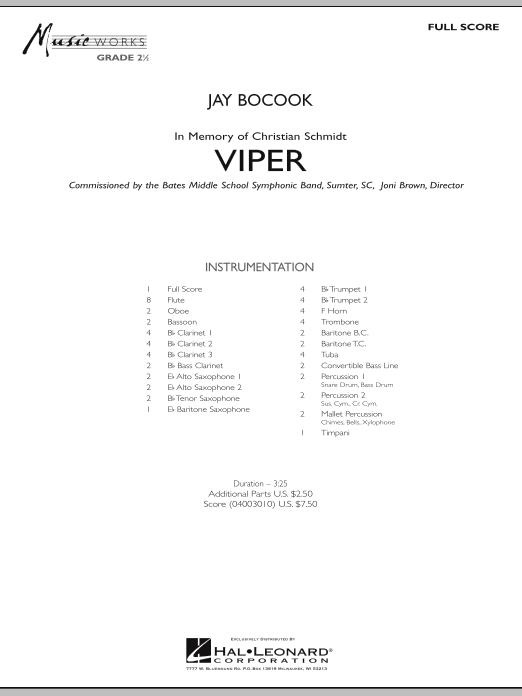

Viper: Concert Band Conductor Score & Parts
By Jay Bocook
Grade: 2.5
Item: 35-PK00157725
$55.00
Pickup currently not available
Buy Extra Parts (Digital PDF Download)
| Product | Price | Quantity |
|---|---|---|
| Viper - Full Score | $10.00 | |
| Viper - Flute | $6.00 | |
| Viper - Oboe | $6.00 | |
| Viper - Bassoon | $6.00 | |
| Viper - Bb Clarinet 1 | $6.00 | |
| Viper - Bb Clarinet 2 | $6.00 | |
| Viper - Bb Clarinet 3 | $6.00 | |
| Viper - Bb Bass Clarinet | $6.00 | |
| Viper - Eb Alto Saxophone 1 | $6.00 | |
| Viper - Eb Alto Saxophone 2 | $6.00 | |
| Viper - Bb Tenor Saxophone | $6.00 | |
| Viper - Eb Baritone Saxophone | $6.00 | |
| Viper - Bb Trumpet 1 | $6.00 | |
| Viper - Bb Trumpet 2 | $6.00 | |
| Viper - F Horn | $6.00 | |
| Viper - Trombone | $6.00 | |
| Viper - Baritone B.C. | $6.00 | |
| Viper - Baritone T.C. | $6.00 | |
| Viper - Tuba | $6.00 | |
| Viper - Convertible Bass Line | $6.00 | |
| Viper - Percussion 1 | $6.00 | |
| Viper - Percussion 2 | $6.00 | |
| Viper - Mallet Percussion | $6.00 | |
| Viper - Timpani | $6.00 |
Parts Added to Cart!
Description
Paying tribute to the storied F-16 Fighting Falcon jet fighter (known to pilots as the "Viper" and flown by the USAF Thunderbirds), this unique and fresh-sounding overture from Jay Bocook is characterized by bold harmonies and driving rhythmic patterns. The opening slow section sets a mood of anticipation with dark sonorities and brief solos, followed by the fast section which contrasts a striking melody with moments of angular intensity. Dur: 3:20 (Grade 2.5)


Viper: Concert Band Conductor Score & Parts isn't in MakeMusic Cloud just yet...but it could be. Let us know you'd like to see it, and you'll help shape what comes next. In the meantime, start a free trial and dive into thousands of interactive titles your students can play along with today.
Request This Title
Tell us you want it.
Start Your Free Trial
Explore everything that's ready to play right now.
Sample Audio
No sample audio found.
Sample Video
No sample videos found.
Additional Details
Publisher:
Hal Leonard
SKU:
35-PK00157725
More about this title
About the Composer: Jay Bocook
Jay Bocook is a prolific composer and arranger whose catalog spans concert band, jazz ensemble, and wind orchestra literature. His work consistently balances accessibility with musical substance, creating pieces that challenge young musicians while remaining performable at their level. Bocook has become known for his ability to craft engaging concert works that connect with student performers through contemporary themes and vivid orchestration.
Why we love this
Bocook builds this overture around a genuine dramatic arc rather than padding out thin material. The slow opening gives your ensemble room to develop control and blend while establishing real tension, then the fast section arrives with a melody so distinctive that audiences remember it. It's the kind of piece that shows off what a Grade 2.5 band can actually accomplish without relying on easy applause.
What to expect
The piece channels the precision and power of military aviation without becoming bombastic. You experience the quiet focus of the pre-flight moment, then the explosive acceleration and angular maneuvering that follow. It's visceral without being cartoonish.
Who it's for
Directors programming a concert that needs a contemporary overture with real personality. This works equally well for a concert focused on modern repertoire or as a bold opener that captures attention from the first notes. Student musicians at this level who want to play something current and engaging, not a century-old standard.
How to get the most out of it
- Shape the dark opening sonorities with careful dynamic layering. The mood of anticipation depends on restraint and precision, not just playing quietly.
- Lock the transition between slow and fast sections so the rhythmic patterns hit immediately with energy and clarity.
- Highlight the solo moments in the opening section individually. Each voice needs room to breathe and be heard.
- Keep the angular intensity sections sharp and articulate without losing musicality. These passages should feel edgy, not sloppy.
How to use it
Open a concert with this to grab the audience immediately, or position it strategically when you need a gear shift in tone and energy. The 3:20 duration fits neatly into concert pacing, and pairing it with contrasting repertoire (a lyrical chorale or classical arrangement) highlights its modern sensibility.
Skills your students will build
- Control of extended dynamic ranges from very soft to boldly fortissimo
- Ensemble articulation in driving rhythmic passages
- Phrase shaping in slow sections with minimal harmonic movement
- Listening for individual balance within complex harmonic textures
- Precision in syncopated and angular rhythmic figures