

Violins Go Vivaldi: Two Movements for Violin Quartet: Piano Accompaniment
Arr. Goran Berg
Item: 00-PC-0015089_K
$6.00
Pickup currently not available
Description
Violins Go Vivaldi: Two Movements for Violin Quartet consists of the third movement of The Four Seasons, "The Summer," and the first movement of Concerto Grosso in D Minor, Op. 3 No. 11, which are favorites with students.
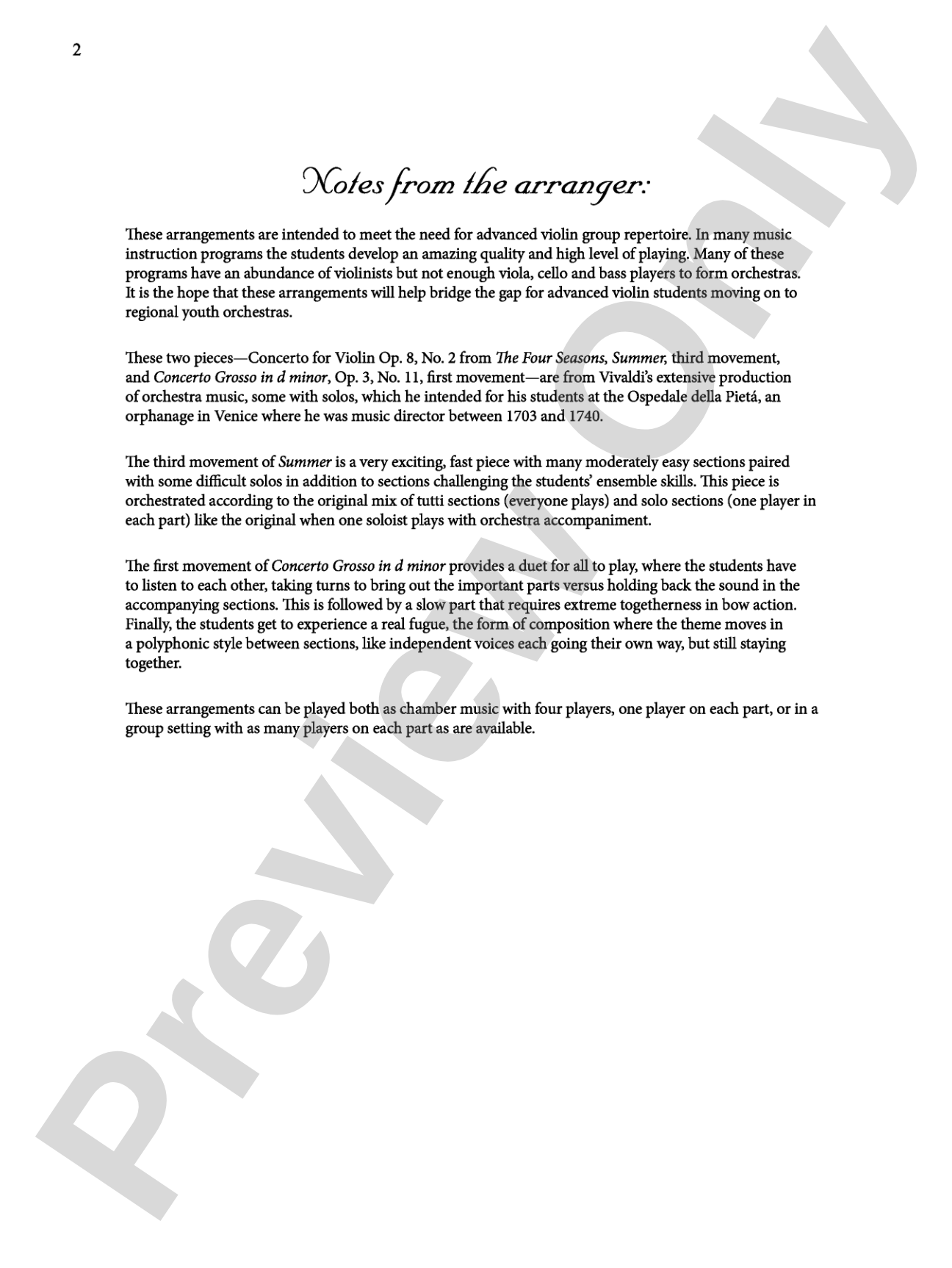
These arrangements (with reproducible parts) will challenge the advanced violin student's ensemble playing skills and can be played both as chamber music with four players or in a group setting with many players in each part.
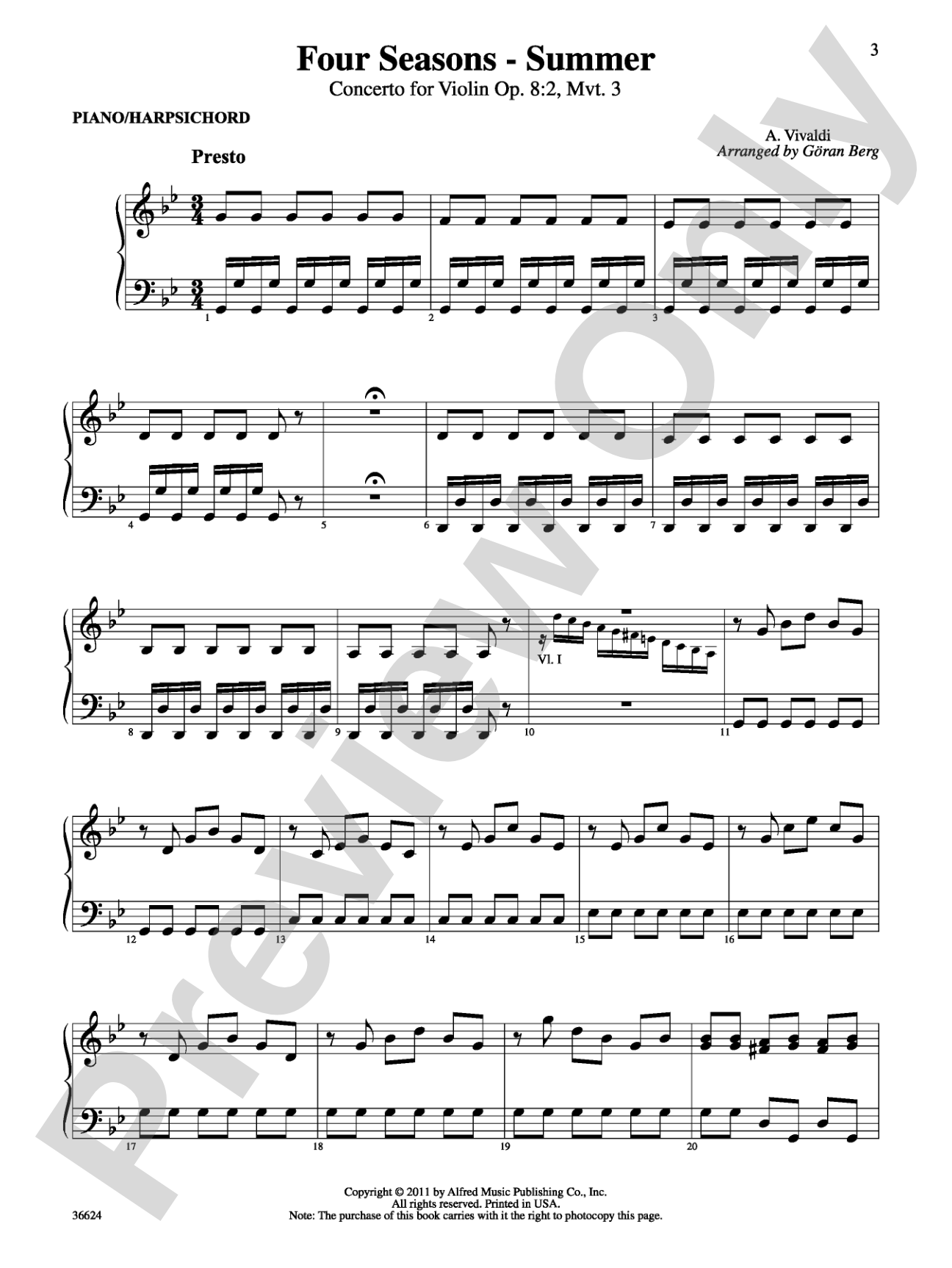
"The Summer" is a very exciting, fast piece with many moderately easy sections paired with some difficult solos, and is orchestrated according to the original mix of tutti sections and solo sections like the original when one soloist plays with orchestra accompaniment.
The first movement of Concerto Grosso in D Minor at first provides a duet for all to play, where the students have to listen to each other, taking turns to bring out the important parts versus holding back the sound in the accompanying sections. There is also a slow part for teaching extreme togetherness in bow action. Finally, the students get to experience a real fugue, the form of composition where the theme moves in a polyphonic style between sections, like independent voices each going their own way, but still staying together.


These arrangements (with reproducible parts) will challenge the advanced violin student's ensemble playing skills and can be played both as chamber music with four players or in a group setting with many players in each part.
"The Summer" is a very exciting, fast piece with many moderately easy sections paired with some difficult solos, and is orchestrated according to the original mix of tutti sections and solo sections like the original when one soloist plays with orchestra accompaniment.
The first movement of Concerto Grosso in D Minor at first provides a duet for all to play, where the students have to listen to each other, taking turns to bring out the important parts versus holding back the sound in the accompanying sections. There is also a slow part for teaching extreme togetherness in bow action. Finally, the students get to experience a real fugue, the form of composition where the theme moves in a polyphonic style between sections, like independent voices each going their own way, but still staying together.
Don't just read it, hear it, play along with it, and watch your students grow with it. In MakeMusic Cloud, Violins Go Vivaldi: Two Movements for Violin Quartet: Piano Accompaniment comes alive with professional accompaniment, adjustable tempo, and built-in practice tools that turn solo practice into real progress.
Open in the Player
Jump straight in and assign it today.
Start Your Free Trial
Open this title and explore the full library in minutes.
Sample Audio
No sample audio found.
Sample Video
No sample videos found.
Additional Details
Publisher:
Alfred Music
Page Count:
44
SKU:
00-PC-0015089_K
More about this title
About the Arranger: Goran Berg
Goran Berg is an arranger with a strong track record of making Baroque masterworks accessible to developing string musicians. His arrangements preserve the compositional integrity of the originals while thoughtfully scaling the technical demands to match advanced student ensembles.
Why we love this
Goran Berg has crafted arrangements that preserve the architectural integrity of these Vivaldi masterworks while making them genuinely playable for advanced young violinists. The decision to keep the original contrast between solo and tutti sections gives students an authentic glimpse into Baroque concerto grosso style, and the fugal section in the D Minor Concerto introduces polyphonic thinking in a context where students hear it unfold in real time.
What to expect
Intense and virtuosic in 'The Summer,' where rapid passagework and sudden shifts between intimate solo writing and full ensemble texture create genuine drama. The Concerto Grosso moves between contemplative duet exchanges and ceremonial fugal independence, demanding both collaborative listening and individual responsibility.
Who it's for
Advanced high school or college-level violin students working toward chamber music performance or festival competition. The arrangements suit groups ranging from four dedicated players to larger ensemble settings where multiple violins share each part.
How to get the most out of it
- Spend rehearsal time on the duet sections of the Concerto Grosso before adding the full texture; students need to lock into each other's phrasing and respond to the written dynamic shifts that signal when a voice steps forward versus accompanies.
- In 'The Summer,' mark your parts clearly to distinguish between solo passages and tutti sections so players know when they are the featured voice and when they are providing harmonic support; this clarity prevents balance problems.
- Shape the slow movement of the Concerto Grosso with unified bow stroke preparation across all players; work on starting and ending bow strokes together rather than trying to match vibrato or tone alone.
- Record a rehearsal and listen back to hear how the polyphonic lines in the fugue section are tracking independently; often one voice will unconsciously follow another rather than maintaining its own line.
How to use it
Position these arrangements as a bridge between the unison repertoire many students know and the contrapuntal independence required in advanced chamber music. The two-movement pairing works well on a concert that highlights Baroque compositional forms, or as a standalone quartet recital centerpiece that demonstrates how well-crafted arrangements can serve as teaching tools.
Skills your students will build
- Balancing solo and accompanying roles within ensemble texture
- Maintaining independent melodic lines in polyphonic writing
- Ensemble intonation and unified bow stroke technique
- Listening and responding to dynamic shifts that signal structural changes
- Reading and interpreting original performance practice conventions (Baroque articulation and phrasing)
- Ensemble coordination across multiple meter and tempo sections