Vincent (Starry Starry Night) Sheet Music Preview

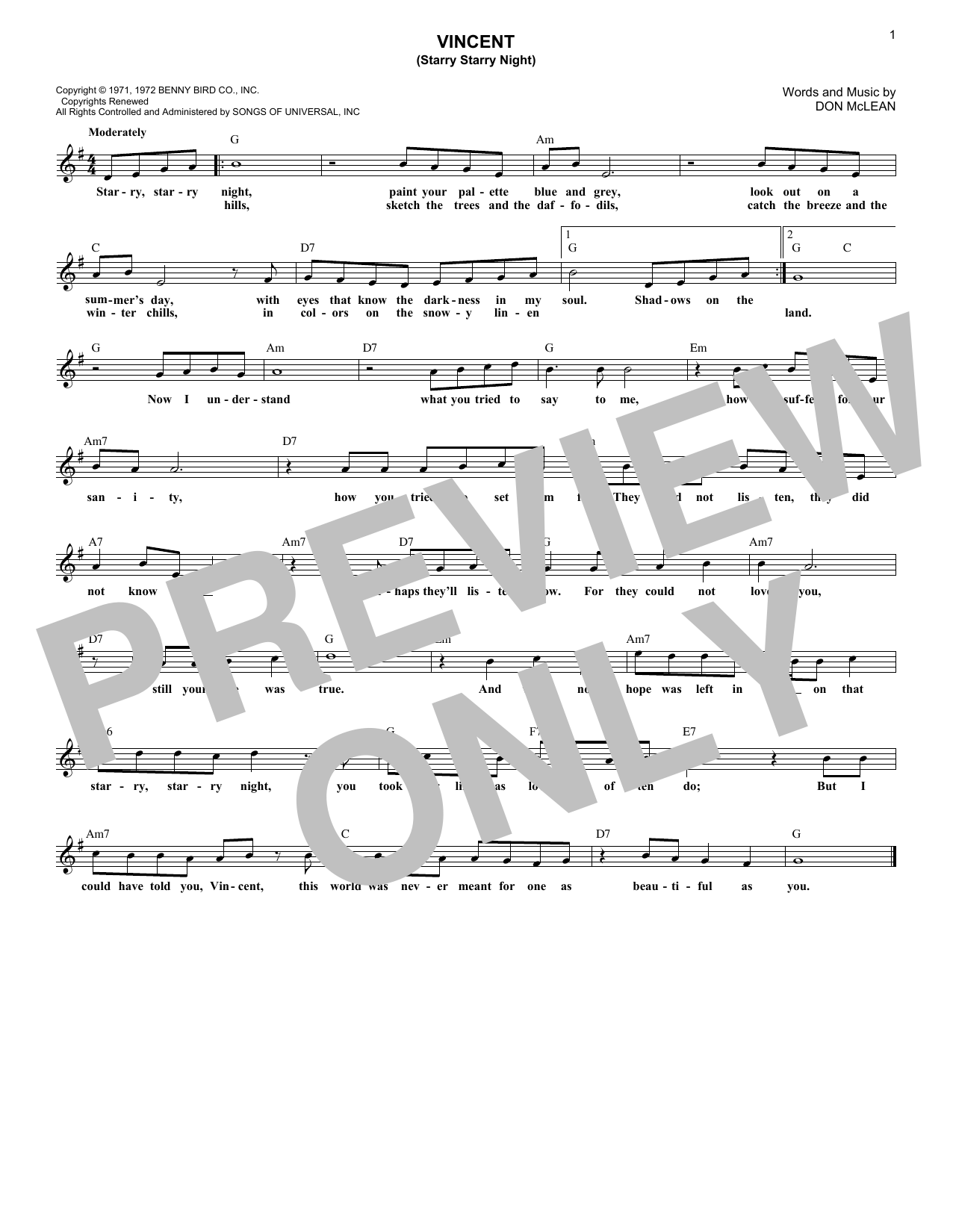
Vincent (Starry Starry Night): Lead Sheet / Fake Book

As performed by Don McLean

Item: 35-DS00377793

Digital Download
$3.99
Description

Vincent (Starry Starry Night): Lead Sheet / Fake Book isn't in MakeMusic Cloud just yet...but it could be. Let us know you'd like to see it, and you'll help shape what comes next. In the meantime, start a free trial and dive into thousands of interactive titles your students can play along with today.

Sample Audio
No sample audio found.
Sample Video
Additional Details
Publisher: Hal Leonard
Page Count: 1
SKU: 35-DS00377793

More about this title

About the Artist: Don McLean

Don McLean's 1971 composition "Vincent" remains one of the most enduring tributes to visual artistry in popular music. Written as a meditation on Vincent van Gogh's life and work, the song showcases McLean's gift for narrative songwriting and his ability to connect literary depth with accessible melody. The track became a global hit and introduced millions of listeners to both McLean's artistry and van Gogh's legacy.

Why we love this

This lead sheet opens a door to teaching storytelling through music. The melody sits naturally for singers across ranges, and the harmonic language is rich enough to reward thoughtful reharmonization while remaining grounded enough for students still building jazz harmony skills. Programming it alongside visual art units or in mixed concerts creates unexpected emotional resonance.

What to expect

The melody unfolds with quiet contemplation, marked by gentle rises and reflective descents that mirror the emotional arc of its lyrics. Accompanying it feels like providing a stable landscape for a voice searching for meaning and connection.

Who it's for

Pianists and vocalists developing their jazz and popular music sight-reading vocabulary will find the lead sheet format inviting. Teachers working with intermediate to advanced students can use this piece to explore how classical and impressionistic influences inform contemporary songwriting.

How to get the most out of it

  • Explore the contour of the melody before committing to tempo. The song breathes differently at slower speeds, allowing lyrical storytelling to emerge.
  • Experiment with chord substitutions and voicings in the comping. The original changes leave space for interpretation, which rewards both soloist and accompanist.
  • Balance rubato in the vocal line with rhythmic stability in the keyboard foundation so the two elements support rather than pull against each other.

How to use it

Pair this with visual presentations of van Gogh's work for an interdisciplinary concert moment, or slot it into a popular music set where its lyrical sophistication offers contrast and depth. It also serves as an excellent vehicle for introducing lead sheet reading in a context students already know and care about.

Skills your students will build

  • Reading lead sheet notation and melody with chord symbols
  • Interpreting harmonic changes for keyboard improvisation and comping
  • Balancing vocal phrasing with accompaniment support
  • Connecting lyrical content to melodic shape and interpretation

You May Also Like