

Villages: Concert Band Conductor Score & Parts
By Michael Sweeney
Grade: 4
Item: 35-PK00293470
$85.00
Pickup currently not available
Buy Extra Parts (Digital PDF Download)
Parts Added to Cart!
Description
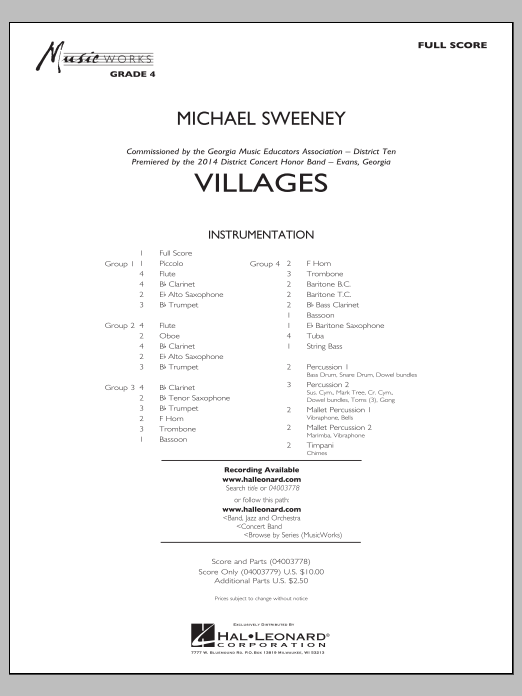
Calling for the band to be divided into four separate ensembles (and spread apart if space permits), "Villages" explores a wide range of harmonic and rhythmic interplay between each of these musical "villages." The opening creates a dense canopy of sound, out of which the unique identity of each group variously emerges then melts back into the texture. As the fast pace continues, melodic fragments are bounced from group to group with interjections from the percussion. A slower lyric section provides contrast before the frantic pace returns leading to the exciting conclusion. Innovative in its conception, this stunning work will expose your students and audience to dramatically new sounds for band!
Dur: 8:15


Villages: Concert Band Conductor Score & Parts isn't in MakeMusic Cloud just yet...but it could be. Let us know you'd like to see it, and you'll help shape what comes next. In the meantime, start a free trial and dive into thousands of interactive titles your students can play along with today.
Request This Title
Tell us you want it.
Start Your Free Trial
Explore everything that's ready to play right now.
Sample Audio
No sample audio found.
Sample Video
No sample videos found.
Additional Details
Publisher:
Hal Leonard
SKU:
35-PK00293470
More about this title
About the Composer: Michael Sweeney
Michael Sweeney is a prolific composer and arranger whose concert band works span multiple decades and skill levels. His output combines accessibility with musical substance, earning him a reputation for writing pieces that engage both performers and audiences without sacrificing compositional integrity.
Why we love this
The four-ensemble division creates a structural concept that feels fresh within the concert band repertoire, and the piece rewards the extra logistical effort with genuinely engaging musical payoff. Students encounter a composition that treats ensemble divisi as a compositional tool rather than a practical necessity, making the architectural choices musically audible and dramatically effective.
What to expect
The piece inhabits a kind of musical ecosystem where four separate musical voices coexist, sometimes competing for attention, sometimes blending into unified sound. Its arc moves from lush, overlapping textures through rhythmically driven exchanges into a moment of lyric repose, then accelerates toward an exhilarating climax that brings all four villages into dynamic convergence.
Who it's for
This work suits concert bands at the Grade 4 level seeking a contemporary piece with structural sophistication and pedagogical depth. Directors assembling programs that feature innovative ensemble writing or seeking music that demonstrates how ensemble divisions function compositionally will find genuine value here.
How to get the most out of it
- Position each ensemble spatially if your performance space allows; even modest separation clarifies the textural exchanges and helps audiences hear the dialogue between groups.
- Conduct the dense opening section with clarity about which ensemble carries primary material at any given moment; your gestures guide students through the overlapping textures.
- Bring contrast to the lyric section by easing the dynamic intensity and allowing the slower pace to breathe; this makes the return to frantic energy land with real impact.
- Highlight the percussion interjections in the fast sections; they serve as connective tissue bouncing fragments between ensembles, so clarity here strengthens the overall form.
How to use it
Reserve this for a concert where you can feature it as a centerpiece work demonstrating your band's textural sophistication and ensemble flexibility. The eight-minute fifteen-second duration and dramatic arc make it equally effective as a standalone feature or as a second-half showcase piece that transitions your program toward contemporary repertoire.
Skills your students will build
- Awareness of harmonic layering and how multiple independent lines create composite color
- Ensemble blend and balance when portions of the band operate as separate units
- Responsiveness to conductor gesture across divided seating arrangements
- Rhythmic precision within fast-paced melodic exchanges between groups
- Dynamic control and sectional independence across extended lyric passages