
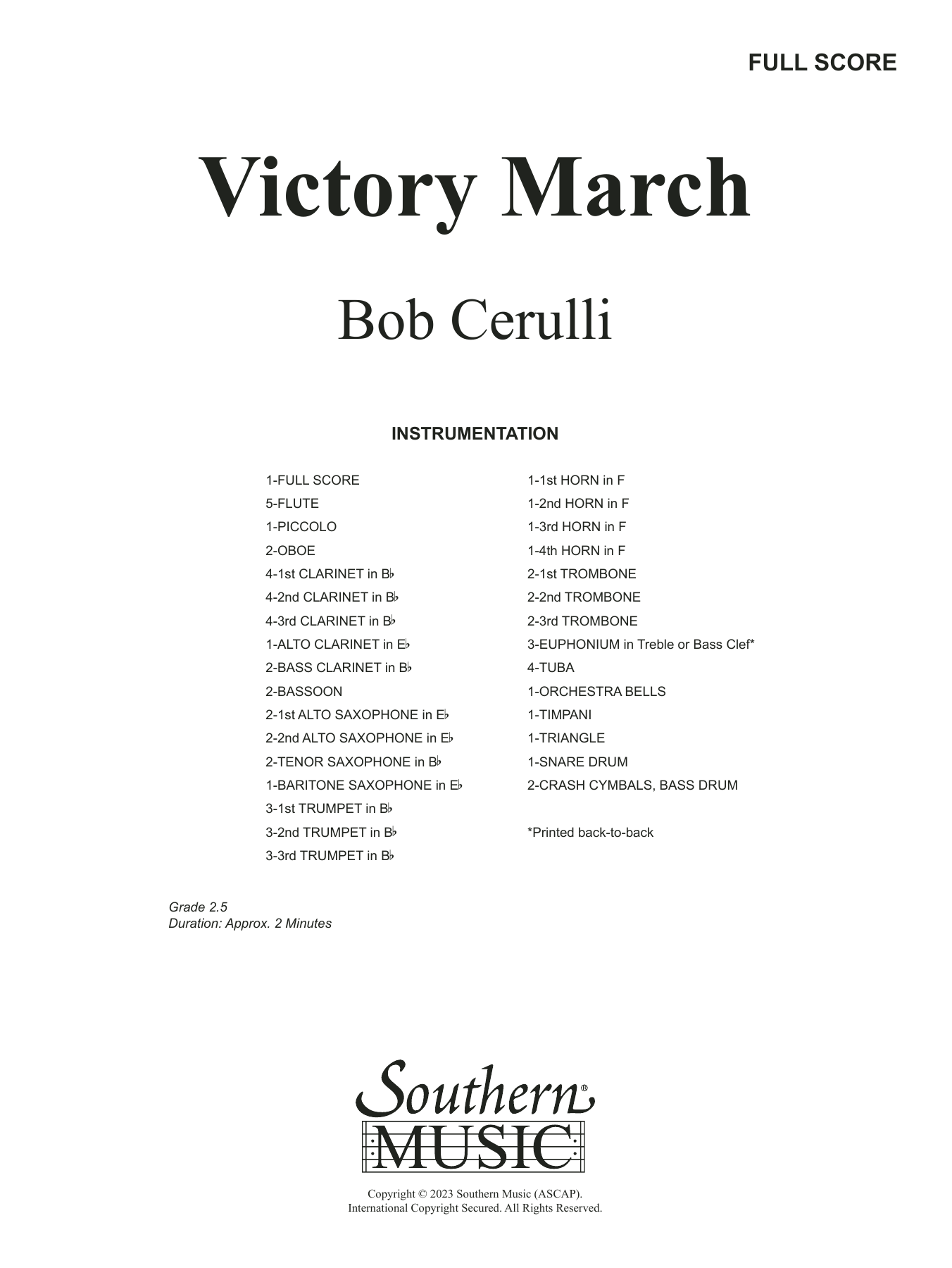

Victory March: Concert Band Conductor Score & Parts
By Bob Cerulli
Grade: 2.5
Item: 35-PK01425675
$65.00
Pickup currently not available
Buy Extra Parts (Digital PDF Download)
Parts Added to Cart!
Description
Victory March brings a fresh, new sound to a familiar and revered form. This is partially a function of tonal center and partially due to sparkling melody and a well-constructed harmonic base. A splash of originality, the march fits well in just about any spot on a program.


Victory March: Concert Band Conductor Score & Parts isn't in MakeMusic Cloud just yet...but it could be. Let us know you'd like to see it, and you'll help shape what comes next. In the meantime, start a free trial and dive into thousands of interactive titles your students can play along with today.
Request This Title
Tell us you want it.
Start Your Free Trial
Explore everything that's ready to play right now.
Sample Audio
No sample audio found.
Sample Video
No sample videos found.
Additional Details
Publisher:
Hal Leonard
SKU:
35-PK01425675
More about this title
About the Composer: Bob Cerulli

Bob Cerulli's musical foundation was built at Curtis, where he studied double bass under Roger Scott. He expanded his training through degrees in music education from the University of the Arts and conducting from the College of New Jersey, positioning himself to work across performance, pedagogy, and leadership.
Cerulli's career spans orchestral performance, studio work, and education. He held principal bass positions with regional orchestras including the Greater Trenton Symphony and Delaware Valley Philharmonic, and performed alongside major figures in classical and popular music. His compositions have been performed by regional ensembles and soloists; The Philadelphia Orchestra premiered his work Celebration. For nearly three decades he taught in public schools, and he continues as a Senior Adjunct Professor at Rowan College at Burlington County, where he conducts festival orchestras and reading sessions.
Why we love this
Cerulli writes marches that sound contemporary without abandoning the form's essential character. The harmonic language here feels richer than stock Grade 2.5 fare, and the melody sings with genuine character. Directors appreciate how cleanly it sits on most programs, whether opening a concert or bridging between heavier works.
What to expect
Victory March carries the dignity of the traditional march form while moving with a lighter step than its predecessors. The tonal center and harmonic choices create a quality of brightness and forward motion, never ponderous or predictable. You hear respect for the march tradition alongside a composer unafraid to color outside conventional lines.
Who it's for
Concert bands tackling Grade 2.5 repertoire who want something with genuine personality. This works equally well for groups seeking a strong opener or a confident standalone piece. Students benefit from the clear formal construction without the repetitive simplicity that marks lesser marches at this level.
How to get the most out of it
- Bring out the melody in the upper woodwinds from the downbeat; this march lives or dies by how clearly the tune emerges.
- Shape the harmonic accompaniment with light articulation rather than matching the melody's weight, creating space for the melodic line to dominate.
- Let the section breaks breathe naturally. Resist rushing into the next strain; the march's freshness depends on confident phrasing between sections.
- Tune the low brass carefully through the middle section. The harmonic base sounds sparkling only when intervals sit cleanly.
How to use it
Open a concert with this to set a confident, contemporary tone. It pairs beautifully after a slower opening number, reclaiming energy without the weight of a full-scale finale. Consider programming it early in the season as groups build technical facility; the Grade 2.5 level and fresh sound sustain student engagement while developing ensemble fundamentals.
Skills your students will build
- Balanced voice leading between melody and accompaniment
- Clarity in executing march rhythms and articulations
- Intonation in four-part harmonic progressions
- Phrasing within a formally structured piece
- Ensemble blend across mixed instrumental color