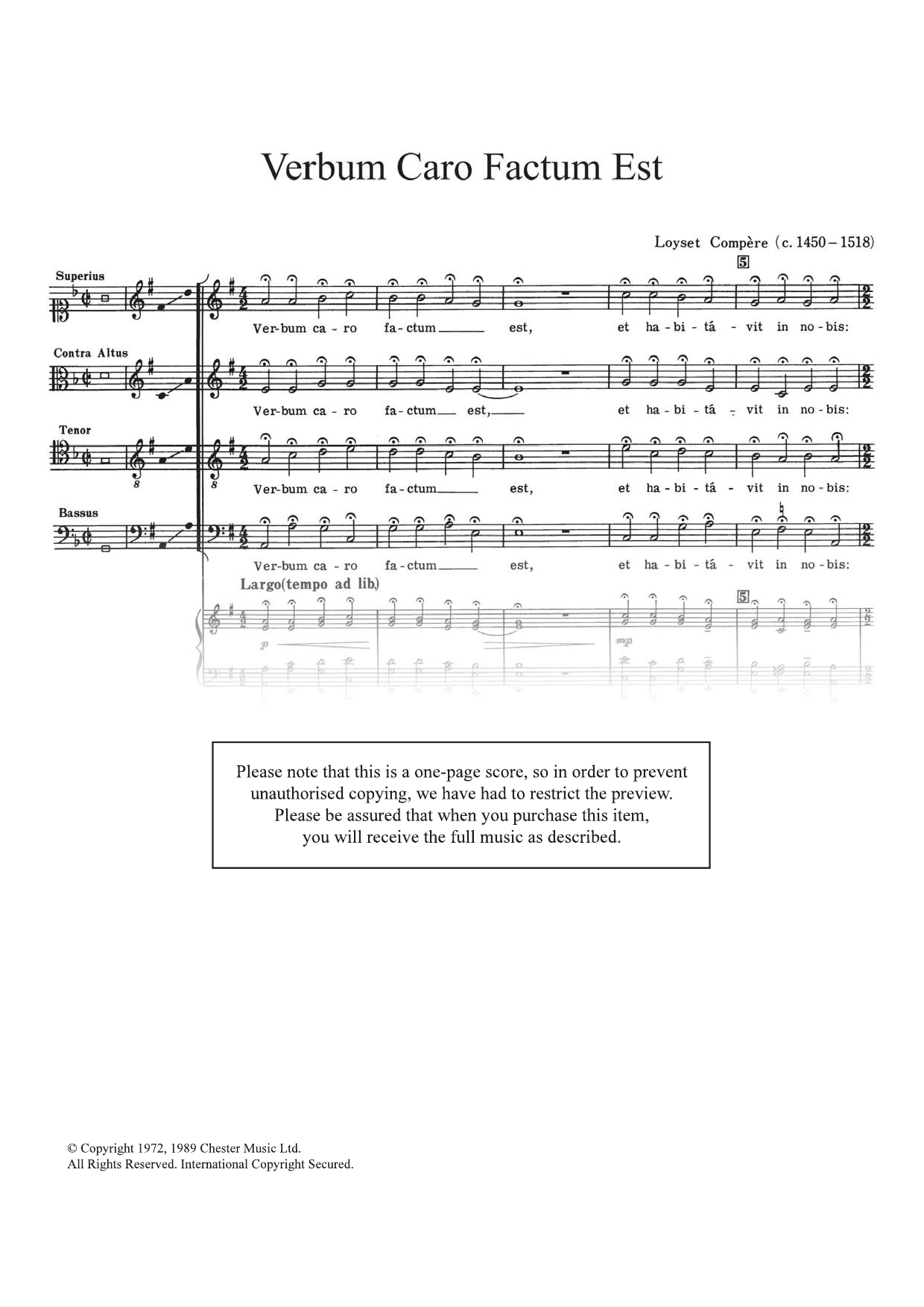
Verbum Caro Factum Est Sheet Music Preview

Verbum Caro Factum Est: SATB Choral Octavo

As performed by Loyset Compere

Item: 35-DS00366768

Digital Download
$2.99
Description

Verbum Caro Factum Est: SATB Choral Octavo isn't in MakeMusic Cloud just yet...but it could be. Let us know you'd like to see it, and you'll help shape what comes next. In the meantime, start a free trial and dive into thousands of interactive titles your students can play along with today.

Sample Audio
No sample audio found.
Sample Video
Additional Details
Publisher: Hal Leonard
Page Count: 2
SKU: 35-DS00366768

More about this title

About the Artist: Loyset Compere

Loyset Compere (c. 1445–1518) was a Franco-Flemish composer whose career spanned the late 15th and early 16th centuries. He served in the papal chapel and held positions at various European courts, making him one of the most widely performed composers of his era. Compere's sacred works demonstrate the hallmark style of the Northern Renaissance: clear counterpoint, lyrical melodic lines, and a gift for setting text with both clarity and expressive depth.

His music remained in continuous circulation well after his death, copied and performed across Europe. For modern choirs, Compere's motets offer an entry point into Renaissance polyphony that rewards careful attention to text declamation and line independence without requiring extensive rehearsal time.

Why we love this

Compere's economy of means makes this motet ideal for choirs expanding into Renaissance repertoire without overcomplicating the learning curve. The four voices sit comfortably within standard ranges, and the two-page length means you can build ensemble skills through a complete, satisfying work rather than a fragmentary excerpt.

What to expect

Reverent and contemplative, with a luminous quality that comes from the clarity of four independent lines weaving together. The text 'Verbum caro factum est' (The Word was made flesh) receives musical treatment that feels both intimate and majestic, allowing singers to inhabit the profound theological meaning without theatrical excess.

Who it's for

Intermediate to advanced choirs with experience in polyphonic singing and a working understanding of Latin pronunciation. This work suits ensembles preparing a Renaissance program or looking to round out a concert with a shorter sacred piece that demonstrates historical breadth.

How to get the most out of it

  • Bring out the text underlay by pronouncing Latin consonants with precision, especially at phrase endings where diction clarity prevents the text from blurring into the next section.
  • Balance the four voices by asking singers to listen horizontally within their own line rather than focusing inward on their note; this creates transparency and lets the polyphonic structure speak.
  • Shape each melodic phrase with gentle dynamic arcs rather than singing at a flat dynamic throughout; Renaissance motets respond beautifully to subtle swells that mirror the natural contours of the text.

How to use it

Pair this with other Renaissance motets or polyphonic sacred works to create a historical survey concert, or use it as a counterweight to longer modern works that demand more rehearsal energy. Its modest length also makes it suitable for including in a diverse program where you want to acknowledge the choir's range without consuming valuable rehearsal time.

Skills your students will build

  • Reading and sustaining independent melodic lines within four-part polyphony
  • Pronouncing and articulating Latin text with musical clarity
  • Balancing ensemble blend when each voice carries equal textural weight
  • Recognizing Renaissance harmonic language and voice leading conventions
  • Shaping phrase contours in early music without relying on dynamic markings

You May Also Like