
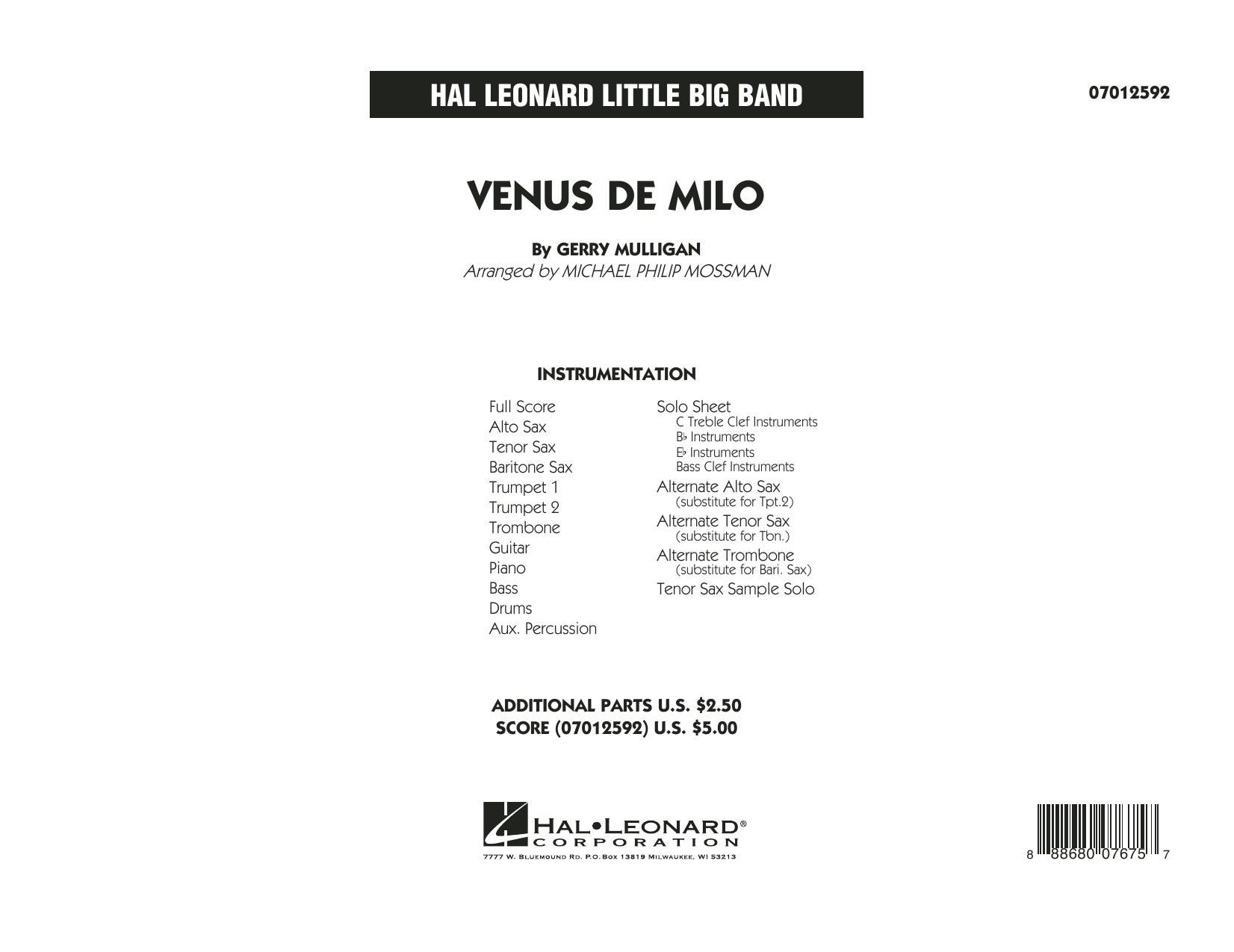

Venus de Milo: Jazz Ensemble Conductor Score & Parts
As performed by Miles Davis / Arranged by Michael Philip Mossman
Grade: 4
Item: 35-PK00314522
$45.00
Pickup currently not available
Buy Extra Parts (Digital PDF Download)
| Product | Price | Quantity |
|---|---|---|
| Venus de Milo - Full Score | $6.00 | |
| Venus de Milo - Alto Sax | $6.00 | |
| Venus de Milo - Tenor Sax | $6.00 | |
| Venus de Milo - Baritone Sax | $6.00 | |
| Venus de Milo - Trumpet 1 | $6.00 | |
| Venus de Milo - Trumpet 2 | $6.00 | |
| Venus de Milo - Trombone | $6.00 | |
| Venus de Milo - Guitar | $6.00 | |
| Venus de Milo - Piano | $6.00 | |
| Venus de Milo - Bass | $6.00 | |
| Venus de Milo - Drums | $6.00 | |
| Venus de Milo - Aux Percussion | $6.00 | |
| Venus de Milo - C Solo Sheet | $6.00 | |
| Venus de Milo - Bb Solo Sheet | $6.00 | |
| Venus de Milo - Eb Solo Sheet | $6.00 | |
| Venus de Milo - Bass Clef Solo Sheet | $6.00 | |
| Venus de Milo - Alternate Alto Sax | $6.00 | |
| Venus de Milo - Alternate Tenor Sax | $6.00 | |
| Venus de Milo - Alternate Trombone | $6.00 | |
| Venus de Milo - Tenor Sax Sample Solo | $6.00 |
Parts Added to Cart!
Description
Based on Michael Mossman's arrangement recorded by Tito Puente (on "Special Delivery") here is Gerry Mulligan's jazz standard set in a simmering mambo style for Little Big Band. The entire ensemble gets a good workout on this well-crafted chart.


Venus de Milo: Jazz Ensemble Conductor Score & Parts isn't in MakeMusic Cloud just yet...but it could be. Let us know you'd like to see it, and you'll help shape what comes next. In the meantime, start a free trial and dive into thousands of interactive titles your students can play along with today.
Request This Title
Tell us you want it.
Start Your Free Trial
Explore everything that's ready to play right now.
Sample Audio
No sample audio found.
Sample Video
No sample videos found.
Additional Details
Publisher:
Hal Leonard
SKU:
35-PK00314522
More about this title
About the Artist: Miles Davis
Miles Davis shaped modern jazz across six decades, moving from bebop through cool jazz, modal exploration, and electric fusion. His restless approach to musical innovation and ear for fresh arrangements made him a magnet for the finest composers and bandleaders of his era.
Davis's influence on jazz education runs deep. Students studying his recordings encounter crystalline improvisation, conversational ensemble playing, and an uncompromising pursuit of sound quality. His work with arrangers like Gil Evans and his openness to material from jazz standards broadened what jazz could encompass.
Why we love this
Mossman's chart captures the essence of Mulligan's melody while reframing it through a mambo lens that keeps the ensemble engaged from top to bottom. Rather than treating the horns as soloists floating over a rhythm section, this arrangement distributes musical responsibility across the band, giving sections and combinations of players time to shine. The simmering energy makes it instantly appealing to listeners without sacrificing the musical craftsmanship that keeps players challenged.
What to expect
Warm and propulsive. The mambo rhythm pulses beneath elegant horn writing that feels both accessible and crafted. There's a sophistication here without pretension; the piece swings naturally and invites both careful listening and dancing.
Who it's for
Jazz ensembles at the high school or community college level looking for repertoire that sounds sophisticated without requiring virtuosic soloists. The arrangement works equally well for directors building a Latin jazz section in their programming or teaching students how jazz standards can be reimagined through different cultural lenses.
How to get the most out of it
- Balance the mambo groove so the rhythm section locks tight without overwhelming the horn lines. The chart's effectiveness depends on groove clarity, not volume.
- Shape the dynamics as a collective. Unlike pieces where individual sections rise and fall independently, this arrangement rewards unified swells that carry the entire ensemble forward.
- Ground the soloists in the mambo pocket rather than allowing them to float into a straight jazz feel. Frame each improvisation as an extension of the arranged groove.
- Pay attention to how Mossman stacks the horns in tutti passages. Intonation within these block voicings will either crystallize the sound or cloud it.
How to use it
Pair this with other Latin jazz standards to build a cohesive set that explores how American jazz absorbed Caribbean and Latin American rhythmic language. It sits naturally alongside other Mulligan compositions or as part of a concert that celebrates the cross-pollination between Afro-Cuban and bebop traditions. The grade 4 difficulty makes it an excellent bridge for ensembles ready to move beyond straight swing into rhythmic and harmonic sophistication.
Skills your students will build
- Reading and executing mambo rhythmic patterns across ensemble parts
- Maintaining groove consistency while playing written countermelodies
- Balancing block voicing intonation in horn sections
- Soloing within a defined rhythmic framework rather than free swing feel
- Understanding how standards can be recontextualized through different cultural musical languages