
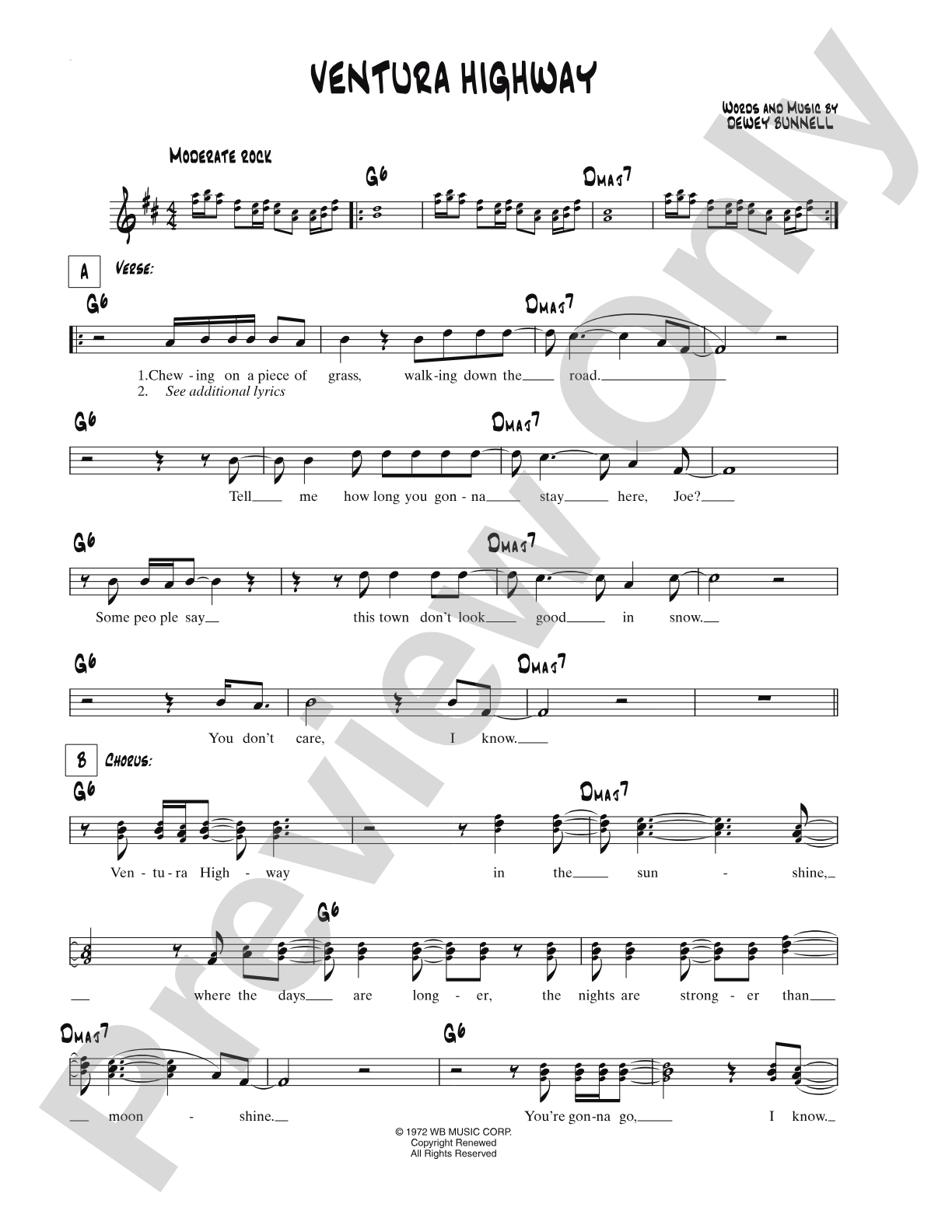

Ventura Highway: Lead Sheet
America
Item: 00-PSL-000606
$4.99
One moment…
Description
Titles: A Horse with No Name * Sandman * Muskrat Love * Sister Golden Hair * and 12 more great songs.


Ventura Highway: Lead Sheet isn't in MakeMusic Cloud just yet...but it could be. Let us know you'd like to see it, and you'll help shape what comes next. In the meantime, start a free trial and dive into thousands of interactive titles your students can play along with today.
Request This Title
Tell us you want it.
Start Your Free Trial
Explore everything that's ready to play right now.
Sample Audio
No sample audio found.
Sample Video
No sample videos found.
Additional Details
Publisher:
Alfred Music
Page Count:
60
SKU:
00-PSL-000606
More about this title
About the Artist: America
America emerged from Los Angeles in the early 1970s with a signature sound that blended folk sensibilities, rock instrumentation, and intricate vocal harmonies. The trio of Gerry Beckley, Dewey Bunnell, and Dan Peek crafted some of the decade's most recognizable hits, earning Grammy Awards and multi-platinum status while maintaining a reputation for musicianship and accessibility. Their catalog represents a pivotal moment when pop-rock could be both commercially successful and musically substantial.
The band's songwriting spans themes of American landscapes, introspection, and human connection, making their material enduringly appealing to vocalists and instrumentalists across generations. Their influence on contemporary singer-songwriters and the evolution of rock production remains significant in music education and performance contexts.
Why we love this
This collection captures America's gift for melodic clarity and vocal-friendly arrangements, giving pianists and singers immediate access to songs that sound sophisticated but remain playable at various skill levels. The lead sheet format preserves the harmonic richness that makes these tunes satisfying to interpret while leaving room for personal expression and arrangement choices.
What to expect
Sunny, introspective, and thoroughly human. These songs carry the warmth of 1970s AM radio at its best: immediate hooks that lodge in memory, lyrics that invite reflection on life's ordinary moments, and harmonies that suggest both simplicity and craft. There's a nostalgic comfort here, but one grounded in genuine melodic invention rather than mere sentimentality.
Who it's for
This collection serves vocalists preparing for recitals, auditions, or casual performance settings who want material with strong melodic lines and harmonic substance. Piano accompanists and music theory students will find these lead sheets useful for developing skills in interpreting chord symbols and creating engaging keyboard arrangements in real time.
How to get the most out of it
- Study the original recordings to internalize the vocal phrasing and rhythmic pocket; the lead sheet structure works best when singers understand the song's natural breathing points and emphasis.
- Treat the chord symbols as a foundation for improvisation rather than a rigid harmonic roadmap, especially in the verses where space often invites instrumental filling or reharmonization.
- Balance the melody line with the harmonic movement underneath; many of these songs depend on subtle color changes in the accompaniment that enhance the vocal line without overwhelming it.
- Pay attention to key changes and modulations built into the original arrangements; they often signal emotional turning points in the song's narrative and benefit from intentional preparation.
How to use it
Incorporate individual titles into recitals as standalone pieces or group several together for a thematic set exploring the pop-rock songwriting tradition. These lead sheets work particularly well in singer-pianist collaborations, youth jazz ensemble arrangements, or musical theater audition preparation contexts where contemporary American songwriting models are valuable.
Skills your students will build
- Interpreting lead sheet symbols and creating varied keyboard accompaniments
- Identifying and performing vocal phrasing in contemporary pop-rock contexts
- Recognizing harmonic patterns and chord function in major-key songwriting
- Developing expressive control over melody while maintaining rhythmic integrity with accompaniment
- Transposing and adapting arrangements to suit vocal range and instrumental capabilities