
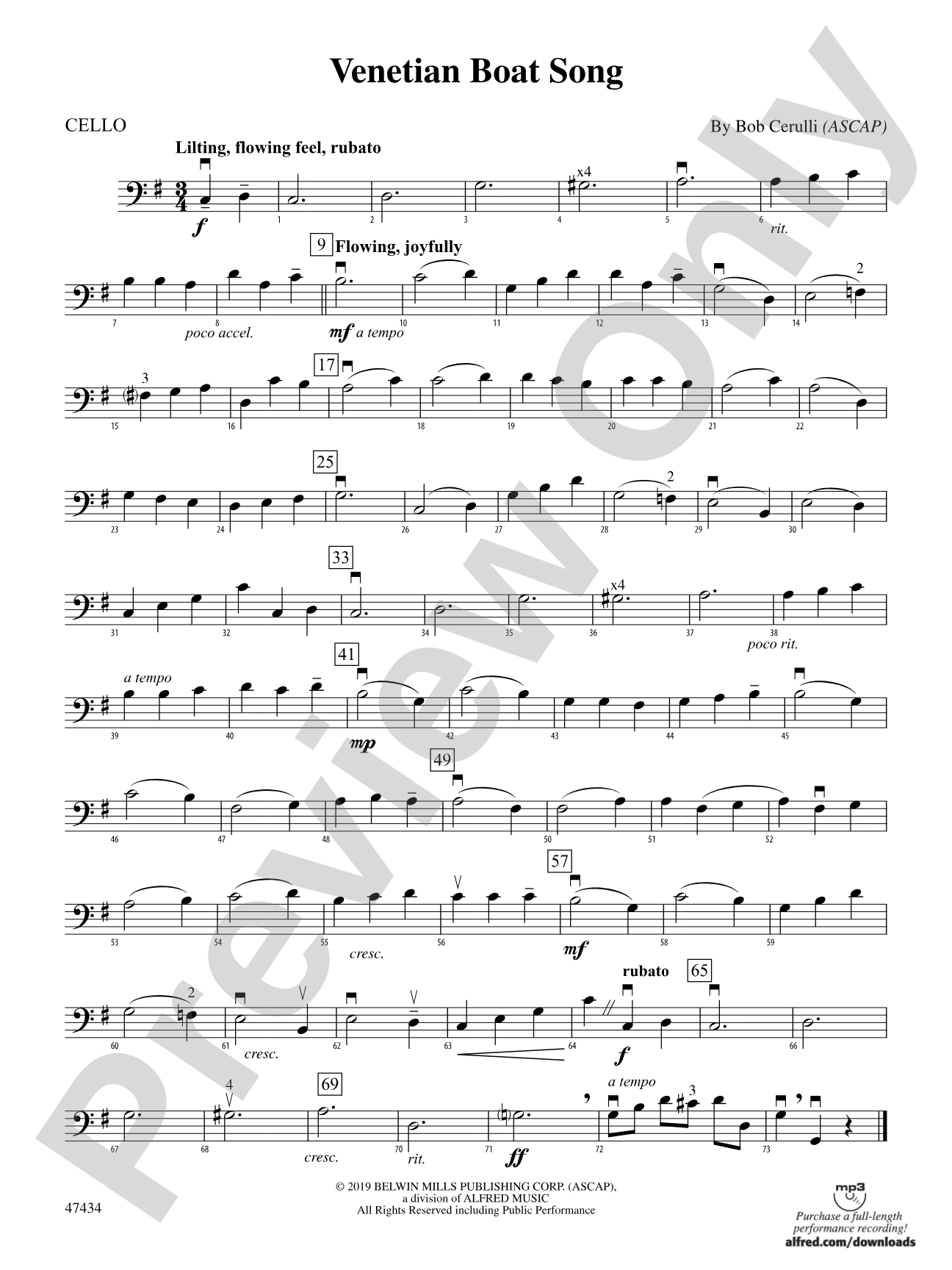

Venetian Boat Song: Cello
By Bob Cerulli
Grade: 2
Item: 00-PC-0017965_VC1
$5.99
Pickup currently not available
Description
This piece will make your students and audience feel like they are paddling through the waterways of Venice. Optional tremolo imitates the sound of mandolins, and the beautiful melody sounds like an Italian love song. Easy fingerings make this a wonderful grade 2 concert piece.


Don't just read it, hear it, play along with it, and watch your students grow with it. In MakeMusic Cloud, Venetian Boat Song: Cello comes alive with professional accompaniment, adjustable tempo, and built-in practice tools that turn solo practice into real progress.
Open in the Player
Jump straight in and assign it today.
Start Your Free Trial
Open this title and explore the full library in minutes.
Sample Audio
1
Audio File
--:--
0:00
0:00
Sample Video
Additional Details
Series:
Belwin Intermediate String Orchestra
Publisher:
Alfred Music
Page Count:
72
SKU:
00-PC-0017965_VC1
More about this title
About the Composer: Bob Cerulli

Bob Cerulli studied double bass at the Curtis Institute of Music under Roger Scott, then completed degrees in music education at the University of the Arts and conducting at the College of New Jersey. He performed as Principal Bass with the Greater Trenton Symphony, The New Jersey Capital Philharmonic Orchestra, and Delaware Valley Philharmonic Orchestra, and freelanced extensively in Philadelphia and Atlantic City alongside Broadway performers and film composers including Henry Mancini, Bill Conte, Michel LeGrand, and Marvin Hamlisch.
Cerulli spent 29 years as a public school music teacher and now serves as a Senior Adjunct Professor at Rowan College at Burlington County. His compositions have been performed by major orchestras; the Philadelphia Orchestra premiered his work Celebration, and Philadelphia Orchestra Principal Cellist William Stokking performed the premiere of his Romance in D Major. He has conducted orchestral reading sessions and performances at regional music festivals.
Why we love this
Cerulli has written a piece that delivers exactly what Grade 2 orchestras need: immediate musical reward paired with genuine technical accessibility. The optional tremolo adds color and orchestration interest without overcomplicating the fundamentals, and the Italian song-like melody gives students real musicality to shape rather than just notes to read.
What to expect
Calm and contemplative, like watching light dance across canal water at dusk. The melody floats above a gently rocking accompaniment, evoking the meditative rhythm of oars and the romantic character of a traditional Italian serenade.
Who it's for
Grade 2 string orchestras that are ready to play with lyrical expression and orchestral color but still need straightforward technical demands. This piece works equally well for students building basic vibrato and tone control as it does for groups preparing a concert program.
How to get the most out of it
- Balance the melody between first and second violins so the phrasing flows as a single voice, even when the line splits between sections. This vocal quality is what makes the piece sing.
- Approach the tremolo sections as an accompaniment layer rather than a prominent effect; let it shimmer beneath the melody without overwhelming the texture.
- Use the easy fingerings as written to keep left-hand preparation minimal, allowing students to focus on tone production and phrase direction instead of struggling with position shifts.
- Shape the piece with gentle dynamic curves rather than dramatic contrasts; the beauty lies in subtle waxing and waning that mirrors the gentle motion of a gondola.
How to use it
Open a spring or end-of-year concert with this piece to establish an elegant mood and showcase the orchestra's lyrical abilities early. Its accessible Grade 2 level makes it an ideal companion to more technically demanding works on the same program, or pair it with other evocative character pieces that explore European musical traditions.
Skills your students will build
- Sustaining long tones with consistent intonation and vibrato control
- Playing tremolo with control and evenness
- Maintaining phrasing across string section divisions
- Balancing melody and accompaniment texture in an orchestra
- Reading and responding to subtle dynamic shaping