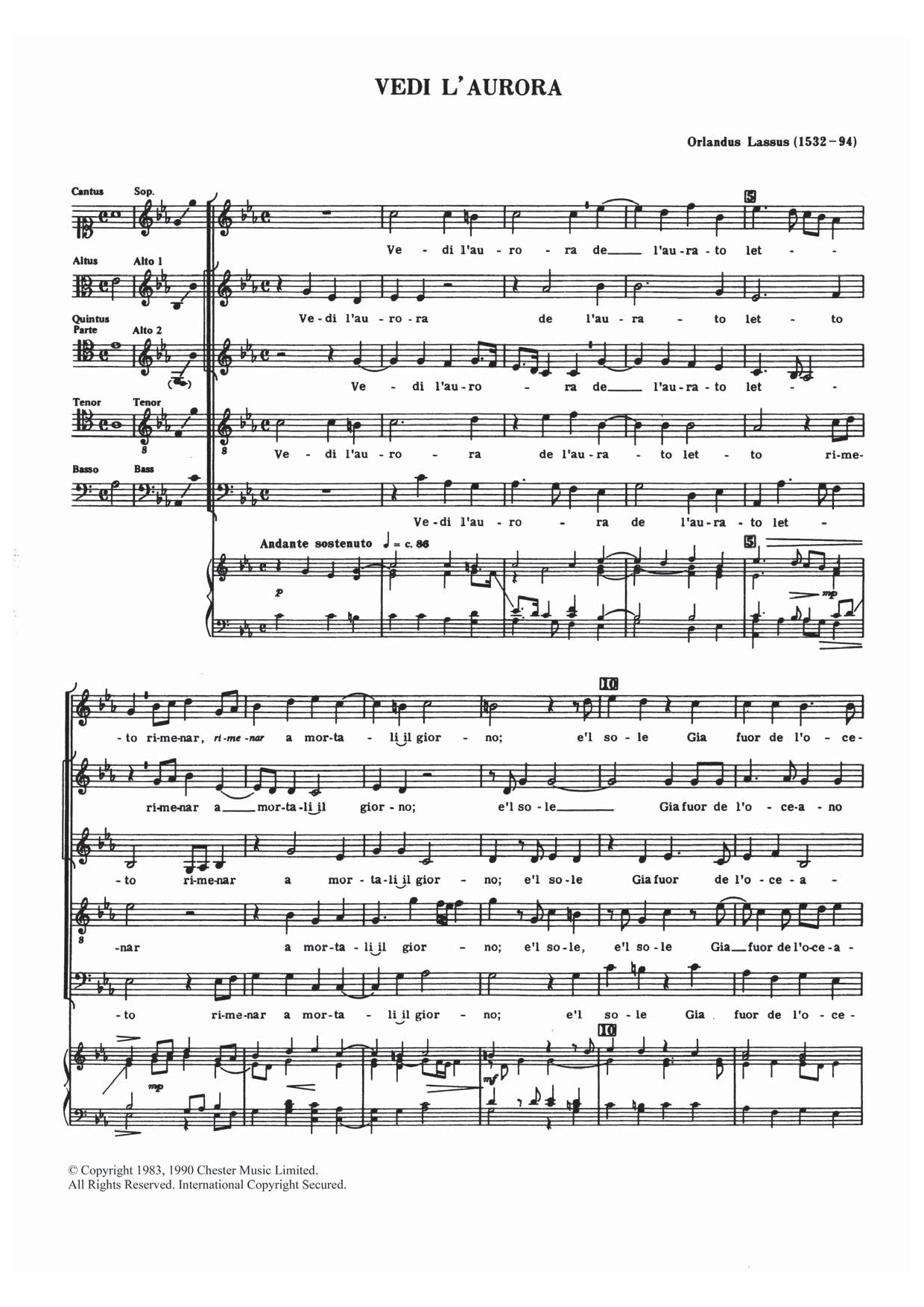
Vedi L'aurora Sheet Music Preview

Vedi L'aurora: Choral Octavo

As performed by Orlandus Lassus / Arranged by Anthony Petti

Item: 35-DS00333619

Digital Download
$2.99
Description

Vedi L'aurora: Choral Octavo isn't in MakeMusic Cloud just yet...but it could be. Let us know you'd like to see it, and you'll help shape what comes next. In the meantime, start a free trial and dive into thousands of interactive titles your students can play along with today.

Sample Audio
No sample audio found.
Sample Video
Additional Details
Publisher: Hal Leonard
Page Count: 3
SKU: 35-DS00333619

More about this title

About the Artist: Orlandus Lassus

Orlandus Lassus (c. 1532–1594) stands as one of the Renaissance's most prolific and versatile composers, with over 2,000 works spanning every major vocal genre. His career took him across Europe's musical centers, from Italy to Bavaria, and he served as maestro di cappella at the Munich court for three decades. Lassus excelled at setting secular texts with expressive clarity and harmonic sophistication, making him a model for both sacred and profane composition throughout the 16th century.

For choral directors today, Lassus represents an accessible entry point into Renaissance polyphony. His secular motets and madrigals balance contrapuntal craft with singable lines and emotional directness, qualities that make his music rewarding for developing ensembles and sophisticated enough to hold attention in concert programming.

Why we love this

This octavo captures the lyrical ease that made Lassus a favorite among Renaissance singers and still appeals to modern choirs. The text painting and harmonic movement feel natural rather than mannered, allowing singers to connect with the music's warmth while building real polyphonic literacy. It's the kind of piece that sits comfortably in a mixed repertoire program without demanding excessive rehearsal time.

What to expect

Sunlit and contemplative. The piece unfolds with the unhurried grace of early morning, its text set in language that sings as naturally as speech. Harmonies shift gently beneath flowing lines, creating moments of brightness and shadow that feel earned rather than imposed.

Who it's for

Mixed or equal-voice choirs developing Renaissance fluency will find this a natural choice for repertoire building. It works equally well for auditioned chamber ensembles and parish choirs seeking material that sounds substantial without excessive difficulty.

How to get the most out of it

  • Shape phrases by listening across all four parts rather than treating your line in isolation; Lassus wrote the voices as equals, and the beauty emerges when they breathe together.
  • Tune the thirds and sixths generously in the Renaissance style, favoring pure intervals over equal temperament, especially at cadences.
  • Balance clarity of text with smooth voice leading; this is secular music meant to convey meaning, so articulation should serve the language without disrupting melodic continuity.
  • Mark the harmonic shifts that support the text and plan your dynamic support accordingly; subtle shaping around these moments gives the piece dimension without sounding self-conscious.

How to use it

Pair this with other Renaissance secular works to build a coherent concert section, or use it as an anchor piece for a program exploring text painting across centuries. Its modest length and accessible character also make it ideal for student-led repertoire rehearsals or festivals where quick preparation is necessary.

Skills your students will build

  • Reading Renaissance clefs and note values with fluency
  • Balancing independent voice lines within four-part harmonic texture
  • Tuning pure intervals and adjusting pitch for harmonic resonance
  • Coordinating text declamation across a polyphonic ensemble
  • Recognizing harmonic function and text painting in secular vocal music

You May Also Like