
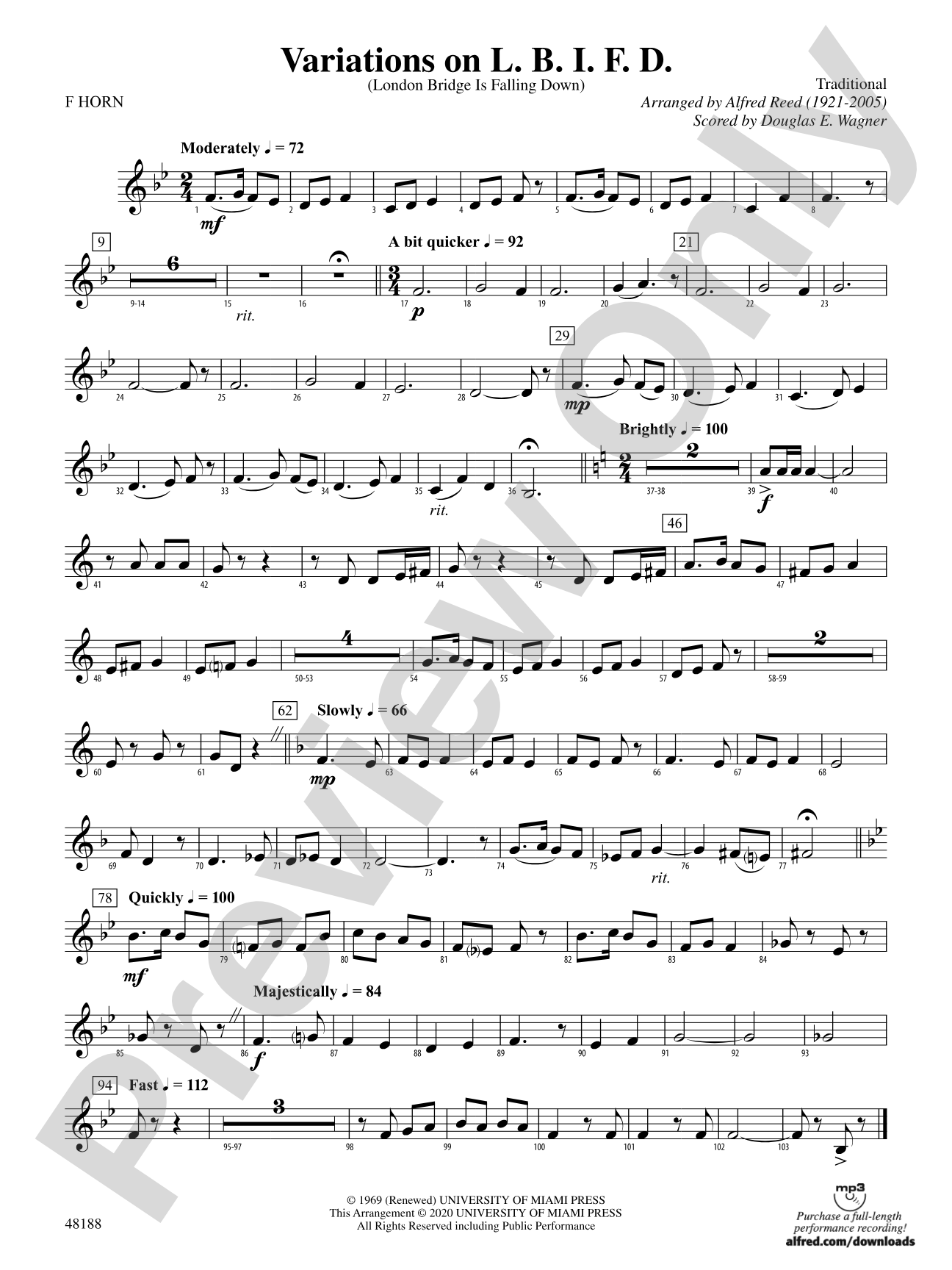

Variations on L. B. I. F. D.: 1st F Horn
(London Bridge Is Falling Down)
Traditional / arr. Alfred Reed / Scored by Douglas E. Wagner
Grade: 2 (Medium Easy)
Item: 00-PC-0018415_H1
$3.00
Pickup currently not available
Description
Alfred Reed needs no introduction for those who admire his distinguished concert band works. This arrangement for concert band draws from five movements of his original 28 composed for brass quintet based on "London Bridge Is Falling Down." Included are: "Statement," "Waltz," "March Fo(u)rth!," "A Little Funeral Music, Please (Eine Kleine Trauermusik)," and "Finale." A demonstration of compositional techniques practiced during the past three centuries, the work is filled with captivating and highly musical moments. Even though players will encounter a few changes in tonal centers, meters, and tempo throughout, there is not much that would get in the way of having a fun experience learning and performing. (2:45)


Don't just read it, hear it, play along with it, and watch your students grow with it. In MakeMusic Cloud, Variations on L. B. I. F. D.: 1st F Horn comes alive with professional accompaniment, adjustable tempo, and built-in practice tools that turn solo practice into real progress.
Open in the Player
Jump straight in and assign it today.
Start Your Free Trial
Open this title and explore the full library in minutes.
Sample Audio
1
Audio File
--:--
0:00
0:00
Sample Video
Additional Details
Series:
Pop Young Band
Publisher:
Alfred Music
Page Count:
124
SKU:
00-PC-0018415_H1
More about this title
About the Composer: Douglas E. Wagner

Douglas E. Wagner grew up in Chicago and earned both his undergraduate and graduate degrees in music from Butler University. He spent three decades as a high school music teacher and administrator before committing himself fully to composition.
Since 1973, Wagner has published over 3,500 works across virtually every ensemble format: choir, concert band, orchestra, handbell ensemble, organ, piano, and voice. His output has reached performance venues globally, with millions of copies distributed to schools, churches, and concert halls worldwide. He currently lives in Indianapolis with his wife, Sandy.
Why we love this
Alfred Reed's legendary command of orchestration transforms a simple, beloved melody into a sophisticated journey through five distinctly voiced movements. The Grade 2 accessibility combined with genuine compositional depth makes this both playable for developing ensembles and genuinely rewarding to conduct and hear. It checks every box: recognizable source material, clear stylistic contrasts, pedagogical value, and pure musical satisfaction.
What to expect
Five snapshots of the same tune, each revealing a different facet of its personality. You move from straightforward elegance into the lilt of a waltz, then march smartly forward before pausing for a moment of dark comedy in the funeral music. The finale ties everything together with wit and momentum, leaving players and listeners equally satisfied.
Who it's for
Concert bands at the Grade 2 level seeking a piece that entertains without sacrificing musicianship. This work appeals equally to school directors building student confidence and to community ensembles who value clever writing and melodic familiarity. Anyone wanting to program something that audiences recognize and musicians enjoy playing.
How to get the most out of it
- Balance the instrumentation across movements as the texture shifts. The "Statement" and "Waltz" require clarity in the woodwind voicings, while "March Fo(u)rth!" benefits from a crisp articulation in the march sections.
- Mark the meter and tempo changes clearly in your score before rehearsal. The piece moves between multiple tonal centers and time signatures; players who can anticipate these shifts will settle into each new section with confidence.
- Let the "Funeral Music" breathe. This movement thrives on space and restraint, so resist the impulse to rush through it. The contrast it creates with surrounding sections will land harder with ensemble and audience alike.
- Feature your solo players in the "Finale." Reed's arrangement typically highlights individual voices in the closing section; giving these moments spotlight treatment adds character and keeps the energy fresh through the end.
How to use it
This piece thrives as a concert opener or closer, where its brevity (2:45) and distinct sectional nature create sharp programming impact. It also works beautifully alongside other Reed arrangements or contemporary band works as part of a "variations on a theme" concert concept. The piece's accessibility and fun factor make it ideal for spring concerts or family-friendly performances where you want to balance serious repertoire with something that puts both audience and ensemble at ease.
Skills your students will build
- Reading multiple meter and tempo changes within a single piece
- Maintaining style consistency across contrasting musical moods (lyrical, dance-like, march, funeral, energetic)
- Balancing transparent orchestration in woodwind-led passages
- Executing articulation clarity in march and rhythmic sections
- Responding to conductor direction through frequent structural shifts