
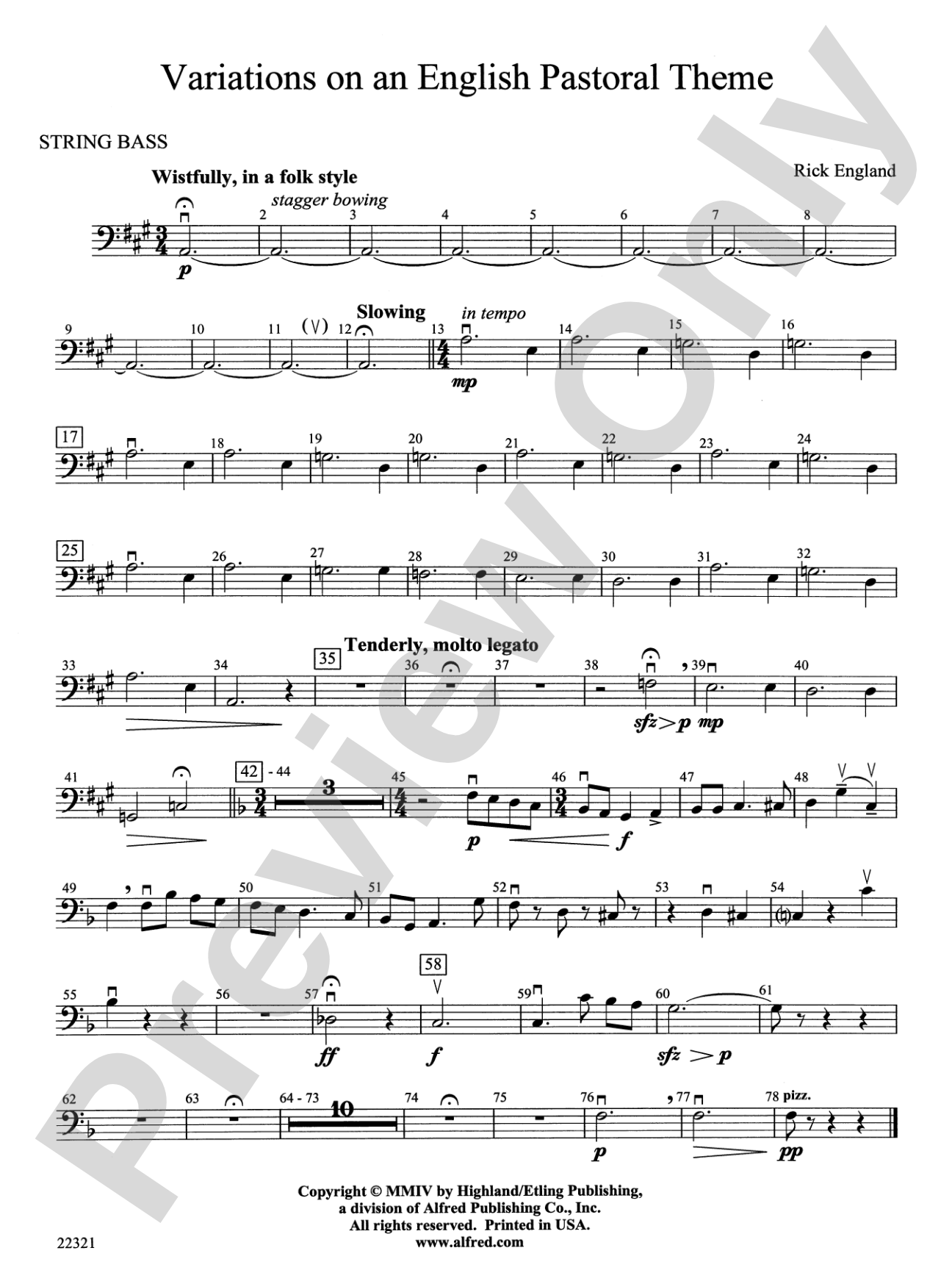

Variations on an English Pastoral Theme: String Bass
By Rick England
Grade: 3
Item: 00-PC-0000570_SB
$5.99
Pickup currently not available
Description
Variations on an English Pastoral Theme is based on the tune "Brother James's Air." At the heart of the piece is the opening violin solo melody, which is rather free-form in a wistful, quasi-improvisatory folk style-as if played while sitting outdoors on a rock. The melody wanders in and out of modal territory in the manner of early 20th century English string suites. Subsequent variations feature guitar-like accompaniment, duets, fragments of melodic material for each instrument, and a wide range of sweeping dynamic contrasts. The piece closes quietly, as it began, but in a new key with the solo in the cello.


Don't just read it, hear it, play along with it, and watch your students grow with it. In MakeMusic Cloud, Variations on an English Pastoral Theme: String Bass comes alive with professional accompaniment, adjustable tempo, and built-in practice tools that turn solo practice into real progress.
Open in the Player
Jump straight in and assign it today.
Start Your Free Trial
Open this title and explore the full library in minutes.
Sample Audio
1
Audio File
--:--
0:00
0:00
Sample Video
No sample videos found.
Additional Details
Series:
Highland/Etling String Orchestra
Publisher:
Alfred Music
Page Count:
62
SKU:
00-PC-0000570_SB
More about this title
Why we love this
Rick England captures the essence of early 20th century English string writing without relying on pastiche or heavy arrangement. The piece earns its Grade 3 rating through genuinely musical challenges (modal writing, sustained lyricism, dynamic control) rather than technical flashiness, making it rewarding for orchestras ready to move beyond simple arrangements into real compositional craft.
What to expect
Quiet reflection in open air. The piece unfolds as a series of contemplative variations on a folk melody, each one revealing new instrumental color and harmonic possibility while maintaining an underlying sense of stillness and introspection. The journey closes as intimately as it began, only to shift key and perspective in the final cello statement.
Who it's for
String orchestras at Grade 3 seeking repertoire that builds musicianship and interpretive depth. This work suits orchestras ready to engage with modal harmony, sustain long lines with control, and explore the lyrical possibilities of the ensemble.
How to get the most out of it
- Shape the opening violin solo with freedom and breath, as if improvising. The quasi-folk character requires restraint from metronomic precision; let rubato and phrase-length phrasing emerge naturally from the melody's contour.
- Balance the guitar-like accompaniment textures so they support rather than swallow the primary melodic line. These sections ask for transparency and clean articulation across the section.
- Pay close attention to dynamic contrasts between variations. The wide range of sweeping dynamics that defines the piece only lands if every entrance and transition is consciously shaped.
- The final shift to cello solo in a new key is a delicate moment. Ensure the shift in tonal center registers clearly for the listener while maintaining the hushed, reflective quality of the closing.
How to use it
Program this as a concert opener or interlude that sets a reflective mood; its chamber-like quality and subdued closing make it an ideal transition into other repertoire. It works equally well on festival concert programs where judges can hear genuine compositional voice and ensemble musicianship in a Grade 3 context.
Skills your students will build
- Reading and performing modal melodies with sensitivity to tonal centers outside traditional major/minor
- Sustaining long, lyrical lines with consistent tone and intonation
- Balancing transparent accompaniment textures that support rather than obscure primary melodic material
- Responding to rubato and interpretive freedom in an orchestral context
- Navigating wide dynamic ranges with control and intentionality
- Sectional awareness across multiple variations with distinct instrumental roles