
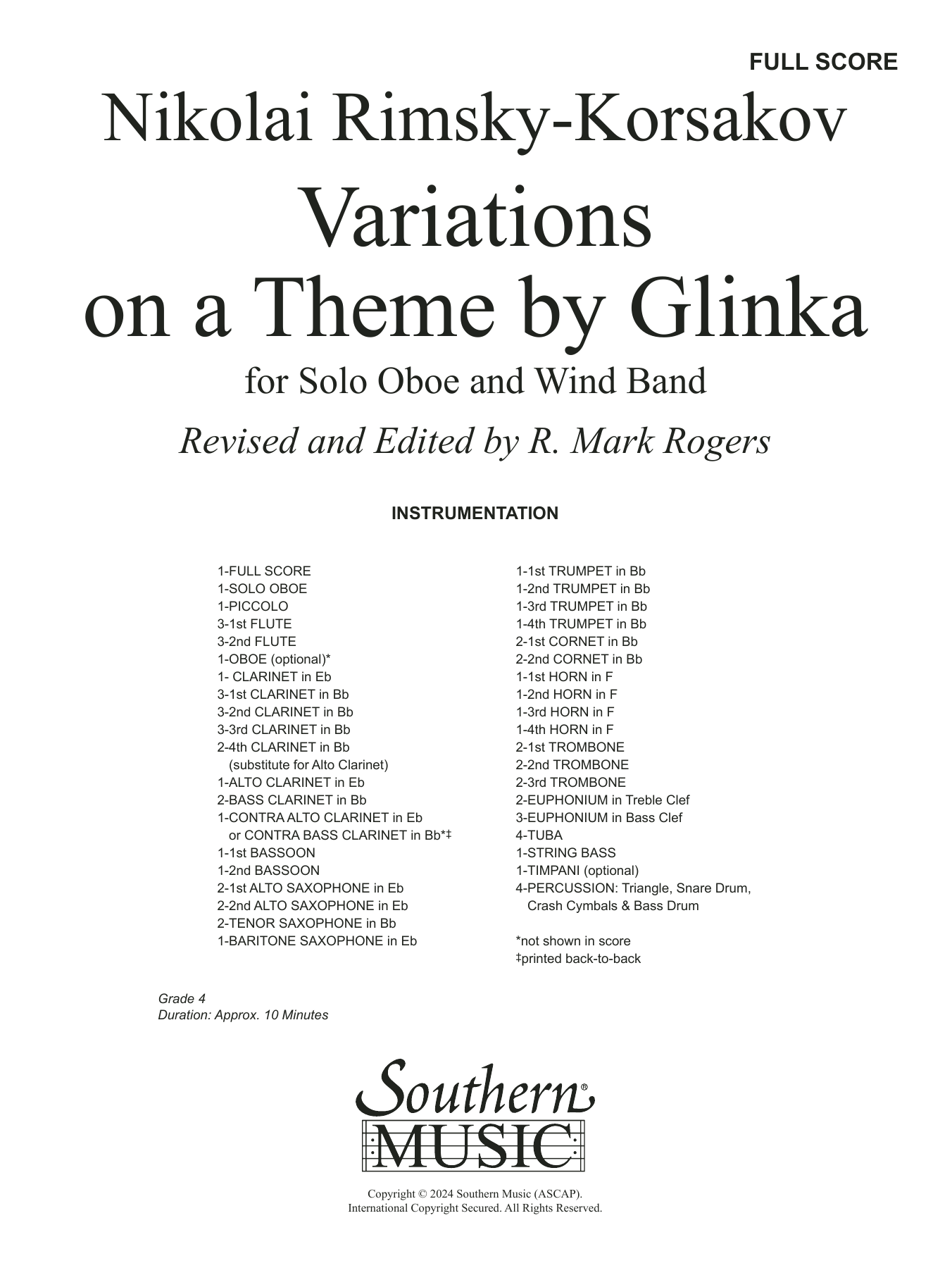

Variations on a Theme by Glinka for Solo Oboe and Wind Band (arr. R. Mark Rogers): Concert Band Conductor Score & Parts
By Nicolai Rimsky-Korsakov / Arranged by R. Mark Rogers
Grade: 4
Item: 35-PK01724813
$85.00
Pickup currently not available
Buy Extra Parts (Digital PDF Download)
Parts Added to Cart!
Description
Nikolai Rimsky-Korsakov's VARIATIONS ON A THEME BY GLINKA was written for solo oboe accompanied by wind band. The theme of the Variations is in a fact a folksong melody which is still occasionally heard in Russia. This edition of VARIATIONS ON A THEME BY GLINKA is based on the full score published by the Russian state publishers and a number of editions of the same piece for solo oboe and piano. Adapted for the present day wind band, the corno basso accompaniment has been rescored for bass clarinet reinforced by the string bass. Saxophones have been added to the instrumentation in tutti sections, along with rehearsal numbers throughout the meticulously edited full score.


Variations on a Theme by Glinka for Solo Oboe and Wind Band (arr. R. Mark Rogers): Concert Band Conductor Score & Parts isn't in MakeMusic Cloud just yet...but it could be. Let us know you'd like to see it, and you'll help shape what comes next. In the meantime, start a free trial and dive into thousands of interactive titles your students can play along with today.
Request This Title
Tell us you want it.
Start Your Free Trial
Explore everything that's ready to play right now.
Sample Audio
No sample audio found.
Sample Video
No sample videos found.
Additional Details
Publisher:
Hal Leonard
SKU:
35-PK01724813
More about this title
About the Composer: Nicolai Rimsky-Korsakov
Nicolai Rimsky-Korsakov (1844–1908) stands as one of Russia's most distinctive orchestral voices, celebrated for his vivid instrumental colors and deep engagement with Russian folk music. His ability to weave traditional melodies into sophisticated harmonic frameworks made him both a composer of concert works and a vital figure in preserving Russian musical culture. His pedagogical influence extended through his teaching at the St. Petersburg Conservatory, where he shaped generations of Russian composers.
Why we love this
The oboe sits at the heart of this work with the kind of lyrical space that makes student soloists sound genuinely musical. Rather than demanding technical fireworks, Rogers's arrangement respects the original's songlike quality while giving the wind band a richly scored accompaniment that stays responsive to the soloist's phrasing. The folk melody carries immediate appeal for audiences while the variations structure gives your ensemble clear architectural landmarks to shape.
What to expect
The familiar folksong melody unfolds with the kind of emotional directness that feels both intimate and grand depending on the variation. Each section deepens or colors the original theme through orchestration and harmonic treatment, creating a journey that holds audiences while remaining accessible. There is something inherently Russian in the character: lyrical, ornamental without becoming precious, and grounded in the music's traditional roots.
Who it's for
This arrangement serves Grade 4 bands with an advanced oboe soloist who can sustain a singing line and respond expressively to the accompaniment. It works equally well for concert bands looking to feature a strong principal oboe and for programs seeking Russian repertoire that resonates with general audiences.
How to get the most out of it
- Balance the bass clarinet and string bass foundation carefully; they replace the original corno basso and need to anchor the harmony without overwhelming the oboe's line.
- Let the oboe breathe naturally across phrase shapes rather than snapping off at every rest; the melody has Russian vocal music written into its DNA.
- Use the rehearsal numbers to isolate each variation's character during sectionals; marking how the accompaniment texture changes between variations helps the band stay responsive to the soloist.
- Shape the dynamics as a collaborative conversation; when the band swells in forte passages, the oboist should feel supported rather than buried.
How to use it
Position this work in the second or third slot of a concert where it can claim focused attention as a featured oboe showcase. It pairs well alongside shorter band selections or light overtures, offering audiences a satisfying chamber work quality within the full ensemble context. The moderate length and clear structure make it ideal for spring concerts or music festival programming.
Skills your students will build
- Balance and blend in accompanimental writing (responding dynamically to a solo line)
- Identifying and executing stylistic contrasts between variations
- Oboe solo technique including sustained lyricism and expressive phrasing
- Historical listening skills through engagement with Russian folk melody and 19th century harmonic language
- Sectional independence (winds, reeds, low brass) within a coordinated ensemble texture