
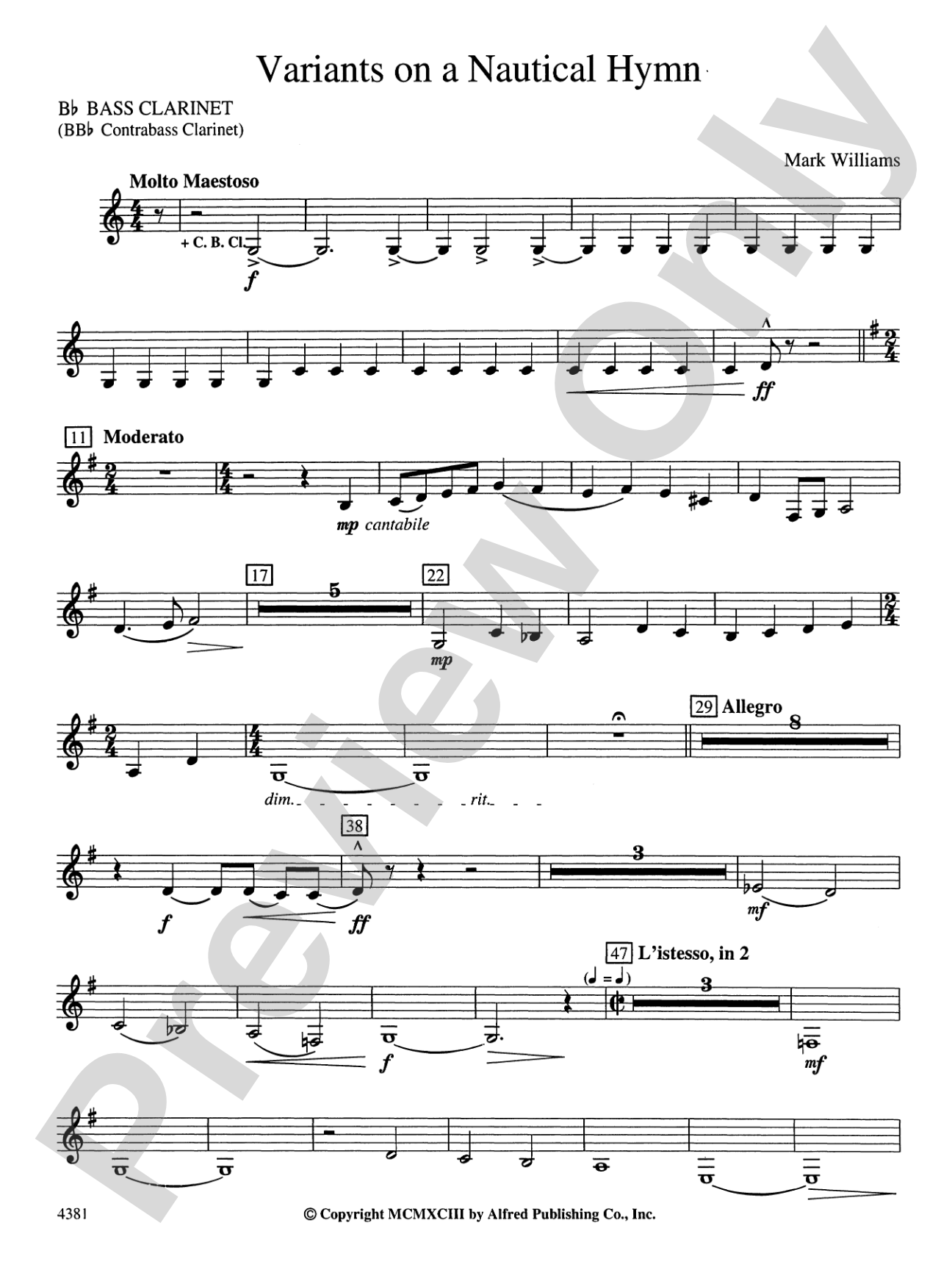

Variations on a Nautical Hymn: B-flat Bass Clarinet
Arr. Mark Williams
Grade: 4 (Medium Difficult)
Item: 00-PC-0015171_BC
$3.00
Pickup currently not available
Description
Based on the Naval Hymn, "Eternal Father, Strong to Save," this work opens with an aggressive fanfare which leads to the hymn, stated in a chorale fashion. The first variant is Allegro and features interplay between rhythmic figures in the percussion section with mirrored polychords in the woodwinds. The second variant is reminiscent of the music of Erik Satie and features a beautiful pairing of flute and oboe solos supported by strong countermelodies played by the horns. A third variant in 6/8 provides another interesting point of view before the work closes in Maestoso fashion. Another Mark Williams masterpiece!


Don't just read it, hear it, play along with it, and watch your students grow with it. In MakeMusic Cloud, Variations on a Nautical Hymn: B-flat Bass Clarinet comes alive with professional accompaniment, adjustable tempo, and built-in practice tools that turn solo practice into real progress.
Open in the Player
Jump straight in and assign it today.
Start Your Free Trial
Open this title and explore the full library in minutes.
Sample Audio
1
Audio File
--:--
0:00
0:00
Sample Video
No sample videos found.
Additional Details
Series:
Alfred Concert Band
Publisher:
Alfred Music
Page Count:
284
SKU:
00-PC-0015171_BC
More about this title
About the Arranger: Mark Williams

Mark Williams composed and arranged over 200 works for school bands, orchestras, and choirs during a prolific career that made him one of the most performed voices in American band literature. A native of Chicago who spent his formative years in Spokane, Washington, Williams earned degrees in education from Eastern Washington University and brought his deep understanding of student musicians to every score he wrote. His work as co-author of the Accent on Achievement Band Method reflected his pedagogical philosophy: music for young ensembles should be sophisticated without being prohibitively difficult.
Beyond the page, Williams was a clinician and guest conductor whose influence extended across 34 states, five Canadian provinces, and Australia. He held principal positions as woodwind performer and arranger with the 560th Air Force Band and served as conductor and artistic director for the Spokane British Brass Band. His compositions earned recognition through the Gralia Competition at the Western International Band Clinic and multiple ASCAP Special Awards, cementing his legacy as a composer who understood both the capabilities and aspirations of student musicians.
Why we love this
This arrangement transforms a solemn sacred melody into a showcase for creative variation and orchestration. Williams keeps the hymn itself reverent and chorale-like, then opens the door for inventive musical storytelling: the Satie-influenced variant is genuinely elegant, the percussion-and-woodwind interplay in the Allegro section demands ensemble focus, and the 6/8 section provides rhythmic relief before the majestic close. The whole arc feels substantial without overshadowing the hymn's dignity.
What to expect
Stately and ceremonial at its core, yet restless with invention. The hymn arrives with weight and dignity, but Williams immediately sets about exploring it from different angles: a crisp, syncopated Allegro; a contemplative Satie-tinged meditation; a lilting 6/8 reinterpretation. The effect is profound rather than flashy, allowing the familiar melody to reveal new dimensions while never losing sight of its sacred character.
Who it's for
Concert bands at the Grade 4 level who are ready for music that combines technical precision with emotional sophistication. Ensembles that have already developed strong fundamental skills and can handle multiple meter changes and rhythmic complexity will find this arrangement rewarding both to rehearse and to perform.
How to get the most out of it
- Balance the fanfare opening with clarity rather than brute force; let the brass articulation define the gesture so the chorale statement that follows feels genuinely contemplative by contrast.
- In the Allegro variant, drill the woodwind polychords and percussion rhythms separately with their mirrored parts before combining them. The interplay only lands if both sections are rock-solid on their own material.
- Shape the flute and oboe solos in the Satie-influenced section with genuine rubato; support them with horn countermelodies that breathe naturally rather than mechanically.
- Approach the 6/8 variant as a fresh harmonic landscape, not a faster version of what came before. Reset the band's articulation and phrasing to suit the meter and mood shift.
How to use it
Program this at a festival or concert where you want to showcase your band's ability to balance reverence with musicianship. It sits naturally on a concert pairing it with a march or contemporary concert piece, or on a patriotic program where the Naval Hymn's military heritage resonates. The substantial length and contest/festival designation also make it excellent for spring contests where judges reward thoughtful arrangement and precise execution.
Skills your students will build
- Reading and executing multiple meter changes (including 6/8 against 4/4 or cut time contexts)
- Blend and balance in polyphonic writing, especially when multiple instrumental choirs carry equal musical weight
- Ensemble rhythmic precision during syncopated passages with cross-rhythms between sections
- Sustaining musical shape across a large-scale multi-movement structure
- Dynamic and tonal control in chorale-style hymnody and legit melodic playing