
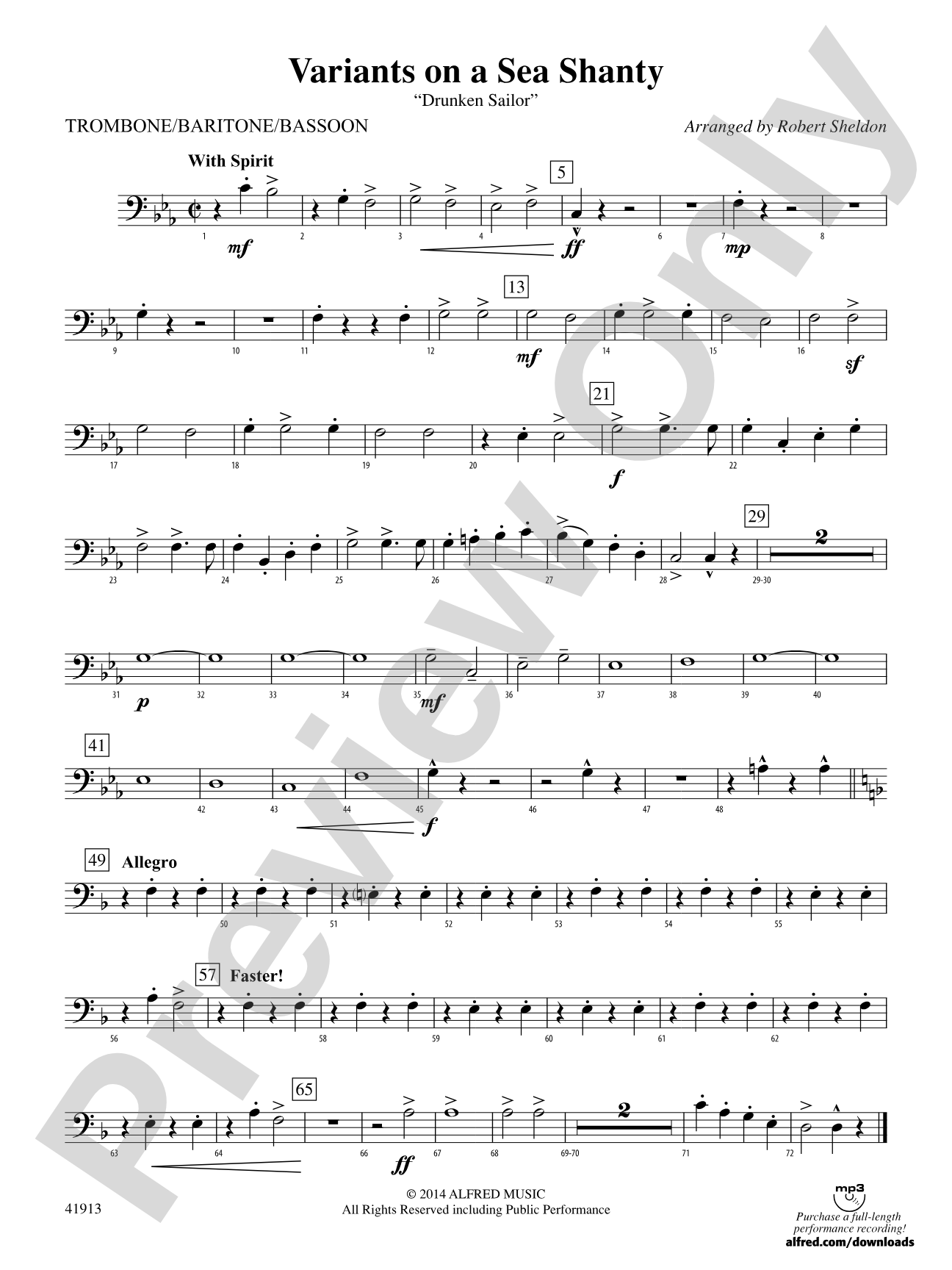

Variants on a Sea Shanty: 1st Trombone
Drunken Sailor
Various / arr. Robert Sheldon
Grade: 1.5 (Easy)
Item: 00-PC-0016395_TN1
$3.00
Pickup currently not available
Description
"Drunken Sailor" is among the best-known of the sea shanties and became a popular song among non-sailors during the 20th century. The infectious tune has lyrics that ask the question, "What do we do with a drunken sailor early in the morning?" Each subsequent verse suggests various forms of punishment for the poor chap. This spirited arrangement is sure to delight audiences with a sparkling and energetic setting of this familiar tune. (1:25) "Variants on a Sea Shanty" correlates to Book 2, Level 3 of Sound Innovations for Concert Band.


Don't just read it, hear it, play along with it, and watch your students grow with it. In MakeMusic Cloud, Variants on a Sea Shanty: 1st Trombone comes alive with professional accompaniment, adjustable tempo, and built-in practice tools that turn solo practice into real progress.
Open in the Player
Jump straight in and assign it today.
Start Your Free Trial
Open this title and explore the full library in minutes.
Sample Audio
1
Audio File
--:--
0:00
0:00
Sample Video
No sample videos found.
Additional Details
Series:
Sound Innovations for Concert Band
Publisher:
Alfred Music
Page Count:
136
SKU:
00-PC-0016395_TN1
More about this title
About the Arranger: Robert Sheldon

Robert Sheldon's arrangements and compositions saturate the wind band repertoire worldwide. Beyond his prolific output as a composer, Sheldon co-authored Sound Innovations for Concert Band, the method series that frames this work educationally. His accolades from the American School Band Director's Association, Phi Beta Mu, and ASCAP reflect the consistent quality and pedagogical thoughtfulness of his work.
Sheldon's conducting career spans continents. He has guest-conducted All-State and Regional Honor Bands across the United States and internationally in Japan, Canada, Italy, Germany, Australia, and China. His compositions have graced Carnegie Hall, Orchestra Hall, Symphony Hall, the Sydney Opera House, and the Kennedy Center. VanderCook College of Music awarded him an honorary doctorate in 2020, recognizing his sustained impact on wind band education and performance.
Why we love this
Sheldon transforms a beloved folk melody into a vehicle that teaches ensemble fundamentals without sacrificing the joy of playing. The sparkling orchestration keeps young musicians engaged while the familiar tune provides an immediate hook for audiences. At Grade 1.5, it sits perfectly for developing bands wanting to build confidence with recognizable material.
What to expect
Salty and sprightly. The arrangement captures the rollicking spirit of the original while maintaining clarity and precision. You'll feel the swagger of the melody contrasted with clever harmonic surprises, all built on a sturdy foundation that young players can trust beneath them.
Who it's for
Concert bands in their first or second year of development will find this accessible and rewarding. Sheldon's Grade 1.5 setting accommodates typical instrumentation and technical demands while delivering the polish expected at a concert or festival.
How to get the most out of it
- Keep the rhythmic energy driving forward through section changes. Sheldon's orchestration relies on crisp articulation to maintain the shanty's infectious character, so lock in the subdivision early.
- Balance the melody across sections carefully. Depending on which instruments carry the tune in each variant, adjust your balance to keep "Drunken Sailor" audible without letting any section overshadow the harmonic foundation.
- Shape each variation as a distinct statement. Rather than playing through the entire piece as one continual energy level, give each variant its own entrance and character. This keeps the audience tracking the transformations Sheldon makes to the melody.
- Communicate the humor of the text. Even as an instrumental arrangement, the shanty's narrative about the unfortunate sailor lives in the music. A knowing energy in rehearsal and performance will land with your audience.
How to use it
Program this as the heart of a lighter concert set where it can anchor audience engagement. Its familiar melody and energetic treatment make it an excellent bridge between a classical opener and other light fare. It also performs well at festivals where judges appreciate both accessibility and genuine musicianship.
Skills your students will build
- Maintaining rhythmic precision through tempo changes and textural shifts
- Balancing melody and accompaniment across varied orchestrations
- Responding to conductor gestures that define each new variant
- Sustaining ensemble cohesion at fast tempos with clean articulation
- Building confidence with recognizable melodic material while expanding technical range