
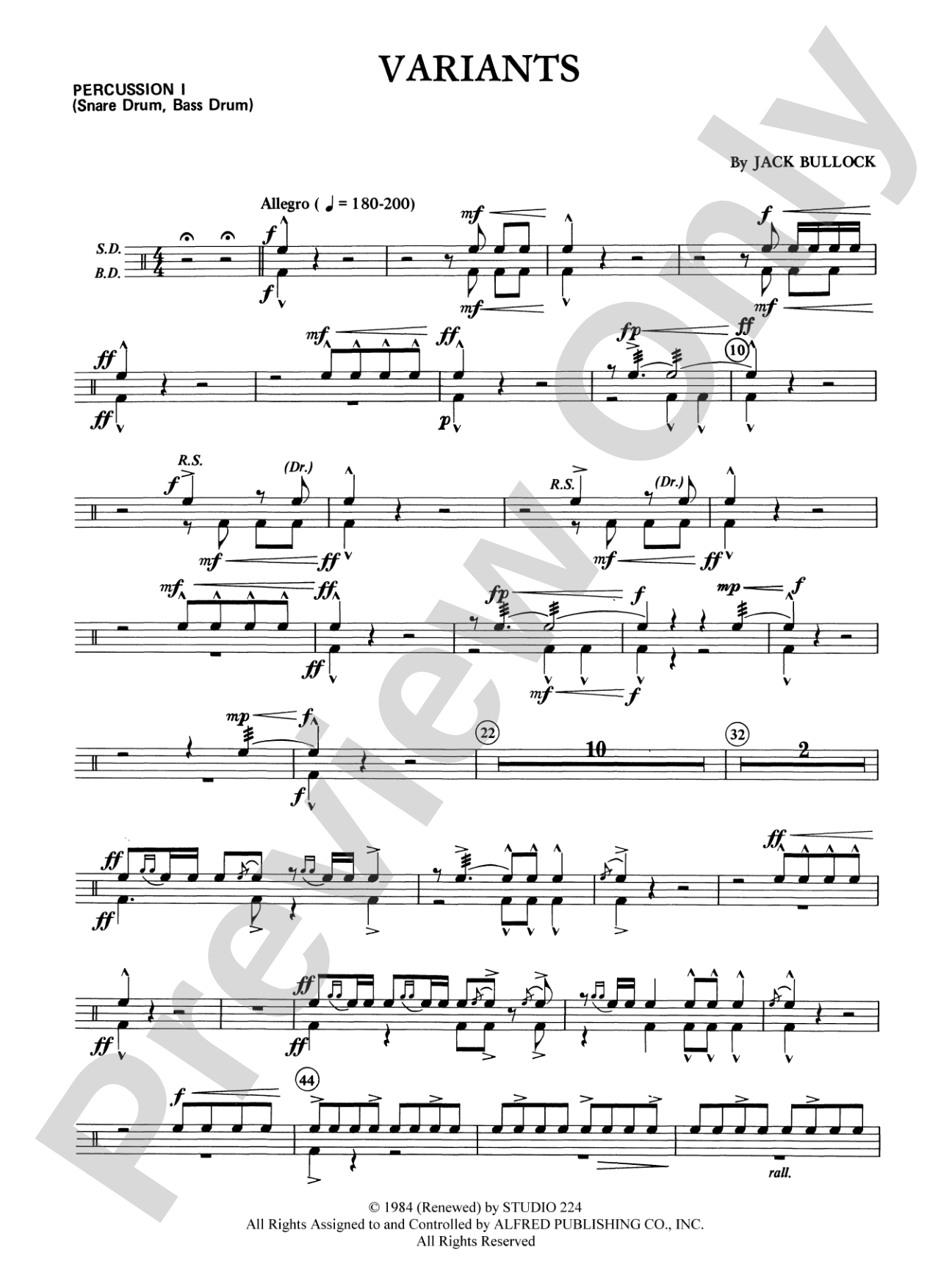

Variants: 1st Percussion
By Jack Bullock
Grade: 3 (Medium Easy)
Item: 00-PC-0002550_PC1
$5.99
Pickup currently not available
Description
This superb concert literature is certain to build enthusiasm among your students. Structured in A-B-A form and derived from the main theme's rhythmic motif, soaring melodies are punctuated musically with engaging rhythmic content to make this work stand out as a crowd pleaser. Bold and impressive!


Don't just read it, hear it, play along with it, and watch your students grow with it. In MakeMusic Cloud, Variants: 1st Percussion comes alive with professional accompaniment, adjustable tempo, and built-in practice tools that turn solo practice into real progress.
Open in the Player
Jump straight in and assign it today.
Start Your Free Trial
Open this title and explore the full library in minutes.
Sample Audio
1
Audio File
--:--
0:00
0:00
Sample Video
No sample videos found.
Additional Details
Series:
Belwin Concert Band
Publisher:
Alfred Music
Page Count:
256
SKU:
00-PC-0002550_PC1
More about this title
About the Composer: Jack Bullock

Jack Bullock brings deep experience across performance, composition, and music education. A trumpet player trained under respected pedagogues, he performed with the Miami Philharmonic Orchestra and Miami Opera Company, and worked with regional and touring ensembles across the United States. His academic credentials include degrees at the undergraduate, graduate, and doctoral levels in Music Education.
As a composer and arranger, Bullock has created over 600 works spanning concert band, orchestra, jazz ensemble, and marching band. He taught instrumental music in school settings for two decades, including seven years as an assistant band director at the Ithaca College School of Music and four years as chair of that institution's Music Education Department. His contributions to music education materials include co-authorship of the Belwin 21st Century Band Method and arrangement work for the Music Expressions curriculum. He holds ASCAP membership since 1980 and has conducted clinics and workshops across North America.
Why we love this
Bullock knows exactly what concert band students need to feel invested in a piece. The A-B-A architecture provides clear landmarks for ensemble learning, while the rhythmic motif that generates both themes gives students something memorable to grasp and execute. It's accessible enough at Grade 3 to engage everyone in the band, yet substantial enough musically that performers leave the rehearsal room feeling they've accomplished something genuine.
What to expect
Variants pulses with energy and forward momentum. The rhythmic underpinning gives the piece drive, while the soaring melodies that emerge from the main motif create moments of genuine lyricism. The overall effect is bold and confident, leaving audiences with the impression that your band commands the music.
Who it's for
Concert bands at the Grade 3 level seeking repertoire that challenges without overwhelming. This work suits ensembles balancing educational value with the desire to perform something musically satisfying, and it programs well for festival and contest settings where strong fundamentals and clear musical architecture matter.
How to get the most out of it
- Establish the main rhythmic motif cleanly before rehearsing the full ensemble. Once that pattern lives in the players' bodies, the derived melodies will fall into place naturally.
- Balance the soaring melodies across your sections so they sing through without drowning in the rhythmic accompaniment. Mark dynamic layers in your score during prep.
- Use the return to section A as a chance to heighten expression. Players should feel the architectural completion, not just repeat what they played at the opening.
- Lock the harmonic foundation early. Solid bass and lower woodwind work makes the upper melodies land with real impact.
How to use it
Program Variants alongside pieces in contrasting styles to showcase your band's range. The Grade 3 accessibility and festival-friendly structure make it ideal for fall or early winter concerts, giving you a solid entry if you plan to contest in spring. It also pairs well as a closer on a concert where it can leave a strong final impression.
Skills your students will build
- Recognizing and executing rhythmic motifs that generate larger musical forms
- Balancing melodic lines with rhythmic accompaniment in ensemble contexts
- Understanding A-B-A formal structure through performance
- Sustaining soaring melodic phrases across changing harmonic backgrounds
- Reading and executing rhythmically engaging material at medium-easy difficulty