
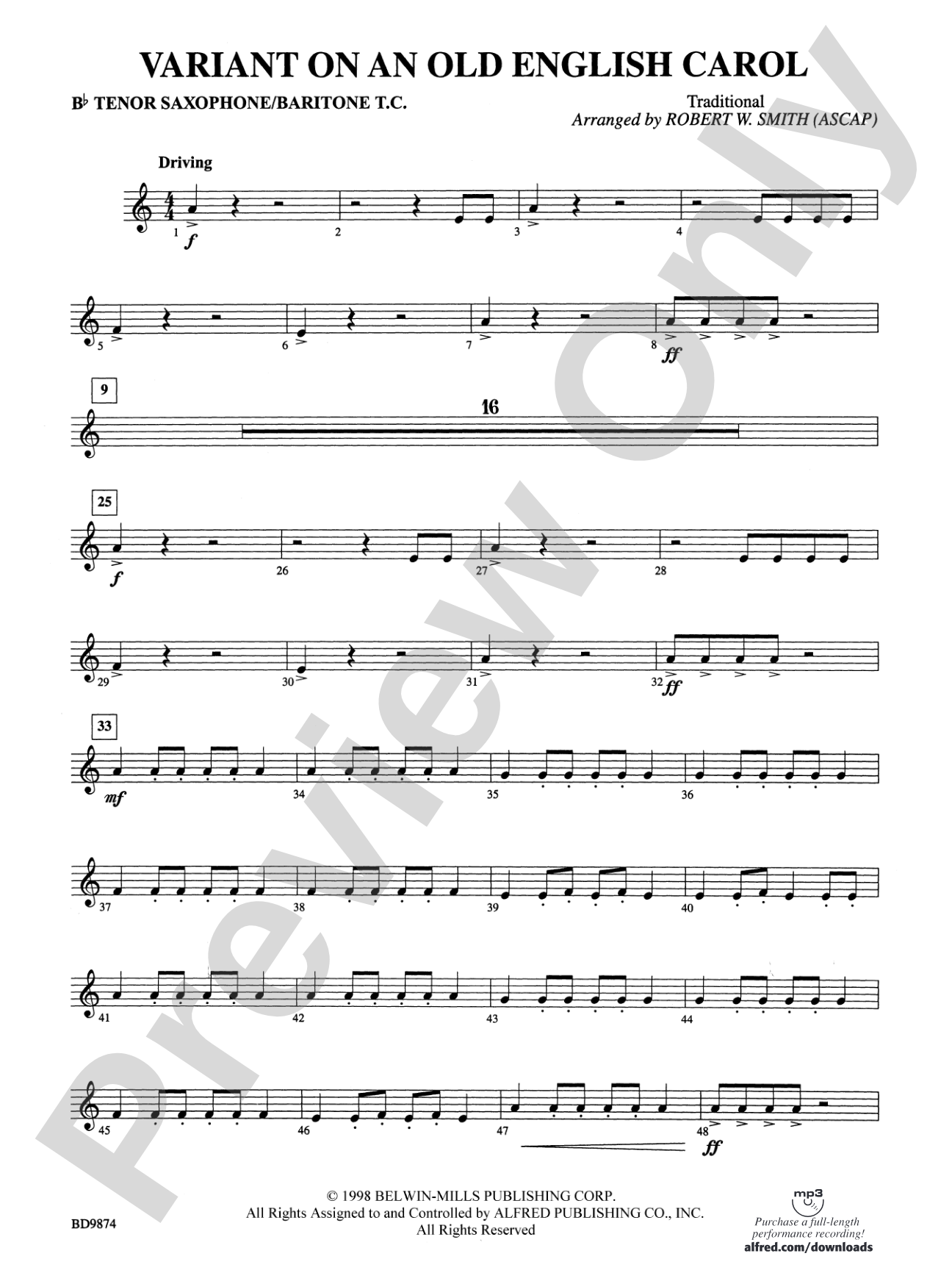

Variant on an Old English Carol: B-flat Tenor Saxophone
Arr. Robert W. Smith
Grade: 1 (Very Easy)
Item: 00-PC-0002093_TX1
$5.99
Pickup currently not available
Description
Based on the classically familiar GREENSLEEVES, here is a poignant setting with musical lines from forceful to flowing. Robert W. Smith stamps the work with his unique sound sculpturing to give a highly atmospheric scoring. Minimal rehearsal time will be needed to assure a dramatic performance. Intense and satisfying! (2:11)


Don't just read it, hear it, play along with it, and watch your students grow with it. In MakeMusic Cloud, Variant on an Old English Carol: B-flat Tenor Saxophone comes alive with professional accompaniment, adjustable tempo, and built-in practice tools that turn solo practice into real progress.
Open in the Player
Jump straight in and assign it today.
Start Your Free Trial
Open this title and explore the full library in minutes.
Sample Audio
1
Audio File
--:--
0:00
0:00
Sample Video
No sample videos found.
Additional Details
Series:
Belwin Beginning Band
Publisher:
Alfred Music
Page Count:
250
SKU:
00-PC-0002093_TX1
More about this title
About the Arranger: Robert W. Smith

Robert W. Smith stands among the most frequently performed composers of concert band and orchestral music in the United States. With more than 400 published works primarily distributed through Alfred Music, his output spans original compositions, orchestrations, and arrangements that have been heard on stages across North America, Europe, Australia, and Asia. Smith holds a Bachelor of Music Education from Troy State University in Alabama and a Master of Music from the University of Miami. His symphonic works, including The Divine Comedy and The Odyssey, have gained international recognition, while his settings for developing ensembles like The Tempest have become foundational repertoire in band curricula.
Beyond the concert hall, Smith's music has reached audiences through major television broadcasts, ceremonial events, and cultural institutions. His compositions have been performed at the Olympic Games, the Macy's Thanksgiving Day Parade, Ringling Brothers and Barnum & Bailey Circus productions, and Opening Day at Dodger Stadium. As both a conductor and clinician, he has worked with musicians throughout the United States, Canada, Japan, Australia, Italy, Austria, and the United Kingdom, bringing his distinctive orchestrational voice directly to developing musicians.
Why we love this
Smith's arrangement transforms Greensleeves into something far more than a holiday nostalgic piece. The atmospheric scoring and dynamic range (from forceful to flowing) give beginning bands genuine interpretive material to work with, not just a simple melody. You'll have a polished, professional-sounding performance ready for winter programming with minimal rehearsal investment.
What to expect
Greensleeves emerges from a lush, modern harmonic landscape rather than a bare-bones arrangement. The piece moves between introspective, lyrical passages and moments of directness, creating an emotional arc that respects the carol's meditative quality while stamping it with contemporary concert band sonority.
Who it's for
Beginning band directors seeking a Grade 1 arrangement with genuine artistic substance and winter programming potential. This is equally effective for concert bands establishing their repertoire or for ensembles building confidence in dynamic expression without technical complexity.
How to get the most out of it
- Shape the dynamic contrasts carefully; the flowing sections benefit from transparent voicing and steady intonation in the harmonic foundation.
- Balance the melodic lines across the ensemble so the familiar tune remains clearly heard even when embedded in the fuller orchestration.
- Use the relatively brief duration (2:11) as an opportunity to nail precise ensemble entrances and cutoffs without stretching rehearsal resources.
- Let the "poignant" character breathe; resist rushing the slower passages, as the drama emerges from space and control rather than momentum.
How to use it
Program this as a centerpiece for a winter concert, perhaps pairing it with a contrasting festive arrangement or original contemporary work. Its accessible Grade 1 difficulty and professional sound make it ideal for mid-concert placements where you want audiences reconnecting with a familiar melody through fresh musical language.
Skills your students will build
- Dynamic contrasts and shaping (moving between forceful and flowing textures)
- Ensemble balance across multiple harmonic layers
- Sustaining tone quality in lyrical passages
- Precision in ensemble cutoffs and phrase endings
- Reading a conductor score and understanding part relationships