
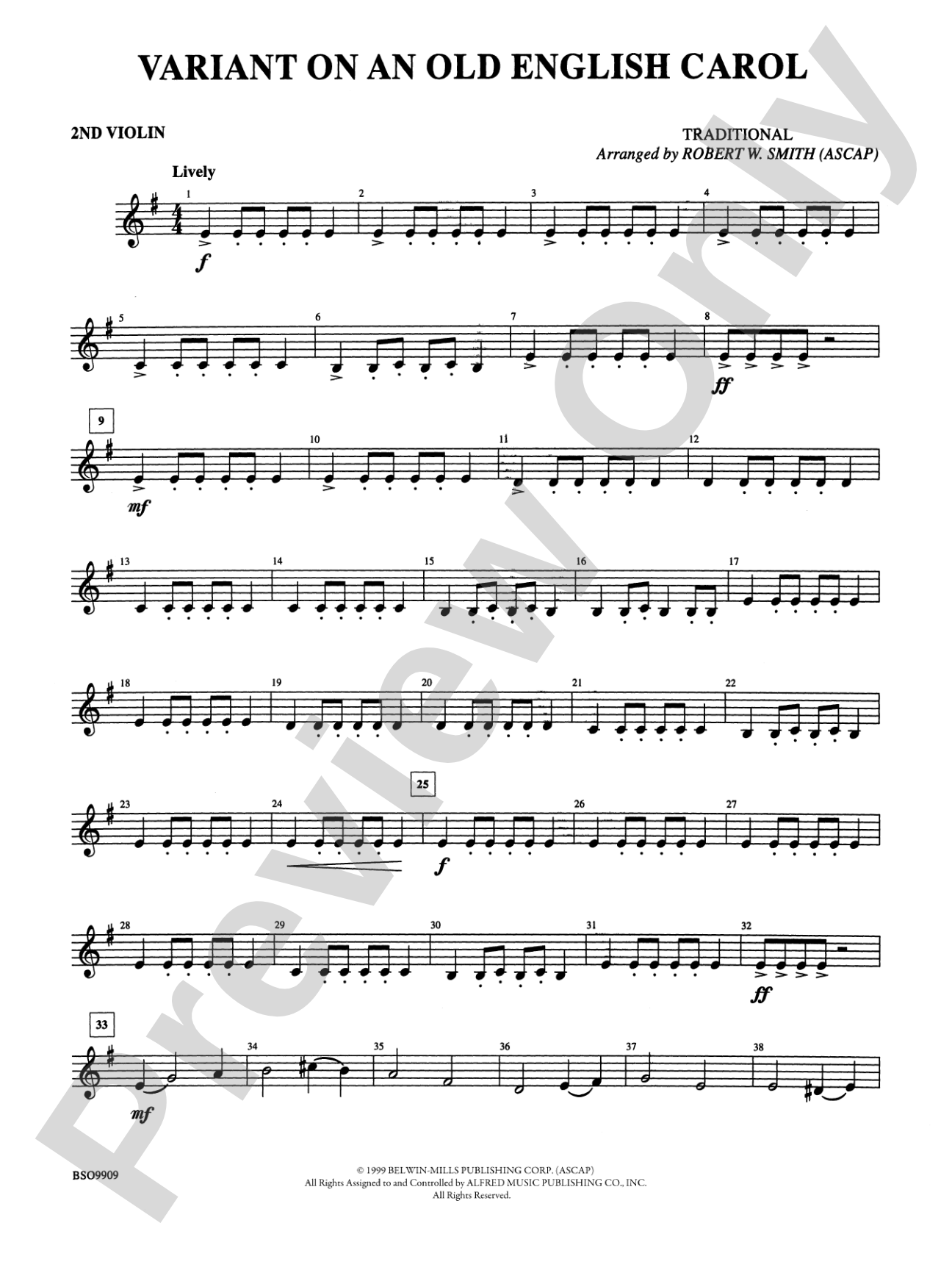

Variant on an Old English Carol: 2nd Violin
Arr. Robert W. Smith
Grade: 2.5
Item: 00-PC-0015605_VN2
$7.99
Pickup currently not available
Description
Based on the classically familiar "Greensleeves," here is a poignant setting with musical lines from forceful to flowing. Robert W. Smith stamps the work with his unique sound sculpturing to give a highly atmospheric scoring. Minimal rehearsal time will be needed to assure a dramatic performance. Intense and satisfying! (2:23)


Don't just read it, hear it, play along with it, and watch your students grow with it. In MakeMusic Cloud, Variant on an Old English Carol: 2nd Violin comes alive with professional accompaniment, adjustable tempo, and built-in practice tools that turn solo practice into real progress.
Open in the Player
Jump straight in and assign it today.
Start Your Free Trial
Open this title and explore the full library in minutes.
Sample Audio
1
Audio File
--:--
0:00
0:00
Sample Video
Additional Details
Series:
Belwin Intermediate String Orchestra
Publisher:
Alfred Music
Page Count:
144
SKU:
00-PC-0015605_VN2
More about this title
About the Arranger: Robert W. Smith

Robert W. Smith stands among America's most recorded composers of orchestral and band music, with over 400 works published primarily through Alfred Music. His education in music education from Troy State University and graduate studies at the University of Miami shaped his gift for writing music that engages both developing and advanced ensembles.
Smith's compositions have traveled globally, from concert halls across North America, Europe, Australia, and Asia to the opening ceremonies of the Olympic Games and the Macy's Thanksgiving Day Parade broadcast. He has worked as both conductor and clinician throughout the United States, Canada, Japan, Australia, and Europe, bringing his distinctive orchestration style to ensembles at every level.
Why we love this
Smith's arrangement captures something that usually takes months to polish at this level: a polished, atmospheric sound that sits comfortably in the young string orchestra's range without sounding overly simplified. The orchestration gives each section moments to carry the line, building ensemble confidence while staying true to the carol's emotional weight. At grade 2.5, this delivers dramatic payoff with genuine minimal rehearsal time.
What to expect
This arrangement wraps the familiar melody of "Greensleeves" in textured orchestration that moves between moments of quiet introspection and dramatic intensity. The sound world feels more refined than typical grade 2 writing, with careful attention to atmospheric coloring that makes each phrase feel considered and deliberate.
Who it's for
String orchestra directors at the intermediate level (grades 2.5 and up) who need a winter concert piece that sounds sophisticated without excessive rehearsal demands. This works equally well for school ensemble concerts and festival performances where time is limited but impact must be substantial.
How to get the most out of it
- Balance the flowing passages by having upper strings play with a warm, sustained tone while lower strings provide harmonic foundation; avoid letting the firmer sections overshadow the poignant character that makes this arrangement distinctive.
- Shape phrases across the full arc rather than stopping at bar lines; the 2:23 duration rewards directors who guide students through long musical sentences that breathe naturally.
- Attend closely to dynamic contrast between the forceful and flowing sections marked in the score; these shifts in intensity create the atmospheric quality that distinguishes this setting from more straightforward carol arrangements.
How to use it
Use this as a mid-to-closing piece on your winter concert where you want to establish a contemplative moment without demanding a full program segment. The attainable rehearsal load makes it ideal for programming alongside more technical pieces in the same concert, or as a festival submission where schools need contest-ready material that doesn't monopolize preparation time.
Skills your students will build
- Sustaining long melodic lines with consistent tone quality across string sections
- Balancing ensemble sound when multiple sections share harmonic material
- Responding to conductor-shaped phrasing across extended musical phrases
- Executing dynamic shifts that enhance harmonic change and emotional arc